




MSCI is consulting on a rule that could remove Strategy, Metaplanet and Yellow Cake Plc from its Global Investable Market Indexes in November, and only two of those three companies hold Bitcoin.
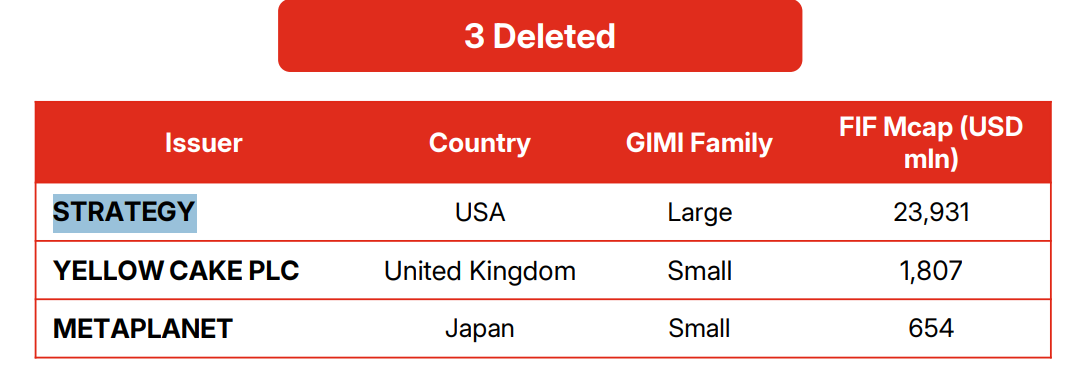
The proposal, published this month, would exclude companies MSCI classifies as “non-operating”: businesses that grow by accumulating assets rather than running an operating business. Comments on the plan close September 30. MSCI expects to publish its final methodology on October 16, with any index deletions taking effect November 11.
The eligibility test runs in two steps. A company whose operating assets exceed half of its total assets passes automatically. Companies that fail move to a second screen built from five financial ratios: operating asset intensity, expense levels, cash flow, fair value exposure and reliance on outside capital. A company fails the second screen if it trips four of the five tests.
Existing index members get more room than new candidates. A company already sitting in an index is only removed after failing the screens for two consecutive years, measured against a looser threshold on each ratio. A company that isn’t yet a constituent can be excluded off a single year’s filing. MSCI is also adding a public watchlist for companies that fail once but haven’t yet hit the deletion bar.
Three names, one uranium company
| Company | Listing Market | Approx. Market Value | Core Asset / Business | Bitcoin Holder? | MSCI Treatment |
|---|---|---|---|---|---|
| Strategy | Nasdaq | $23.9B | Software + Bitcoin treasury | Yes | Proposed deletion |
| Metaplanet | Tokyo | $654M | Bitcoin treasury | Yes | Proposed deletion |
| Yellow Cake Plc | London | $1.8B | Physical uranium | No | Proposed deletion |
MSCI Watchlist
| Company | MSCI Treatment |
|---|---|
| Center Laboratories | Watchlist |
| Lydia Holding | Watchlist |
| Sharplink | Watchlist |
Yellow Cake’s presence points to what the rule is actually built around. The screen runs off a company’s balance sheet, not the type of asset sitting on it. A uranium stockpile fails the same operating-asset test a Bitcoin balance sheet does. That cuts against the argument, made by Strategy, that MSCI is writing a rule aimed specifically at digital-asset companies.
The rule treats a crypto treasury and a commodity-holding company the same way. That reading would break if MSCI’s October methodology ends up applying the screens differently by asset class, or if Yellow Cake comes off the list while the two Bitcoin companies stay on it.
Not MSCI’s first attempt
This is not MSCI’s first pass at the question. In October 2025, MSCI proposed a narrower rule targeting only companies holding digital assets worth 50% or more of total assets, a step that would have affected roughly 39 companies with a combined market value near $113 billion.
- October 2025: MSCI proposes excluding companies with digital-asset holdings worth 50% or more of total assets.
- December 2025: Strategy executives publicly challenge MSCI’s proposed digital-asset exclusion.
- January 6, 2026: MSCI decides not to implement the digital-asset-treasury exclusion and says it will study non-operating companies more broadly.
- September 30, 2026: MSCI’s current consultation closes for public comments.
- October 16, 2026: MSCI is expected to publish the final methodology.
- November 11, 2026: Proposed effective date for any resulting index deletions.
MSCI walked that proposal back in January 2026, saying it needed more research to separate genuine investment funds from operating companies that hold digital assets as part of running their business. The consultation now underway is that research, broadened from crypto holdings to non-operating assets generally.
| Criteria | 2025 Proposal | 2026 Proposal |
|---|---|---|
| Primary target | Digital-asset treasury companies | Non-operating companies generally |
| Core trigger | Digital assets ≥50% of total assets | Operating/non-operating asset screens |
| Scope | Crypto-specific | Asset/business-model neutral |
| MSCI outcome | Not implemented | Consultation underway |
| Key question | Is a crypto treasury company an investment vehicle? | What qualifies as a non-operating company? |
One company pushing back, one saying nothing
Strategy has fought the idea in public since the first version of the proposal. Executive Chairman Michael Saylor and CEO Phong Le wrote to MSCI in December 2025 calling the exclusion misguided.
Response to MSCI Index Matter
Strategy is not a fund, not a trust, and not a holding company. We’re a publicly traded operating company with a $500 million software business and a unique treasury strategy that uses Bitcoin as productive capital.
This year alone, we’ve completed…
— Michael Saylor (@saylor) November 21, 2025
Saylor has since argued the company doesn’t fit the category MSCI is trying to screen out:
“We’re a publicly traded operating company with a $500 million software business and a unique treasury strategy that uses Bitcoin as productive capital.” He has also said, “Holding companies sit on investments. We create, structure, issue, and operate.” Metaplanet, facing the same proposed deletion, has not made a comparable public statement on the current consultation.
Strategy and Metaplanet Lead Corporate Bitcoin Holdings
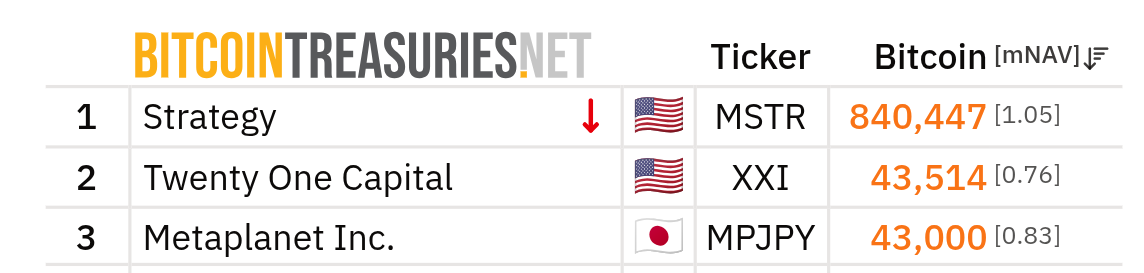
Strategy ranks as the largest corporate Bitcoin holder with 840,447 BTC, while Metaplanet holds 43,000 BTC, placing both among the largest corporate holders. The scale of their Bitcoin treasury strategies makes them key examples in MSCI’s proposed index-eligibility changes.
If adopted, the proposed rules could put both companies at risk of removal from certain MSCI indexes. Such an exclusion could potentially affect passive investment flows and investor demand for their shares. The development adds significance to MSCI’s ongoing consultation and its upcoming decision on the proposed methodology change.
JPMorgan estimated in a research note that Strategy alone could face $1.8 billion to $2 billion in MSCI-linked selling if it’s removed, a figure that could grow to $8.8 billion if FTSE Russell and S&P Dow Jones Indices make similar changes. The note prompted public boycott calls against the bank from crypto investors on social media.
The consultation stays open through September 30. MSCI is set to publish its final methodology on October 16, and if the rule proceeds as proposed, any resulting index deletions would take effect November 11.
Disclaimer: Cryip's content is strictly for educational and informational purposes and does not constitute financial, legal, or investment advice. Cryptocurrency involves significant risk, and readers assume full responsibility for their own financial decisions. Asset references are never endorsements.
To make complex crypto topics accessible to readers at all experience levels, our team uses AI tools strictly to refine language, correct grammar, and simplify terminology. AI is never used to draft facts, source information, or form conclusions. Every article is fact-checked and approved by a human editor before publication. Read our full AI Use & Content Policy.