




- Bitcoin fell below $67,000 as selling pressure intensified across the cryptocurrency market.
- U.S. spot Bitcoin ETFs recorded roughly $3 billion to $3.5 billion in net outflows over 10–11 consecutive trading sessions, the longest withdrawal streak since launch.
- Mt. Gox transferred 10,422 BTC worth approximately $739 million, raising concerns about potential future supply entering the market.
- More than $400 million in leveraged long positions were liquidated during the recent sell-off, accelerating Bitcoin’s decline.
- Geopolitical tensions, institutional repositioning, and capital rotation into AI-related stocks have further weighed on Bitcoin sentiment.
Bitcoin Slides Under $67,000 Amid Growing Market Pressure
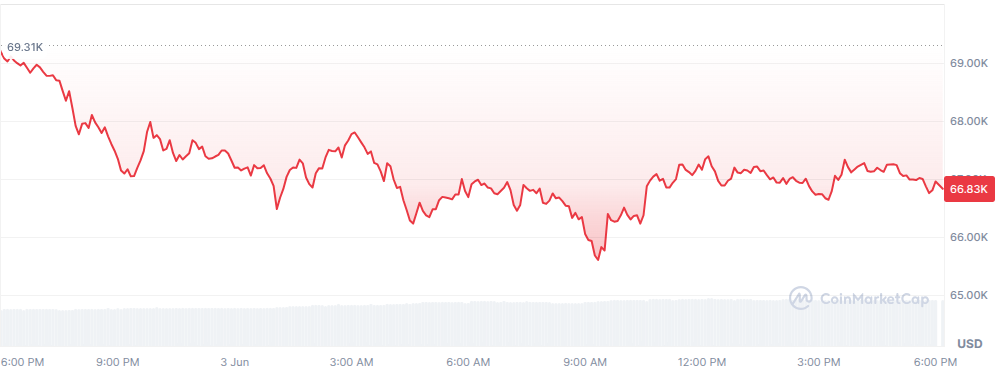
Bitcoin fell below $67,000 at 12:43 pm UTC on June 3, extending a multi-week decline that has driven the world’s largest cryptocurrency significantly lower from its recent highs. The latest drop comes amid record spot Bitcoin ETF outflows, major on-chain transfers from Mt. Gox, increased geopolitical tensions, leveraged liquidations, and signs that institutional investors may be temporarily rotating capital into other sectors.
While no single event appears responsible for the decline, several developments have converged to create a more risk-averse environment across digital asset markets.
Record Bitcoin ETF Outflows Add Selling Pressure
One of the most closely watched developments has been the prolonged streak of withdrawals from U.S. spot Bitcoin exchange-traded funds. U.S. spot Bitcoin ETFs have recorded approximately 10 to 11 consecutive trading sessions of net outflows totaling between $3 billion and $3.5 billion. The withdrawal streak marks the longest since the products launched in 2024 and has coincided with Bitcoin’s retreat below key support levels.
Although ETF assets remain near $100 billion overall, sustained outflows can affect market sentiment by signaling reduced short-term demand from institutional investors.
Analysts note that the magnitude of withdrawals remains relatively small compared with total assets under management, suggesting the move may reflect tactical portfolio repositioning rather than a broad abandonment of Bitcoin exposure.
Mt. Gox Transfer Revives Supply Concerns
Market participants are also closely monitoring activity linked to the defunct Mt. Gox exchange. On June 2, Mt. Gox transferred 10,422 BTC worth approximately $739 million to new wallets. Of that amount, 10,306.35 BTC was moved to a previously unseen address, while 116.30 BTC was sent to a known hot wallet.
The transfer occurred ahead of the exchange’s October 31, 2026, creditor repayment deadline. Although no immediate sales were confirmed, large wallet movements tied to Mt. Gox have historically generated concerns about potential future selling pressure as creditors gain access to long-held Bitcoin holdings. Mt. Gox still controls approximately 34,504 BTC valued at more than $2.4 billion at current market prices.
Strategy Activity Draws Investor Attention
Bitcoin treasury company Strategy, formerly MicroStrategy, also became a focal point for traders. Between May 26 and May 31, the company sold 32 BTC worth roughly $2.5 million, marking its first reported Bitcoin sale since 2022. While the amount represented only a tiny fraction of Strategy’s 843,706 BTC holdings, the transaction attracted attention because the company has long promoted a strong long-term accumulation strategy.
Separately, on May 29, blockchain data showed Strategy transferring approximately 411 BTC to Coinbase Prime before later withdrawing nearly the same amount back into custody. The movement appeared consistent with treasury management activity but nevertheless generated speculation among market observers. The company also paused its regular Bitcoin purchases between May 18 and May 24 while repurchasing discounted convertible notes due in 2029.
Liquidation Cascade Accelerated the Decline
Market data suggests leveraged trading amplified the sell-off. After Bitcoin fell below major support levels near $75,000 in late May, exchanges automatically liquidated hundreds of millions of dollars worth of leveraged long positions. More than $400 million worth of leveraged long positions were reportedly liquidated within minutes during one phase of the decline.
Forced liquidations create additional market sell orders, often accelerating downward momentum and pushing prices lower than would otherwise occur under normal trading conditions. The liquidation wave appears to have contributed significantly to Bitcoin’s rapid move lower over the past two weeks.
Geopolitical Tensions Increase Risk Aversion
Growing geopolitical uncertainty has further weighed on market sentiment. Cryptocurrency markets experienced increased volatility after comments from U.S. President Donald Trump regarding Iran and escalating concerns surrounding Middle East tensions. Rising oil prices and broader risk-off sentiment across financial markets have pressured speculative assets, including cryptocurrencies.
Historically, periods of heightened geopolitical uncertainty often lead investors to reduce exposure to higher-risk assets until market conditions stabilize.
Capital Rotation Into AI and Technology Stocks
Beyond crypto-specific developments, broader market trends may also be influencing investor behavior. Several major artificial intelligence and semiconductor companies have significantly outperformed Bitcoin in recent months. Companies such as Taiwan Semiconductor Manufacturing Company and Broadcom have expanded their market capitalizations, while technology-focused investment products have posted strong gains.
On May 28, Bitcoin fell to the 13th-largest global asset by market capitalization after declining toward the mid-$70,000 range in late May. Some analysts believe investors have been rotating capital toward high-performing technology sectors while reducing exposure to more volatile digital assets.
Trump Media Bitcoin Transfers Add to Market Scrutiny
Another development attracting attention involved Trump Media & Technology Group, which transferred 2,650 BTC worth approximately $205 million to Crypto.com on May 22.
The transaction followed an earlier transfer of 2,000 BTC in December 2025 and renewed scrutiny of corporate Bitcoin treasury strategies. While no direct evidence links the transfer to market selling activity, large corporate Bitcoin movements are frequently monitored by traders for potential signals regarding future supply.
What Investors Are Watching Next
- Whether spot Bitcoin ETF outflows begin to slow or reverse.
- Potential creditor-related activity connected to Mt. Gox repayments.
- Whether Bitcoin can establish support above current levels.
- The pace of leveraged liquidations across crypto derivatives markets.
- Broader macroeconomic and geopolitical developments.
Many analysts argue that the current downturn appears more consistent with a temporary de-risking phase than a structural collapse in institutional demand. However, sustained ETF outflows and continued weakness in risk assets could increase pressure on Bitcoin in the near term.
Conclusion
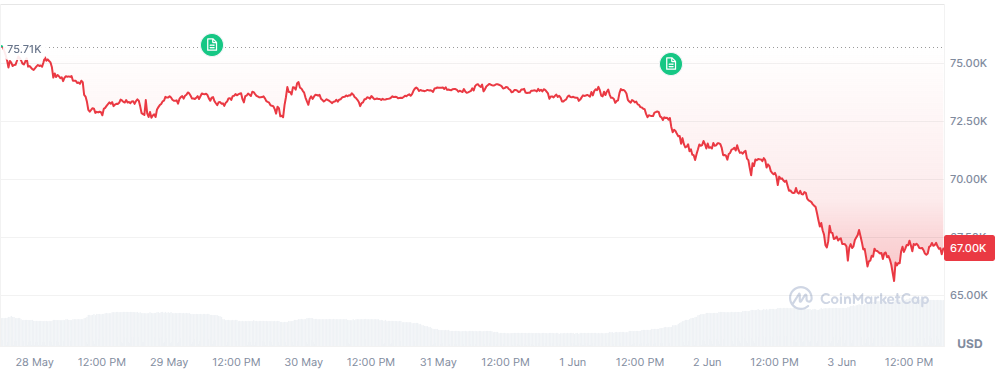
Bitcoin’s drop below $67,000 appears to be the result of several converging factors rather than a single catalyst. Over the past week, BTC has fallen more than 11%, declining from nearly $75,800 on May 28 to around $67,200 on June 3 as market sentiment weakened. Record ETF outflows, major Mt. Gox wallet transfers, Strategy’s first reported Bitcoin sale in years, and a wave of liquidation-driven selling have all contributed to the downturn. Meanwhile, rising geopolitical tensions and investor rotation into AI-focused technology stocks have added further pressure on risk assets.
Despite the correction, the broader institutional Bitcoin investment thesis remains largely unchanged. Spot Bitcoin ETFs continue to hold substantial assets, and long-term adoption trends remain intact. Investors will now closely monitor ETF flows, Mt. Gox-related activity, on-chain data, and macroeconomic developments to determine whether the recent decline is a temporary pullback or the beginning of a more prolonged market correction.
Disclaimer: Cryip's content is strictly for educational and informational purposes and does not constitute financial, legal, or investment advice. Cryptocurrency involves significant risk, and readers assume full responsibility for their own financial decisions. Asset references are never endorsements.
To make complex crypto topics accessible to readers at all experience levels, our team uses AI tools strictly to refine language, correct grammar, and simplify terminology. AI is never used to draft facts, source information, or form conclusions. Every article is fact-checked and approved by a human editor before publication. Read our full AI Use & Content Policy.