



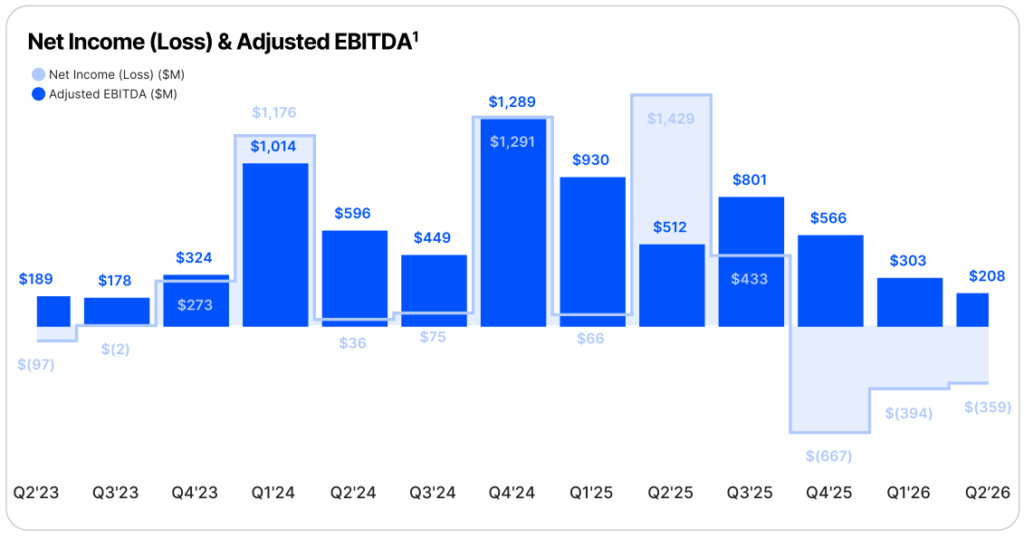
Coinbase reported a net loss of $359.5 million for the second quarter of 2026, its third consecutive quarterly loss under GAAP accounting. But roughly 58% of that loss, $209.5 million, came from an unrealized markdown on crypto assets the company holds for investment, not from a collapse in its core business. Adjusted EBITDA, which strips out that kind of non-cash swing, stayed positive at $208 million, Coinbase’s 14th straight profitable quarter on that measure, though the figure itself fell 31% from Q1 and 59% from a year earlier.
The quarter is a useful test case for a question that’s followed Coinbase for years: is this company still a leveraged bet on crypto trading volumes, or has it actually built something more durable underneath?
Where the $359 million loss actually came from
Coinbase’s own reconciliation tables break the loss down into three layers, and each tells a different story:
| Measure | Q2 2026 | Q1 2026 | Q2 2025 |
|---|---|---|---|
| GAAP net income (loss) | $(359.5)M | $(394.1)M | $1,428.9M |
| Adjusted EBITDA | $208M | $303M | $512M |
| Adjusted Net Income (Loss) | $(104.9)M | $(45.6)M | $33.2M |
The $209.5 million unrealized loss on crypto assets held for investment, largely a mark-to-market effect of falling crypto prices during the quarter, is the single largest driver of the gap between the GAAP loss and the smaller Adjusted Net Income loss of $104.9 million. That’s a meaningfully different picture than “Coinbase lost $359 million this quarter” suggests on its own. It is not, however, the whole story: even stripping out the investment markdown, Coinbase still posted an adjusted loss, and Adjusted EBITDA, the cleanest read of operating performance, kept sliding for a second straight quarter.
The trading business hasn’t turned the corner
Transaction revenue, Coinbase’s traditional core business, fell 21% quarter-over-quarter to $599 million, driven by a 25% drop in industry-wide crypto spot trading volume and an 11% decline in total crypto market capitalization during the quarter. Consumer transaction revenue alone fell 20% to $452 million.
This is the third straight quarter Coinbase has posted a GAAP net loss, following losses of $666.7 million in Q4 2025 and $394.1 million in Q1 2026, even as the company gained market share throughout that stretch. Coinbase’s crypto trading volume market share hit an all-time high of 10.3% in Q2, up from 9.1% in Q1, meaning the company is capturing a larger slice of a shrinking pie rather than losing ground in a healthy market.
The businesses meant to replace trading are growing, but with cracks
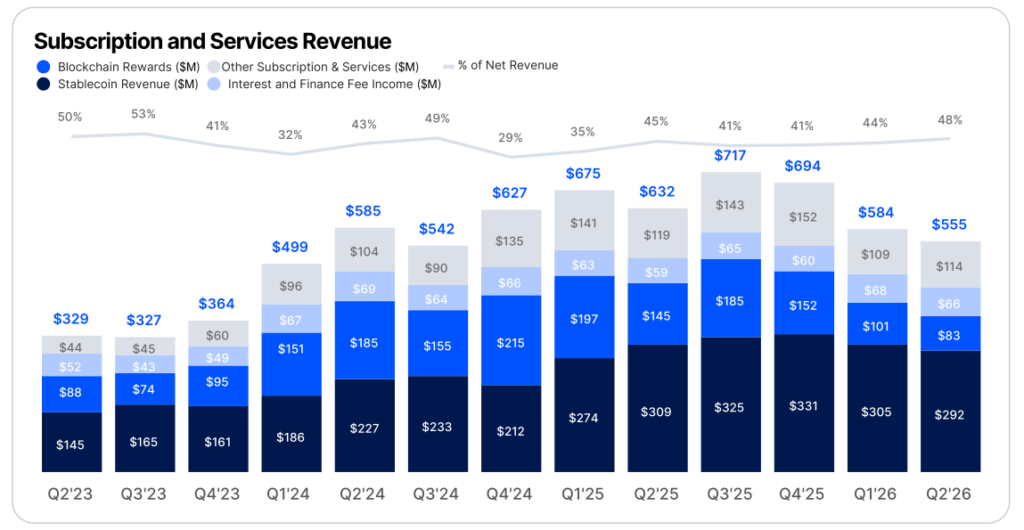
Coinbase has spent the past two years building revenue lines that don’t depend on trading fees, and by its own numbers, that shift is real: subscription and services revenue reached $555 million, 48% of net revenue, a record share, and prediction markets revenue more than doubled quarter-over-quarter, growing 106% and crossing a $100 million annualized run rate.
But the diversification story has a soft spot Coinbase’s own materials didn’t emphasize: stablecoin revenue, one of the pillars of that subscription and services line, came in at $292 million, below the roughly $327 million Wall Street analysts surveyed by StreetAccount had expected, and down about $17 million from the same quarter last year. That’s despite Coinbase reporting a record $20 billion in average USDC held in its products during the quarter. The gap suggests that growing balances alone haven’t been enough to grow stablecoin-linked revenue at the pace investors were modeling, as falling interest rates and lower off-platform USDC balances offset the balance growth, according to Coinbase’s own disclosures.
The shift away from trading dependency is underway, but Coinbase’s newer revenue streams are not yet large or stable enough to offset the volatility of its core trading business.That diversification push extends beyond crypto trading itself , Coinbase has also been rolling out tokenized U.S. stocks and AI-powered investment tools as part of a broader bet on non-trading revenue.
What Coinbase says comes next
On the earnings call, Coinbase Chief Financial Officer Alesia Haas said the Bitcoin ETF-driven outflows from Coinbase’s custody platform, a factor that pulled Assets on Platform down to $246 billion in Q2, had already stabilized in the current quarter. That’s a company disclosure, not an independently confirmed trend, and should be read as context on management’s outlook rather than proof the underlying pressure has lifted.
The biggest financial shift of our lifetime is starting, and Coinbase was built for this moment.
Every asset on earth (stocks, bonds, commodities, real estate, etc) is going to move onchain. The hundred-trillion-dollar financial system is being updated, faster than the… pic.twitter.com/K2Y97ya09S
— Brian Armstrong (@brian_armstrong) July 30, 2026
Coinbase’s own guidance for the third quarter projects subscription and services revenue of $500 to $580 million and cites roughly $130 million in transaction revenue quarter-to-date through July 26, a figure the company explicitly cautioned investors against extrapolating into a full-quarter trend. On the user-growth side, Coinbase has also reportedly opened account registration to users in mainland China, though it remains unclear whether that extends to actual trading access. CEO Brian Armstrong, in a post on X following the release, framed the quarter as evidence the company can “execute on the things in our control” despite tough market conditions.
Whether Q2 marks the bottom of a cyclical trading slump or a checkpoint in an unfinished transition away from trading dependency is a question Coinbase’s own numbers don’t yet answer. The mark-to-market loss makes the quarter look worse than the operating trend does; the stablecoin miss makes the diversification story look less finished than the headline growth numbers suggest. Both are true at once, and Q3, not this print, is likely where the answer starts to show up.
AI Disclosure: Cryip uses AI-assisted tools to help refine language — correcting spelling and grammar and simplifying complex terms for readability.
We do this to make crypto topics easier to understand for readers at all experience levels. AI does not draft facts, sources, or conclusions. Every article is reviewed and approved by a human editor before publication. Read our full AI Use & Content Policy.