


- The Zcash ETF, ticker ZCSH, began trading on NYSE Arca on August 25, 2026, converting from Grayscale’s over-the-counter Zcash Trust.
- The fund charges a 2.5% annual fee, ten times the 0.25% BlackRock charges on its spot Bitcoin ETF.
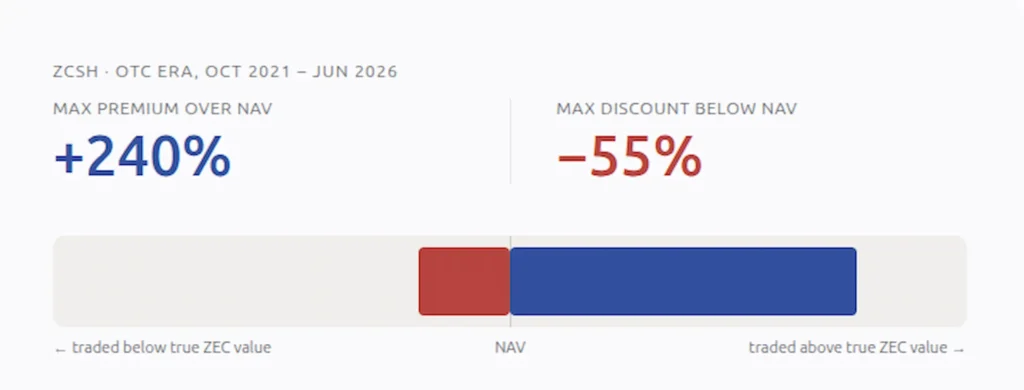
- Under the old OTC structure, ZCSH traded below the value of the ZEC it actually held on 700 separate trading days between 2021 and 2026.
Grayscale’s Zcash fund, which first filed to convert into an ETF last year, started trading on NYSE Arca on Tuesday under the ticker ZCSH, giving brokerage and retirement account investors regulated exposure to ZEC for the first time. The fund holds roughly 391,000 to 393,000 ZEC, worth more than $330 million at current prices, according to its SEC registration statement.
A pricing problem the wrapper is built to solve
The bigger story is what ZCSH is leaving behind. As an OTC trust, its shares often traded nowhere near the value of the ZEC backing them. Grayscale’s own fund filings show the fund traded at a premium of up to 240% over net asset value at one point, then swung to a discount of as much as 55% at another. It closed below net asset value on 700 separate trading days across its OTC life.
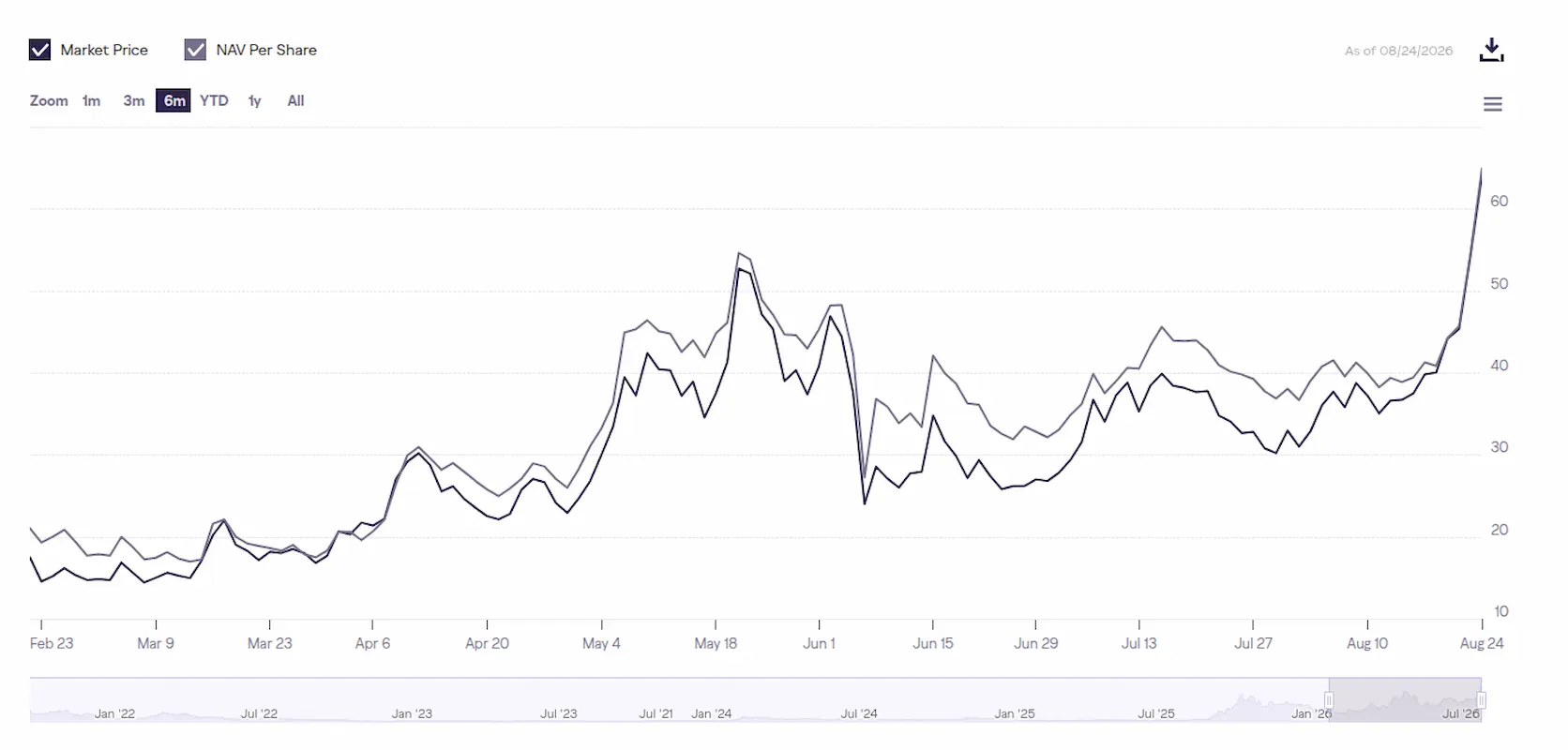
An ETF wrapper is designed to prevent exactly that. Authorized participants, in this case Jane Street Capital and Virtu Americas, can create or redeem shares directly against the fund’s ZEC holdings, which should keep the market price tethered to net asset value through arbitrage. Grayscale’s own Bitcoin trust showed the same pattern: its discount to net asset value collapsed once it converted to an ETF in January 2024. ZCSH is now testing whether that fix works for a much thinner, less liquid market. Grayscale’s own six-month chart already shows market price and NAV per share moving further apart, then snapping back together right as the ETF conversion approached.
A network that was flagged risky months ago
The listing lands three months after Zcash’s own credibility took a hit. A previously undisclosed flaw in the network’s Orchard shielded pool, four years old by the time it surfaced this spring, could have let an attacker mint counterfeit ZEC without leaving a traceable record, a consequence of the same privacy design that makes Zcash valuable to begin with. Developers pushed an emergency patch in June and followed it in July with the Ironwood upgrade, which retired the vulnerable pool and added accounting rules meant to trap any counterfeit coins that might already exist.
ZEC lost roughly half its value in the aftermath. It has since recovered past its pre-incident level, climbing near $857, an eight-year high, in the week before the ETF listing. Grayscale has said it will keep watching how the Ironwood upgrade gets adopted across the network.
The Zcash ETF – Built by Grayscale (Ticker: $ZCSH) begins trading today @ZcashETF.
The world’s first Zcash ETF offering exposure to $ZEC, now accessible from brokerage or investment accounts.
Why $ZEC?
⟶ Zcash shares key features with Bitcoin: a 21 million… pic.twitter.com/nuaR2HBTWx
— Grayscale (@Grayscale) August 25, 2026
The cost of getting in
Investors are paying a premium for that access. ZCSH’s 2.5% fee compares with 0.25% on BlackRock’s iShares Bitcoin Trust. Held unchanged for a decade, that fee alone would erode roughly 22% of an investor’s real ZEC exposure. Separately, Digital Currency Group’s international arm is in non-binding talks to contribute about 200,000 ZEC to the fund in exchange for shares, a deal that would nearly double its holdings if it closes.
Whether ZCSH actually trades near net asset value in its first weeks on NYSE Arca is the real test of whether this conversion solved the problem it was built to solve.
Disclaimer: Cryip's content is strictly for educational and informational purposes and does not constitute financial, legal, or investment advice. Cryptocurrency involves significant risk, and readers assume full responsibility for their own financial decisions. Asset references are never endorsements.
To make complex crypto topics accessible to readers at all experience levels, our team uses AI tools strictly to refine language, correct grammar, and simplify terminology. AI is never used to draft facts, source information, or form conclusions. Every article is fact-checked and approved by a human editor before publication. Read our full AI Use & Content Policy.