

MANTRA Chain halted all network activity after the team said an attacker had found and exploited a flaw in outside code the chain depends on but doesn’t control.
- MANTRA halted its network on August 20 and 21, 2026, after detecting an attacker exploiting a vulnerability in an upstream dependency.
- The company says it has identified the flaw, is preparing a patch, and is tracing where affected funds moved, though the full impact remains unconfirmed.
- MANTRA’s token fell 18.5% to an all-time low within minutes of the chain’s last block, and several exchanges paused deposits and withdrawals.
How the Halt Unfolded
MANTRA said on its status page that it first flagged the incident late Thursday, halting the network shortly after. The affected systems included public endpoints, validators, the chain’s bridge, and its inter-chain relays.
The company confirmed the halt publicly early Friday morning.
We’re aware of an incident affecting MANTRA Chain and have halted the chain as a precaution while we investigate. All endpoints and transactions are currently frozen.
This means deposits and withdrawals to/from MANTRA Chain are temporarily affected. If you’re unsure how this…
— MANTRA | The EVM L1 for RWAs (@MANTRA_Chain) August 21, 2026
At that point, it added, there was no root cause or timeline yet to share. The halt came two days after MANTRA deployed a major upgrade to its chain’s EVM compatibility layer on August 18. The company has not said whether the two events are connected.
Patch in Progress, Fund Trail Still Open
In a later update to its status page, MANTRA gave its first account of what happened.
“Earlier today we detected an attacker exploiting a vulnerability in an upstream dependency used by the chain, and halted the network as a precaution,” the company said.
In practical terms, that means the flaw sat in outside code the chain uses rather than in software MANTRA wrote itself, the same category of risk that hit hardware wallet maker Trezor last week, when a breach at a third-party shipping vendor exposed customer data despite Trezor’s own systems staying untouched.
“We have identified the vulnerability and are proceeding to prepare a patched release,” the update continued.
The update added that MANTRA is “tracing the movement of funds,” though it cautioned that “our assessment of the full impact is ongoing and we are not yet in a position to confirm the complete scope.”
Deposits and withdrawals to and from the chain remain frozen. MANTRA has told users to hold off on transactions until it shares more, and has warned that it will only post verified updates through its own official channels.
MANTRA Slips to a Record Low as Exchanges Pause Withdrawals
MANTRA’s token, formerly OM, fell sharply as the chain went dark. According to coinmarketcap data cited across multiple markets, the token dropped from about $0.00506 to an all-time low of $0.004126, an 18.5% decline, in the minutes before the chain stopped producing new blocks.
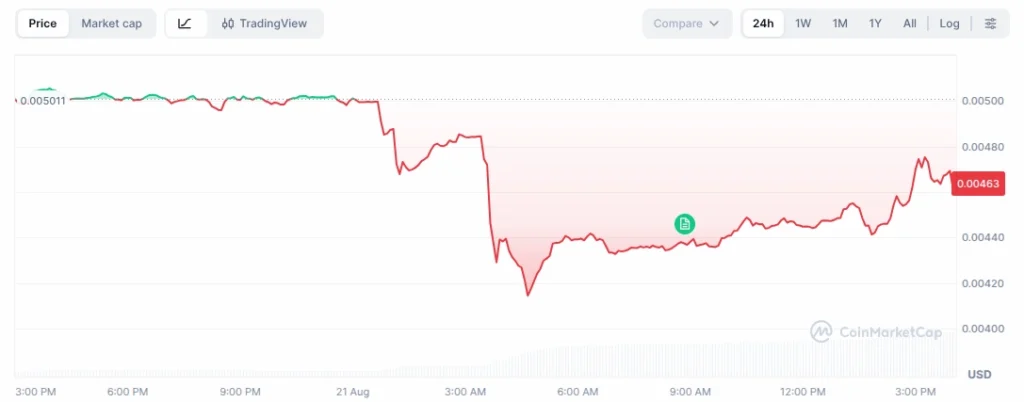
The chain’s own record lines up with that timing: the last block, number 17,449,398, was produced around 11:13 p.m. UTC on August 20, just minutes after the token touched its low. It recovered part of the loss shortly after, trading near $0.0044, while 24-hour trading volume jumped roughly sixfold to about $24 million. By Friday afternoon, MANTRA was back near $0.005, close to where it stood before the halt began, even though the chain itself remains offline.
South Korea’s Upbit exchange paused MANTRA deposits and withdrawals, citing the network’s halted block production as the reason under the country’s Virtual Asset User Protection Act. Trading itself continued uninterrupted on Upbit and other exchanges; only moving tokens on and off those platforms was affected.
A Chain Already Mid-Overhaul
This is not MANTRA’s first crisis. In April 2025, OM’s price collapsed by roughly 90% within hours, erasing most of its market value. Co-founder John Patrick Mullin attributed the crash to forced liquidations by exchanges rather than deliberate selling, and later pledged to burn a large share of the team’s own token holdings.
Since then, MANTRA has rebranded its ticker from OM to MANTRA and carried out a 1:4 token split. In June 2026, the company agreed to be acquired by Inveniam Capital Partners, a deal expected to close in the third quarter of 2026, building on a $20 million investment Inveniam made in the company the previous year. Then, on August 18, MANTRA rolled out its EVM-compatibility upgrade, just two days before this week’s halt.
Taken together, the pattern is a chain that has spent the past year and a half reshaping its brand, its token structure, and now its ownership, while its underlying infrastructure has twice come under acute strain: first from a market collapse, now from a security exploit.
Patch Release and Fund Trace Will Decide the Next Chapter
What happens next rests on two things MANTRA has promised but not yet delivered: a patched release, and a clear account of where the traced funds ended up. Other protocols hit by exploits this month have taken different routes once that tracing is done. Maya Protocol, after a $1.7 million exploit in August, chose to backfill its affected liquidity pool with outside funds rather than pursue on-chain recovery of the stolen tokens. Whether MANTRA follows a similar path, or manages to claw back what moved, isn’t yet known. Until then, users can’t move funds on or off the chain, and a company already mid-acquisition has one more question left to answer for the firm buying it.
Disclaimer: Cryip's content is strictly for educational and informational purposes and does not constitute financial, legal, or investment advice. Cryptocurrency involves significant risk, and readers assume full responsibility for their own financial decisions. Asset references are never endorsements.
To make complex crypto topics accessible to readers at all experience levels, our team uses AI tools strictly to refine language, correct grammar, and simplify terminology. AI is never used to draft facts, source information, or form conclusions. Every article is fact-checked and approved by a human editor before publication. Read our full AI Use & Content Policy.