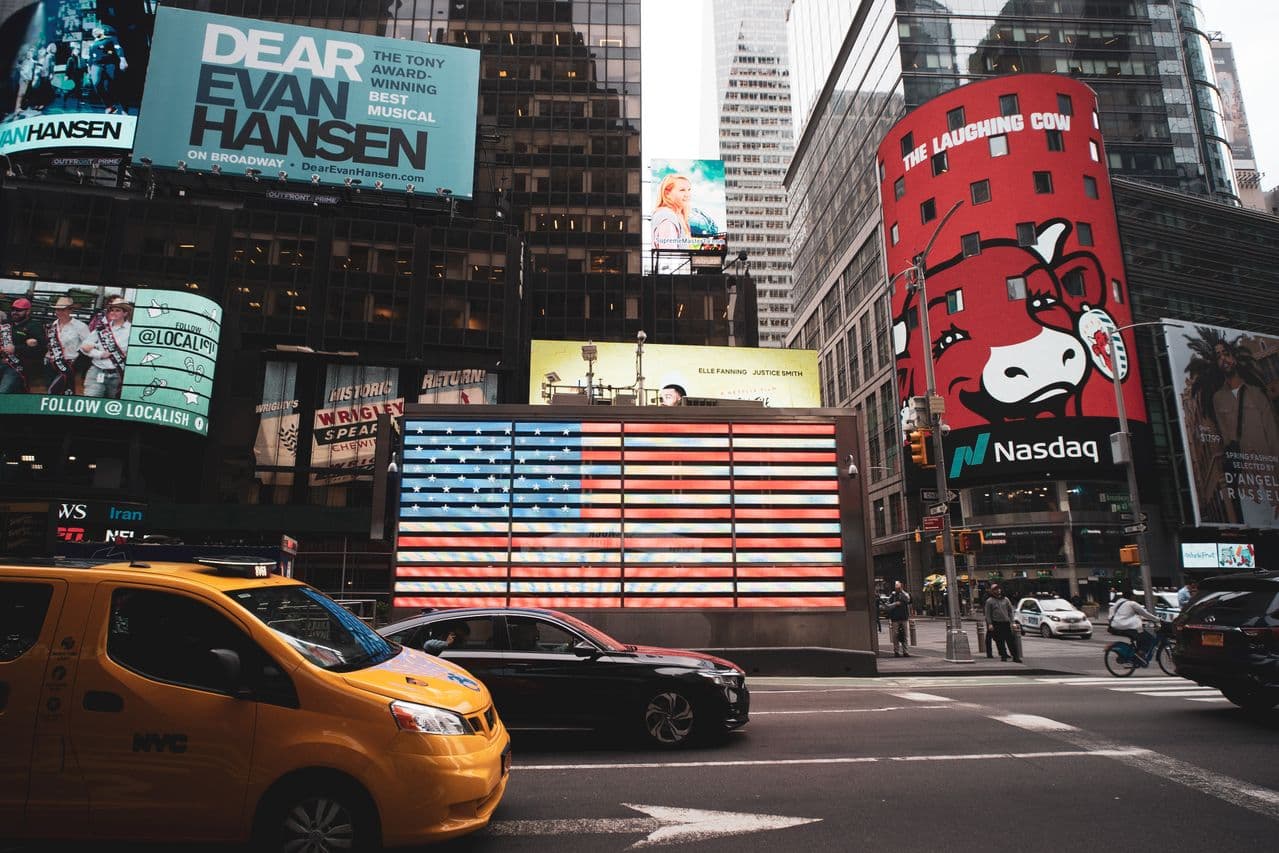


- Nasdaq Ventures is investing $100 million in Payward, Kraken’s parent company, at a $21 billion valuation.
- The deal expands Nasdaq’s tokenized-equity framework and puts Payward’s crypto, equities and derivatives venues under Nasdaq’s own market surveillance technology.
- It follows a $13.3 billion valuation dip in April, a second IPO delay, and rival exchange operators ICE and the London Stock Exchange striking their own tokenization deals within the same ten-day span.
Nasdaq is investing $100 million in Payward, the parent company of crypto exchange Kraken, at a $21 billion valuation. The deal, announced Thursday, expands a tokenization and market surveillance partnership the two companies have built since March.
Under the agreement, Payward will adopt Nasdaq’s surveillance technology across its crypto, equities, tokenized equity, futures and options markets. Wells Fargo advised Nasdaq on the transaction.
Tal Cohen, Nasdaq’s president, said the move reflects confidence in Payward’s role in that build-out.
“Expanding our relationship with Payward reflects our conviction that the company can play an important role in building the infrastructure that supports this evolution.”
Nasdaq is buying its own supplier
The investment builds on Nasdaq Equity Tokens, a framework the exchange unveiled in March that lets public companies issue blockchain-recorded shares while keeping their existing share registry and regulatory status intact. Nasdaq wants those tokens operational by the second quarter of 2027, and Payward’s xStocks system is the rail it is building on: the tokenized-stock product has processed more than $25 billion in trading volume and settled over $4 billion of it on-chain since launching less than a year ago.
Arjun Sethi, Payward and Kraken’s co-CEO, put the logic in blunt terms:
“More than $2 trillion of stock trades run through the U.S. clearing system daily. Onchain settlement removes the wait.”
That dependency is why the size of the check matters less than the timing.
A valuation that didn’t climb in a straight line
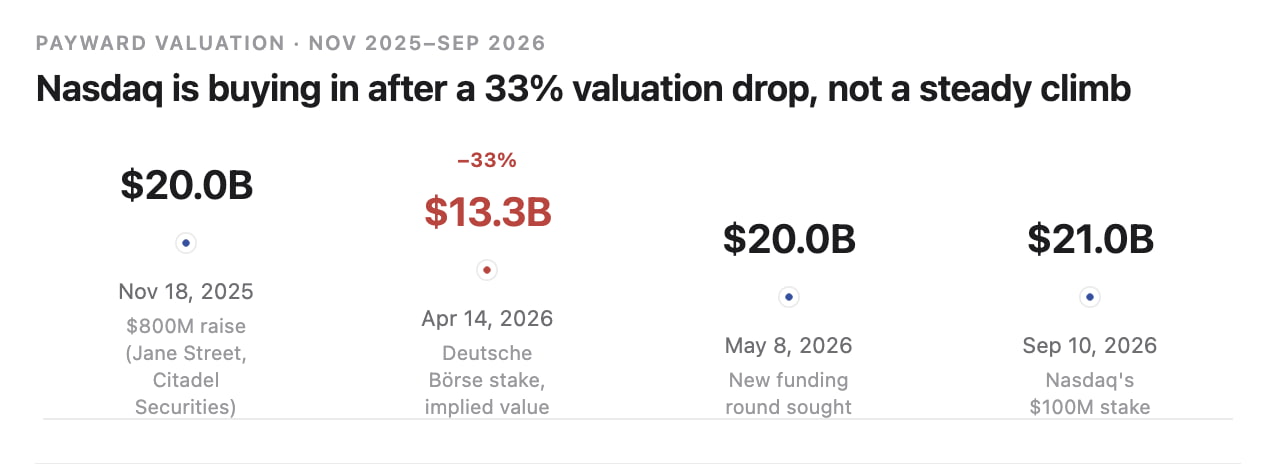
Payward’s valuation hasn’t risen steadily to get here. It fell by roughly a third in the months after Deutsche Börse invested at a lower implied value, then recovered to land almost exactly where it started ten months earlier.
The business underneath hasn’t been steady either. Payward’s second-quarter results, reported in August, showed revenue up 17% year over year to $508 million, while adjusted EBITDA fell 71% to $23 million as trading volume dropped 18%.
Eight days before the Nasdaq deal, Payward pushed its IPO back to the second quarter of 2027 at the earliest, the second delay this year, citing weak crypto prices and cooled investor demand for newly listed crypto stocks.
Three exchanges, one land grab
Nasdaq isn’t alone in moving now. Ten days before this deal, NYSE parent ICE took an equity stake in tokenization infrastructure firm tZERO.
The next day, the London Stock Exchange agreed to put its 100 largest listed stocks on Payward’s xStocks platform for round-the-clock trading.
Three of the world’s biggest exchange operators locked in tokenization partners inside the same ten-day span, each choosing an equity stake or an exclusive-feeling infrastructure deal over a simple licensing arrangement.
Payward’s own IPO and Nasdaq’s tokenized-stock rollout are now aimed at the same quarter, the second of 2027. Whether either actually lands on schedule is a separate question from why Nasdaq wanted this stake now.
Disclaimer: Cryip's content is strictly for educational and informational purposes and does not constitute financial, legal, or investment advice. Cryptocurrency involves significant risk, and readers assume full responsibility for their own financial decisions. Asset references are never endorsements.
To make complex crypto topics accessible to readers at all experience levels, our team uses AI tools strictly to refine language, correct grammar, and simplify terminology. AI is never used to draft facts, source information, or form conclusions. Every article is fact-checked and approved by a human editor before publication. Read our full AI Use & Content Policy.