




- Sui mainnet suffered three outages within 36 hours after the v1.72 upgrade.
- Bugs in gas payment logic and randomness generation triggered the network halts.
- Validators coordinated multiple restarts and emergency fixes to restore operations.
- No user funds were lost and no finalized transactions were rolled back.
- SUI token dropped roughly 15%–16% amid concerns over network reliability.
- Sui plans infrastructure improvements to prevent future outages.
Sui’s mainnet experienced three separate outages over a 36-hour period last week, raising fresh questions about the Layer-1 blockchain’s stability shortly after deploying its v1.72 software update.
Following last week’s outages related to the 1.72 release, the Sui Core Team has completed an investigation and incident review, detailing what happened and the steps taken by validators to restart the network.
— Sui (@SuiNetwork) May 31, 2026
According to a detailed post-mortem released by the Sui Foundation, the disruptions began on May 28 and continued into May 29, with network halts lasting several hours each. The issues stemmed primarily from bugs introduced in the new release, which included changes to gas charging and address balance functionality.
The first outage struck approximately 14:00 UTC on May 28 and lasted more than six hours. A second outage hit early the next morning, followed by a third incident later that afternoon during a scheduled epoch transition. In all cases, validators had to coordinate restarts and deploy emergency fixes to restore operations.
Root Causes Tied to Recent Upgrade
The initial two outages were linked to flaws in the new hybrid gas payment system introduced in v1.72. The update allows users to pay transaction fees directly from address balances in addition to traditional coin objects. However, under certain conditions involving cancelled transactions and insufficient funds, the system generated invalid negative balance deltas, causing validator nodes to crash.
An interim patch deployed to resolve the first incident failed to fully address the problem. A variation of the same bug resurfaced on May 29, bypassing the temporary safeguard and triggering the second halt.
The third outage occurred during an epoch transition on May 29 and was linked to Sui’s distributed key generation (DKG) process, which initializes the network’s randomness beacon. While validators remained online and continued producing system transactions, user transactions stopped being accepted as the network failed to complete its transition into the next epoch.
According to the reports, the issue emerged while validators were deploying a coordinated software upgrade containing a long-term fix for the earlier incidents. As validators restarted, the randomness initialization process failed to reach the higher quorum threshold required for execution. A previously undiscovered software bug then prevented the failure state from being properly preserved across validator restarts, causing the epoch transition to stall.
Validators subsequently deployed an additional fix addressing both the affected epoch and the underlying software issue, allowing the network to resume normal transaction processing.
No Funds Lost, But Confidence Impact Likely
The Sui Foundation emphasized that no user funds were at risk and that no previously committed transactions were rolled back. Normal network operations have since been restored after validators implemented permanent fixes.
Still, the back-to-back incidents represent a significant operational setback for Sui, which has positioned itself as a high-performance blockchain. This marks the latest in a series of mainnet reliability issues for the network since its launch.
In its post-mortem, Sui outlined several areas targeted for improvement, including better end-of-epoch resilience, more robust gas-charging architecture, and enhanced failure containment. The foundation also noted plans to expand the use of AI-assisted tools for diagnosing production problems.
The repeated outages are likely to draw scrutiny from developers and institutional users who have been evaluating Sui for high-throughput decentralized applications. The SUI token’s price reaction to the news was not immediately detailed in the foundation’s report.
SUI Token Slides as Outages Shake Market Confidence
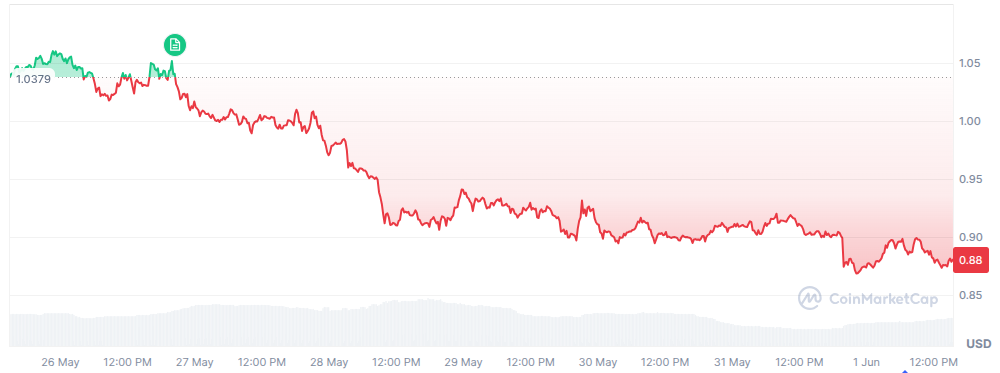
The network disruptions also weighed heavily on the price of SUI, the native token of the Sui blockchain. Over the course of last week, SUI fell approximately 15%–16%, declining from around $1.04 to near $0.88 as of 10:04 UTC, as traders reacted to the repeated mainnet outages.
The sharpest decline occurred following the first network halt on May 28, when the token dropped more than 8% intraday amid heightened uncertainty over the stability of the newly deployed v1.72 upgrade. While the market attempted to recover between incidents, the subsequent outages renewed selling pressure and undermined investor confidence.
By the end of the week, SUI was testing key support levels as market participants assessed the potential long-term impact of the disruptions on developer adoption and institutional interest. The price weakness highlighted the sensitivity of investors to reliability concerns, particularly for high-performance Layer-1 networks competing for decentralized application and enterprise adoption.
As of Monday, the network is reported to be operating normally.
Source: Sui Foundation
Disclaimer: Cryip's content is strictly for educational and informational purposes and does not constitute financial, legal, or investment advice. Cryptocurrency involves significant risk, and readers assume full responsibility for their own financial decisions. Asset references are never endorsements.
To make complex crypto topics accessible to readers at all experience levels, our team uses AI tools strictly to refine language, correct grammar, and simplify terminology. AI is never used to draft facts, source information, or form conclusions. Every article is fact-checked and approved by a human editor before publication. Read our full AI Use & Content Policy.