



KPMG has issued an unqualified opinion on Tether’s financial statements for the year ended December 31, 2025, certifying that the stablecoin issuer’s reserves exceeded its liabilities by $6.814 billion on that date. It is the first full financial statement audit Tether has completed in the company’s history, after nearly a decade of promising one and, in 2021, paying $18.5 million to settle with the New York Attorney General and $41 million to settle with the CFTC over how it described its reserves. It first climbed to a record $8.23 billion by March 31, then fell to $4.11 billion by June 30, a drop of roughly half from that peak and about 40 percent below the audited year-end figure itself.
What KPMG Actually Checked
KPMG’s engagement went well beyond the quarterly reserve attestations Tether has published since 2021. Auditors tested Tether’s balance sheet, income statement, changes in equity and cash flows under U.S. accounting standards, and examined the company’s transactions, valuations and counterparty records. They also physically counted and inspected each gold bar in Tether’s vaults rather than relying on custodian statements alone.
| Period / document | Accounting work | Assets/reserves examined | Liabilities examined | Income/cash flows | Physical gold inspection | Conclusion |
| Q4 2025 attestation | Reserve-focused | Reserve assets | USDT liabilities | No full financial statements | Not equivalent to full audit | Attestation |
| KPMG 2025 audit | Full financial-statement audit | Balance sheet/assets | Liabilities | Income statement, equity and cash flows | Yes, gold bars physically inspected | Unqualified opinion |
CEO Paolo Ardoino called the audit “a defining moment for the stablecoin industry.” CFO Simon McWilliams said the audited numbers backed up what the company’s prior quarterly attestations had already shown.
An unqualified opinion is the most favorable conclusion an auditor can reach. It means the financial statements fairly represent the company’s position under generally accepted accounting principles. It does not mean KPMG endorsed Tether’s business model, and it does not guarantee Tether can meet redemption demands if a large share of USDT holders tried to cash out at once. Those are separate questions an audit opinion isn’t built to answer.
What Happened Between the Engagement and the Opinion
Tether first said it had engaged a Big Four firm on March 24, 2026, as it pursued U.S. expansion and a fundraising round reported at the time at $15 billion to $20 billion. It said it had also hired PwC that month to help prepare its internal systems ahead of the audit. Shares of Circle, USDC’s issuer, fell 20.1 percent the next trading session.
Tether moved on several other fronts throughout the year. It disclosed buying about 27 metric tons of gold in the fourth quarter of 2025, as USDT’s circulating supply climbed above $180 billion. On March 12, it named Zachary Lyons chief investment officer, with Richard Heathcote stepping into an advisory role. On May 1, Tether published its first-quarter attestation, reporting $1.04 billion in net profit backed by roughly $141 billion in direct and indirect U.S.
Treasury exposure, about $20 billion in physical gold and about $7 billion in bitcoin. Tether has also expanded its presence in Africa through the Tether Nairobi Securities Exchange partnership, supporting digital-asset infrastructure and broader blockchain adoption in the region. In mid-June, the company said it would wind down Alloy by Tether and its gold-backed aUSDT token, citing insufficient demand, and redirect resources toward “products with stronger user demand, deeper liquidity, and broader long-term market opportunity.” By the time KPMG’s opinion arrived on August 13, the reserve picture it described was already out of date.
Tether’s Path to Its First Full Audit
- Feb. 2021: New York AG settlement; Tether/iFinex agreed to pay $18.5M and provide greater transparency.
- Oct. 15, 2021: CFTC imposed a $41M penalty over misleading claims concerning USDT’s backing.
- Mar. 24, 2026: Tether announced engagement of a Big Four accounting firm for its first full financial-statement audit.
- Mar. 31, 2026: Excess reserves reached $8.232B.
- Jun. 30, 2026: Excess reserves fell to $4.11B.
- Aug. 13, 2026: KPMG issued the unqualified opinion on the 2025 financial statements.
The Surplus KPMG Signed Off On Has Already Shrunk by 40%
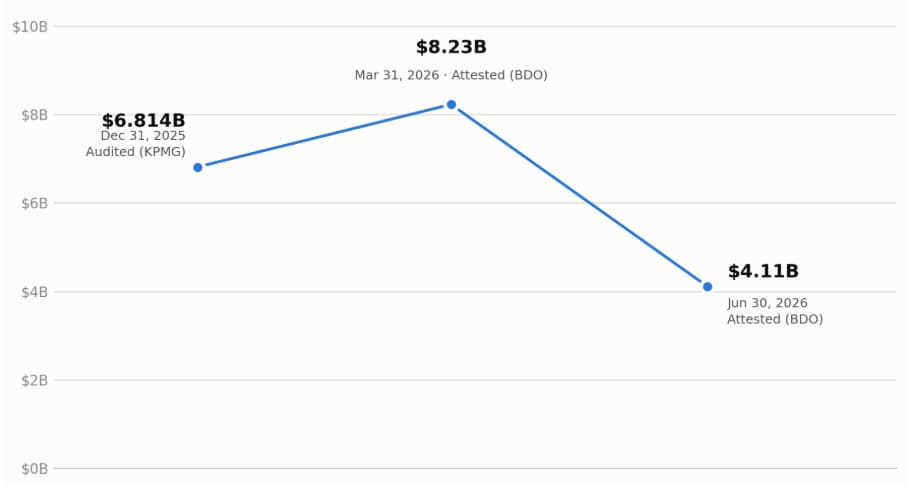
Tether’s excess reserves changed sharply after the audit’s Dec. 31, 2025 cutoff. They first rose to a record $8.23 billion by March 31, then fell to $4.11 billion by June 30, highlighting a significant shift that the audit’s single year-end snapshot does not capture.
Tether’s own numbers show the decline was not gradual. The Q1 attestation also put the reserve buffer at $8.23 billion, a record high and about 21 percent above the audited year-end figure. By June 30, it had fallen to $4.11 billion, a drop of roughly half from that peak, even as the company reported $1.5 billion in Tether Q2 profit for the same quarter. Gold prices fell more than 20 percent from their January highs over roughly the same stretch, and gold makes up a large share of Tether’s reserves.
There is also a gap in Tether’s own numbers from before the audit. Tether’s fourth-quarter 2025 attestation, published earlier this year, had put the same year-end surplus at $6.34 billion, about $474 million below the figure KPMG later certified for that date.
Tether’s Bigger Test Is the 2028 Compliance Deadline
The audit lands as Tether faces a separate deadline. The GENIUS Act, the federal stablecoin law signed in July 2025, gives issuers until 2028 to move reserves fully into compliant assets like cash and short-term Treasuries before non-compliant stablecoins lose their safe harbor on U.S. platforms.
About a quarter of USDT’s reserves, including gold, lending positions and bitcoin, still sit outside that compliant category, according to Kevin Wysocki of Anchorage Digital. Meanwhile, Tether is expanding USDT’s utility through its planned Tether USDT Bitcoin integration using the RGB protocol.
Tether launched USAT, a separate dollar token built to meet the new law’s requirements, through Anchorage Digital Bank in January 2026. Adoption has been minimal so far. A clean audit opinion settles a question about the past. Whether Tether can move a $180 billion token into full compliance, and hold its reserve cushion steady while doing it, is still open.
Disclaimer: Cryip's content is strictly for educational and informational purposes and does not constitute financial, legal, or investment advice. Cryptocurrency involves significant risk, and readers assume full responsibility for their own financial decisions. Asset references are never endorsements.
To make complex crypto topics accessible to readers at all experience levels, our team uses AI tools strictly to refine language, correct grammar, and simplify terminology. AI is never used to draft facts, source information, or form conclusions. Every article is fact-checked and approved by a human editor before publication. Read our full AI Use & Content Policy.