




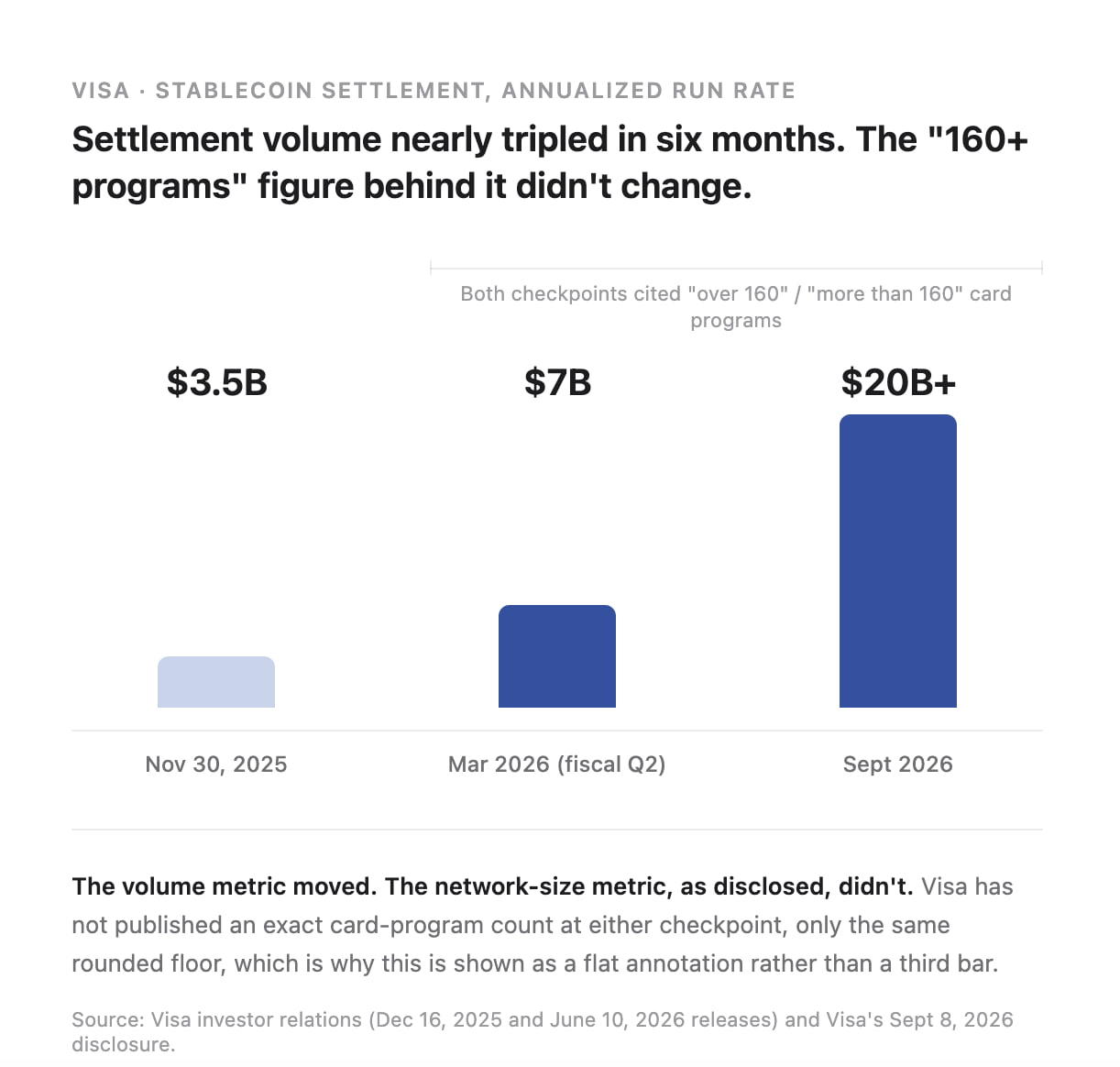
- Visa said its stablecoin-linked card settlement hit a $20 billion annualized run rate in September, more than 15 times higher than a year earlier and nearly triple the $7 billion pace it reported in March.
- The “more than 160” stablecoin-linked card programs Visa cited alongside that number is the same rounded figure it gave investors in June, when the run rate was $7 billion.
- The volume runs through a credit facility built by Credit Coop, a startup that had raised $4.5 million in total funding before taking on billions of dollars a year in settlement financing.
Visa said Tuesday that settlement volume on its stablecoin-linked cards has reached a $20 billion annualized run rate, more than 15 times what it was a year ago and nearly triple the $7 billion pace the company reported in March. Payment volume on those cards is up almost 200% year over year.
The figure drawing the most attention is the other one Visa put out alongside it: more than 160 stablecoin-linked card programs now run on its network. That is the same rounded number Visa gave investors in June, when it disclosed the $7 billion run rate. Visa has not published an exact program count at either point, so it is possible the real number moved and simply got rounded to the same floor twice. But going by what the company has actually said, the network did not visibly grow while its volume roughly tripled. The growth is coming from inside the programs that already existed, not from new ones signing up.
The credit line behind the volume
That volume has to be financed somewhere, since card issuers need to fund settlement before stablecoin balances convert into the fiat their merchants get paid in. Visa built that financing layer with Credit Coop, a fintech that runs a stablecoin-denominated revolving credit facility secured against the settlement receivables card programs generate. Loans are funded and repaid through a smart contract Credit Coop calls Spigot, which reads Visa’s daily settlement files directly.
Credit Coop says it has financed $2.5 billion cumulatively since 2023, across more than 3,000 borrowing events and 9,000 repayments, with zero defaults.
Rain, a Visa principal member, accounts for $2 billion of that total on its own, and has used the facility since August 2023.
A newer entrant, the U.S. travel card issuer Karta, built its program on the same financing after raising $140 million in June, split between a $15 million Series A led by Galaxy Ventures and a $125 million credit facility from Community Investment Management.
Visa says bringing in more lenders through the facility has cut borrowing costs for participating programs by as much as 30%, and the company is now working with Credit Coop on a “just-in-time” funding model meant to shrink the borrowing window from days to hours. Both companies are framing the relationship as foundational, not incidental.
“Stablecoins are not only changing how money moves, they’re creating opportunities to rethink the financial infrastructure that supports payments,” said Rubail Birwadker, Visa’s global head of growth products.
Credit Coop’s own chief executive described the mechanism in more literal terms.
“By combining Visa settlement data with onchain infrastructure, we can evaluate live performance and enforce repayment from the settlement flow,” said Chris Walker, Credit Coop’s founder and chief executive.
A company that had raised $4.5 million in seed funding as of last August is now operating the credit plumbing under billions of dollars a year in Visa settlement obligations. Credit Coop is not necessarily carrying that risk on its own balance sheet, since its model is built to pull in outside lenders. But its smart contract is the layer everything runs through, which is a lot of load-bearing infrastructure to sit on a company of that size, zero-default record or not.
A partner search of its own
Visa is having this success at the same time it is short a settlement partner. Mastercard completed its purchase of stablecoin infrastructure firm BVNK in early August, ending BVNK’s relationship with Visa. Visa has since been looking for a replacement, one licensed across the U.S., U.K., Canada and Singapore, and has acknowledged that the pool of qualified partners has shrunk.
Credit Coop sits on the lending side of Visa’s stablecoin business, not the settlement-routing side BVNK occupied, so the two gaps do not overlap directly. But they land in the same stretch of the year. Together they show a company leaning harder on outside infrastructure providers for its stablecoin push at the exact moment one of those providers was bought out from under it by its biggest rival.
Visa has not said when it expects to name a new settlement partner, or whether it will start disclosing an exact stablecoin card-program count instead of the same rounded floor. Both would be worth watching the next time the company updates these numbers.
Disclaimer: Cryip's content is strictly for educational and informational purposes and does not constitute financial, legal, or investment advice. Cryptocurrency involves significant risk, and readers assume full responsibility for their own financial decisions. Asset references are never endorsements.
To make complex crypto topics accessible to readers at all experience levels, our team uses AI tools strictly to refine language, correct grammar, and simplify terminology. AI is never used to draft facts, source information, or form conclusions. Every article is fact-checked and approved by a human editor before publication. Read our full AI Use & Content Policy.