



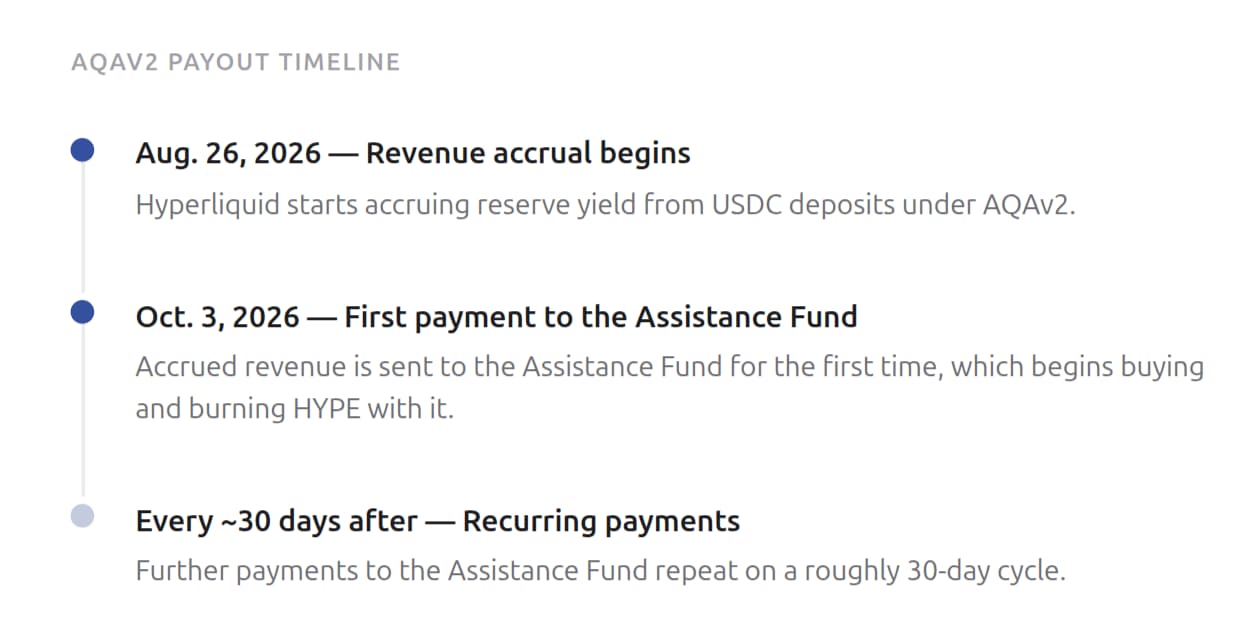
Hyperliquid began accruing revenue from its USDC reserves on August 26 under a mechanism called AQAv2, the protocol’s second channel for funding HYPE buybacks.
Hyperliquid Turns $USDC Yield Into hyperliquid:native Deflation
Starting today, @HyperliquidX begins accruing revenue from USDC reserves through AQAv2.
The key mechanism:
• Stablecoin reserve revenue is shared with Hyperliquid
• Around 90% of reserve revenue after operating… pic.twitter.com/fWFkuzUTVq— Hyperliquid Daily (@HYPERDailyTK) August 26, 2026
Reserve yield earned on USDC held on the platform is now shared with Hyperliquid, and most of it is set to flow into buying HYPE on the open market and burning it permanently. The first actual payment lands October 3, with further payments arriving roughly every 30 days after that.
How the mechanism works
AQAv2 assigns two roles to the stablecoin’s reserve managers: Coinbase serves as treasury deployer and Circle as technical deployer for Hyperliquid’s USDC reserves, and each staked 500,000 HYPE to back the role.
Their reserve balances are split in a fixed 9:1 ratio between the two addresses, managed automatically on-chain. Hyperliquid validators approved the mechanism with 69.08% support, above the 66.67% threshold required to pass.
Stripped to its core steps, the flow runs in one direction:
- USDC reserves held on Hyperliquid earn yield.
- Roughly 90% of that yield, after operating costs, is shared with Hyperliquid.
- The revenue is sent to Hyperliquid’s Assistance Fund, on a roughly 30-day cycle.
- The Assistance Fund uses it to buy HYPE on the open market.
- Every token it buys is burned, permanently removing it from circulation.
Why the size of this scales with USDC liquidity
The mechanism is built so that buyback size tracks stablecoin liquidity rather than trading activity. More USDC deposited on the platform means more reserve revenue for Hyperliquid to share, which means more capital available to the Assistance Fund, which means more HYPE bought and burned.
That is a distinct funding source from Hyperliquid’s existing trading-fee buyback program, which depends on trading volume rather than deposits.
Based on current USDC deposits and prevailing reserve yields, market estimates suggest AQAv2 could generate roughly $135 million to $160 million a year in additional buyback revenue. That figure is not an official Hyperliquid forecast. Hyperliquid has not published its own projection, and the actual number will move with how much USDC sits on the platform and what yield it earns, both of which can change.
Until that first payment lands, the actual size of AQAv2’s contribution stays an estimate rather than a settled number.
Disclaimer: Cryip's content is strictly for educational and informational purposes and does not constitute financial, legal, or investment advice. Cryptocurrency involves significant risk, and readers assume full responsibility for their own financial decisions. Asset references are never endorsements.
To make complex crypto topics accessible to readers at all experience levels, our team uses AI tools strictly to refine language, correct grammar, and simplify terminology. AI is never used to draft facts, source information, or form conclusions. Every article is fact-checked and approved by a human editor before publication. Read our full AI Use & Content Policy.