




May 2026 proved to be a bruising month for decentralized finance. A record surge in multisig tampering, bridge exploits, and private key compromises drained over $84 million from protocols spanning 16 blockchains, with Ethereum bearing the heaviest share of losses.
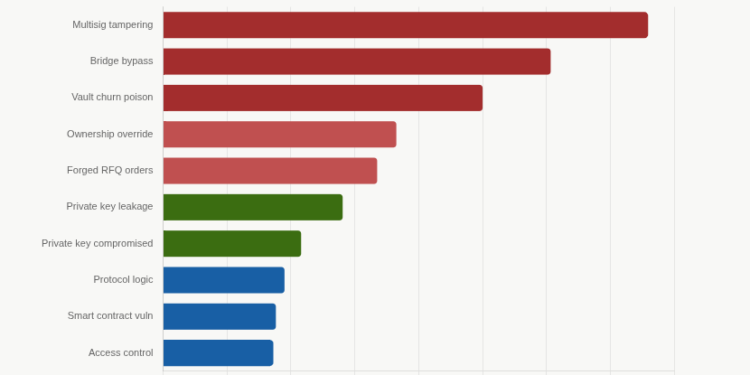
Of the $84.2 million total, more than $37 million was lost across just three attack vectors: multisig address tampering ($15.18M), bridge verification bypasses ($12.13M), and vault churn address poisoning ($10M). This concentration reflects a calculated shift by threat actors toward higher-value, harder-to-patch systemic vulnerabilities.
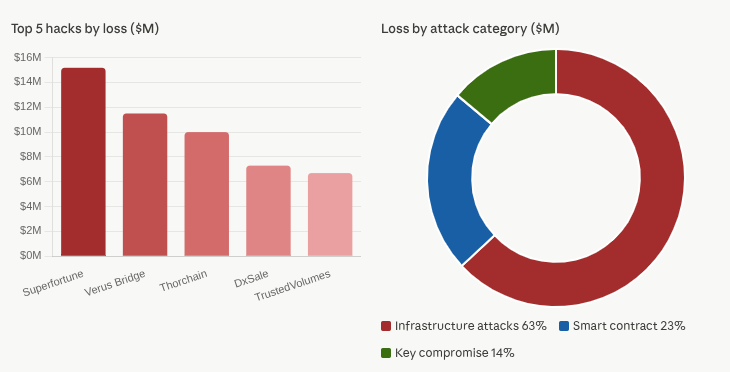
Key trend: 63% of total losses in May came from infrastructure-layer attacks, not smart contract bugs, marking a notable shift from prior months dominated by DeFi protocol exploits.
QUICK STATS
Total Losses: $84,207,570 Total Incidents: 41 Average Loss per Incident: $2,053,843 Chains Affected: 16 Largest Single Hack: $15,180,000 (Superfortune, Multisig Tampering) Most Targeted Chain: Ethereum ($61.9M lost)
TOP 5 LARGEST HACKS
- Superfortune ($GUA) | $15,180,000 | Ethereum, BSC | Multisig Address Tampering
- Verus-Ethereum Bridge | $11,500,000 | Ethereum | Bridge Verification Bypass
- Thorchain DEX | $10,000,000 | Bitcoin, Ethereum | Vault Churn Address Poisoning
- DxSale | $7,300,000 | BNB Chain | Ownership Override Attack
- TrustedVolumes | $6,700,000 | Ethereum | Forged RFQ Orders
MAJOR INCIDENT BREAKDOWN
Superfortune ($GUA), $15.18M lost (May 27) The month’s largest loss came from a multisig address tampering attack targeting the Superfortune protocol on Ethereum and BSC. Attackers gained the ability to redirect multisig approvals to a controlled address, draining protocol reserves before the team could respond. This attack type is particularly dangerous because it exploits governance trust, not code.
Verus-Ethereum Bridge, $11.5M lost (May 17) A bridge verification bypass allowed attackers to forge cross-chain withdrawal proofs on the Verus-Ethereum Bridge. The exploit bypassed signature verification logic, enabling unauthorized minting of native assets on the Ethereum side. This marks the second-largest bridge attack of 2026 to date.
Thorchain DEX, $10M lost (May 15) Thorchain’s decentralized exchange suffered a vault churn address poisoning attack affecting both Bitcoin and Ethereum vaults. By injecting a malicious address during a scheduled vault rotation event, attackers redirected outbound transactions worth $10M. The exploit targeted a timing window in Thorchain’s churn mechanism.
DxSale, $7.3M lost (May 28) An ownership override attack on DxSale running on BNB Chain allowed the attacker to seize contract ownership via a logic flaw in the upgrade mechanism. Once ownership was transferred, the attacker drained liquidity pools and locked out legitimate administrators. DxSale’s launchpad contracts had not been audited post the last upgrade.
TrustedVolumes, $6.7M lost (May 7) Forged Request-For-Quote (RFQ) orders allowed an attacker to drain TrustedVolumes’ on-chain liquidity on Ethereum. The exploit took advantage of insufficient validation on off-chain signed order data accepted by the Solidity settlement contract.
Chain-by-chain security breakdown of the blockchain ecosystems most affected by hacks in May 2026
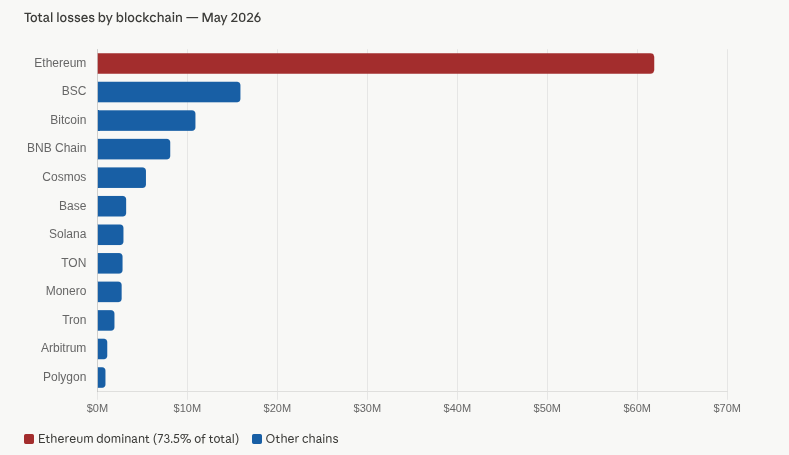
When you map all 41 confirmed incidents against the chains they hit, a clear hierarchy of vulnerability emerges. Some chains bled hundreds of millions. Others barely got scratched. Here’s what the data actually shows.
Ethereum: The Biggest Target, By Far
No surprise here, but the scale still shocks. Ethereum-connected protocols lost $61,894,900 in May alone, accounting for 73.5% of all losses across the entire month. That’s nearly three-quarters of an $84M problem sitting on one chain.
What makes this number more alarming is how those losses happened. Ethereum wasn’t hit by one massive exploit; it was death by a thousand cuts. Verus-Ethereum Bridge alone drained $11.5M through a bridge verification bypass. TrustedVolumes lost $6.7M via forged RFQ orders. Thorchain’s Ethereum vaults were part of a $10M vault churn poisoning. StablR lost $2.8M from a compromised private key. SquidRouter bled $3M through an access control failure. New Market Trading lost $3.8M to a protocol logic flaw.
The pattern is clear: attackers aren’t targeting Ethereum because it’s weak. They’re targeting it because that’s where the money is. Every major DeFi protocol, every significant liquidity pool, every cross-chain bridge has an Ethereum endpoint. That makes it the single highest-value attack surface in all of crypto. If you’re building on Ethereum, May’s data sends one loud message: bridge integrations and access control logic are your biggest liabilities right now.
BSC: The Scammer’s Playground
Binance Smart Chain came in second with $15,933,850 lost, but the nature of BSC incidents tells a very different story from Ethereum. BSC wasn’t targeted by sophisticated bridge hackers or vault poisoning attacks. It was hit by the kind of exploits that thrive in low-audit environments.
The headline hit was Superfortune ($GUA), which lost $15.18M to a multisig address tampering attack, the single largest hack of the entire month. One incident nearly wiped out BSC’s entire monthly loss figure on its own. Outside of that, SKP lost $212,850 to a smart contract vulnerability, and MAP Protocol’s BSC deployment was partially caught in an infinite mint and dump for $110,000.
BSC’s problem isn’t protocol sophistication; it’s governance negligence. The Superfortune attack exploited a multisig setup that clearly lacked timelocks, address change verification, or any meaningful signer controls. This type of attack doesn’t require advanced exploit code. It requires a team that didn’t take its own treasury security seriously.
Bitcoin: Collateral Damage from Cross-Chain Risk
Bitcoin showing up with $10,858,000 in losses might seem counterintuitive because Bitcoin itself wasn’t exploited. But May exposed the danger of wrapping Bitcoin into DeFi infrastructure.
Two incidents drove this number. The dominant one was Thorchain DEX, which lost $10M across its Bitcoin and Ethereum vaults through a vault churn address poisoning attack. Thorchain’s architecture involves native Bitcoin custody, and when its vault rotation mechanism was manipulated, Bitcoin holders paid the price. The second was Bisq, which lost $858,000 through a fake Bisq V1 client hack, a social engineering attack targeting Bitcoin users directly.
Bitcoin’s appearance on this list is a warning to any protocol that natively custodies BTC: your security model is only as strong as your vault rotation and client distribution mechanisms. Bitcoin itself is fine. The infrastructure built around it is not.
BNB Chain: One Attack, One Massive Bill
Technically distinct from BSC in Binance’s ecosystem, BNB Chain recorded $8,115,000 in losses, almost entirely from a single incident. DxSale lost $7.3M on May 28 through an ownership override attack, where an attacker exploited a logic flaw in the contract upgrade mechanism to seize full ownership of the protocol’s contracts. The Alephium Bridge also contributed $815,000 through an off-chain vulnerability affecting both Ethereum and BNB Chain endpoints.
DxSale’s hack is particularly instructive. The protocol’s launchpad contracts hadn’t been audited after the last upgrade. That one operational gap, skipping a post-upgrade audit, cost users $7.3 million. On BNB Chain, where deployment is cheap and fast, teams routinely push upgrades without re-auditing. May showed exactly what that shortcut costs.
Cosmos: Quiet Chain, Catastrophic Single Loss
Cosmos doesn’t see many hacks. But when it does, they hurt. In May, $5,400,000 left the Cosmos ecosystem through Gravity Bridge, which suffered a private key leakage on May 30. The bridge connects Ethereum and Cosmos, and once the private key controlling bridge operations was compromised, the attacker drained funds from both sides.
Cosmos’s relatively small loss count of one incident shouldn’t be read as good security culture. It should be read as: fewer protocols, fewer targets, but the ones that exist are just as exposed to key management failures as anyone else.
Base: The New Chain Vulnerability Window
Coinbase’s Base chain, still relatively young, recorded $3,175,000 in losses across two incidents. SquidRouter’s $3M access control exploit hit Base alongside Ethereum. Bankr lost $170,000 to compromised session keys. Veil Cash lost a minor $5,000 to a smart contract vulnerability.
Base’s numbers reflect something predictable: new chains attract teams moving fast, and fast-moving teams make access control mistakes. SquidRouter’s exploit was a textbook access control failure, the kind that gets caught in thorough audits but slips through when teams are racing to ship cross-chain features.
Solana: A Celebrity Account, A Real Problem
Solana had one incident in May, but it was a high-visibility one. The Roaring Kitty X account was hacked, and the attacker used it to manipulate a Solana-based token, draining $2,860,000 from people who traded on the false signals.
This wasn’t a smart contract exploit. It wasn’t a bridge hack. It was a social media account compromise weaponized against on-chain liquidity. Solana’s DeFi ecosystem has no defense against this because the attack vector isn’t on-chain at all. The lesson here isn’t about Solana’s code quality. It’s about how off-chain influence directly moves on-chain money.
TON: Cross-Chain Complexity Bites
TON recorded $2,800,000 in losses from a single incident: TAC Cross-Chain Layer, which suffered a smart contract vulnerability on May 13. As TON integrates more deeply with Ethereum-based DeFi through cross-chain layers, it inherits the same smart contract risks that have plagued EVM chains for years. The vulnerability wasn’t novel; it was the same category of smart contract bug that Ethereum protocols faced three years ago. TON’s ecosystem is effectively re-learning hard lessons.
Monero: An Unexpected Entry
Monero’s appearance on this list, with $2,700,000 lost, is unusual. RetoSwap, a peer-to-peer Monero exchange built in C++, suffered an ACK message frontrun exploit. The attacker manipulated the trade acknowledgment message flow to front-run settlements and drain funds.
This is notable because Monero’s privacy features are often cited as a security advantage. But privacy at the protocol layer doesn’t protect application-layer logic. RetoSwap’s vulnerability was entirely in its own trade settlement code; Monero’s underlying privacy had nothing to do with it. Privacy coins aren’t immune to application-layer exploits.
Arbitrum, Polygon, Tron and the Smaller Chains
Arbitrum recorded $1,088,420 across six incidents, all relatively small, ranging from $13,700 (Fractal Protocol flashloan) to $456,000 (Aurellion uninitialized proxy). The pattern across Arbitrum hacks is consistent: uninitialized proxies, access control gaps, and flashloan manipulations. These are auditable, preventable vulnerabilities. Arbitrum’s low per-incident losses suggest its larger protocols have reasonable security posture, but its smaller protocols clearly don’t.
Polygon lost $941,400 across three incidents: INK Finance ($140K), Huma Finance ($101K), and Polymarket ($700K). Polymarket’s private key compromise was the standout, and it’s the kind of operational failure that no amount of smart contract auditing can prevent.
Tron contributed $1,880,000 through a single incident: Transit Finance, which lost funds through a deprecated smart contract exploit. The protocol had a legacy contract still holding user funds that it had stopped actively maintaining, and attackers found it. Deprecated contracts are live vulnerabilities until they’re explicitly killed.
The Clearest Signal in This Data
When you look at all 41 incidents mapped to their chains, one pattern dominates everything else: the chain itself almost never matters. Ethereum lost $61M not because Ethereum is insecure, but because Ethereum hosts the most value. BSC’s Superfortune hack wasn’t a BSC problem; it was a governance problem. Bitcoin’s losses came from infrastructure built around it, not from Bitcoin itself.
The real security variable in May 2026 wasn’t the chain. It was the team: their audit discipline, their key management practices, their governance design, and how carefully they shut down what they were no longer actively protecting.
ANALYSIS AND OUTLOOK
Three clear trends emerge from May’s incident data that every protocol team, auditor, and investor should internalize going into the second half of 2026.
Bridge infrastructure remains acutely underprepared. Two bridge verification bypass attacks in the same month, Adshares ($628K) and Verus-Ethereum ($11.5M), underscore that cross-chain message validation is still an unsolved problem at scale. The industry’s bridge security audit processes must evolve to treat off-chain verification components with the same rigor as on-chain contracts.
Multisig hygiene is deteriorating. The $15.18M Superfortune hack via multisig address tampering points to a governance layer attack that audits traditionally don’t catch. Protocols relying on multisig governance should implement timelocks, on-chain address change proposals, and hardware security modules for signer key management.
Private key security is an operational failure, not a code failure. Five incidents involving compromised or leaked private keys collectively drained approximately $10M. This pattern suggests that as code-level security improves, attackers increasingly target the humans and infrastructure managing keys, through social engineering, malware, and insider threats.
The DeFi industry’s security investments must expand beyond smart contract auditing. Operational security, governance architecture, bridge validator design, and key management infrastructure are now the frontlines of the security battle.
Disclaimer: Cryip's content is strictly for educational and informational purposes and does not constitute financial, legal, or investment advice. Cryptocurrency involves significant risk, and readers assume full responsibility for their own financial decisions. Asset references are never endorsements.
To make complex crypto topics accessible to readers at all experience levels, our team uses AI tools strictly to refine language, correct grammar, and simplify terminology. AI is never used to draft facts, source information, or form conclusions. Every article is fact-checked and approved by a human editor before publication. Read our full AI Use & Content Policy.