
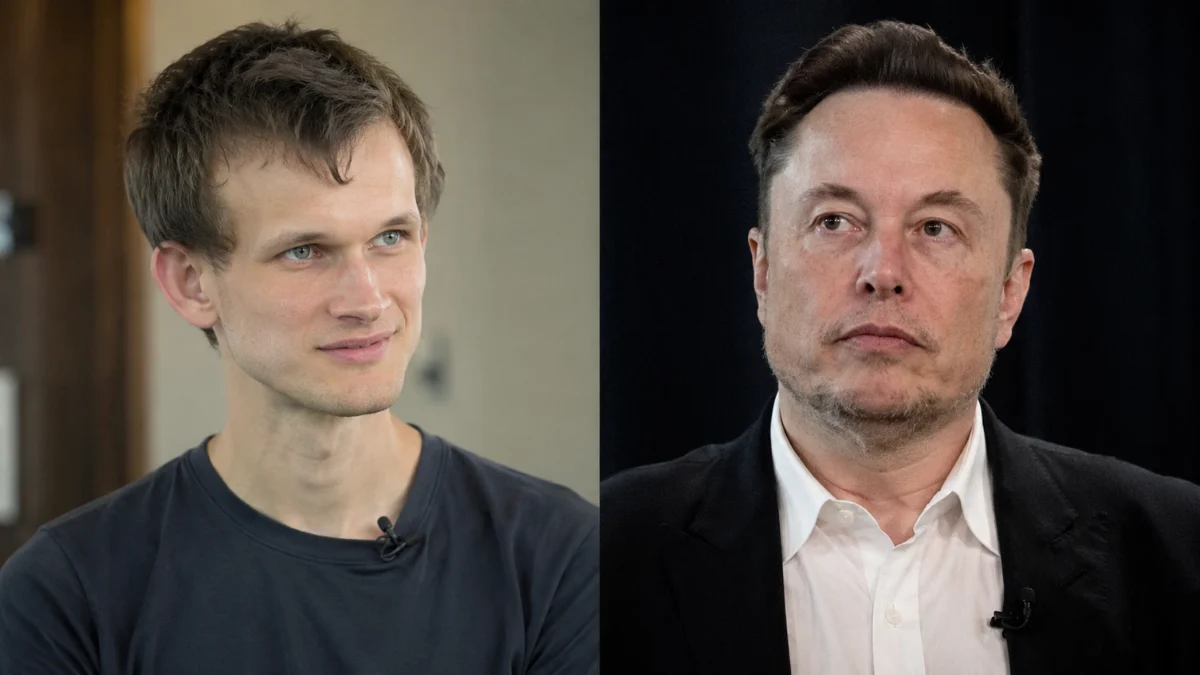


Ethereum co-founder Vitalik Buterin has proposed a new vision for Elon Musk’s social media platform X, suggesting it could evolve into a global hub for AI governance where users collectively shape policies surrounding advanced artificial intelligence.
Speaking about the future of AI oversight, Buterin argued that governance should not be left solely to governments, large technology companies, or centralized institutions. Instead, he believes digital platforms like X could facilitate transparent, community-driven decision-making by allowing people to debate, evaluate, and coordinate responses to emerging AI risks.
Earlier this month, Vitalik Buterin described “Lean Ethereum” as the network’s biggest transformation since the 2022 Merge, outlining a three-to-four-year roadmap to modernize nearly every core layer of the protocol.
The initiative prioritizes quantum-resistant cryptography, native privacy, and more efficient verification systems while aiming to improve scalability without disrupting existing Ethereum applications.
Community-Led AI Governance
One thing I find striking in the discourse between AI 2040 and its detractors is that the two seem to be locked in to totally incompatible worldviews of how fast and how much of a big deal AI progress is:
* In AI 2040, every scenario sees superintelligence of some kind emerging…
— vitalik.eth (@VitalikButerin) July 11, 2026
According to Buterin, X already possesses features that could serve as building blocks for decentralized governance. He pointed to Community Notes and prediction markets as examples of mechanisms that encourage public participation, improve information quality, and help identify consensus on complex issues.
Rather than focusing on restrictive regulation, Buterin proposed creating systems that encourage collaboration and enable users to reach mutually beneficial outcomes while maintaining openness and transparency.
Proposed AI Safety Triggers
Buterin also outlined several predefined scenarios that could justify temporarily slowing the development of frontier AI systems if they pose significant societal risks.
- Global outbreaks of highly dangerous pandemics.
- Unemployment rates exceeding 25% due to AI-driven automation.
- Large-scale deployment of autonomous lethal drone systems.
- Other measurable indicators showing AI has reached critical societal risk levels.
He suggested that establishing clear triggers in advance would provide a more objective framework for responding to future AI threats instead of relying on ad hoc policy decisions.
Aligned With Defensive Acceleration
The proposal reflects Buterin’s broader “defensive acceleration” (d/acc) philosophy, which advocates accelerating technologies that improve security, resilience, and public welfare. The framework emphasizes privacy, cryptography, cybersecurity, pandemic preparedness, and transparent information systems alongside responsible AI development.
Potential Role for Blockchain
If implemented, Buterin’s vision could create new opportunities for blockchain-based governance tools. Technologies such as decentralized voting, prediction markets, zero-knowledge proofs, and on-chain verification could help improve transparency and accountability in AI-related decision-making.
While Musk has not publicly responded to the proposal, the idea highlights the growing discussion around how decentralized technologies and social platforms could contribute to governing increasingly powerful AI systems without concentrating authority in a small group of organizations.
In May, Vitalik Buterin said combining artificial intelligence with formal verification could help developers build provably secure smart contracts and critical software systems. He argued the approach could strengthen cybersecurity and reduce vulnerabilities as AI-driven cyberattacks become increasingly sophisticated.
Disclaimer: Cryip's content is strictly for educational and informational purposes and does not constitute financial, legal, or investment advice. Cryptocurrency involves significant risk, and readers assume full responsibility for their own financial decisions. Asset references are never endorsements.
To make complex crypto topics accessible to readers at all experience levels, our team uses AI tools strictly to refine language, correct grammar, and simplify terminology. AI is never used to draft facts, source information, or form conclusions. Every article is fact-checked and approved by a human editor before publication. Read our full AI Use & Content Policy.