



BNB Chain activated the Pasteur hardfork on BSC mainnet at 02:30 UTC on August 25, 2026, closing a bridge verification flaw and tightening validator governance without changing the chain’s block time or gas limit, according to the official announcement and the underlying code proposals it implements.
Pasteur hardfork is now live on BSC Mainnet.
The upgrade strengthens bridge, staking and governance security, while giving blocks more room to carry transactions at the same 450ms block time.
Read the full upgrades 👇https://t.co/41QWQh1GGL pic.twitter.com/mTTnRb9PNk
— BNB Chain (@BNBCHAIN) August 25, 2026
The forge-a-supermajority flaw it closes
The headline fix is BEP-682, which changes the precompiled contract at address 0x67 that BSC’s bridge uses to check cross-chain signatures. Before this fix, the contract did not enforce that every validator in a signature set was unique.
“A duplicated validator counts multiple times, and one signature satisfies multiple index slots, allowing a minority to forge a supermajority.”
That is BEP-682’s own description of the problem it fixes. The update now rejects duplicate validator addresses, consensus keys, BLS keys, and relayer addresses before a cross-chain transfer can be authorized.
Three BEPs, one activation
Pasteur bundles three separate proposals into a single mainnet cutover. Each targets a different part of the chain.
| Area | BEP | What changed |
|---|---|---|
| Bridge verification | BEP-682 | Rejects duplicate validator addresses, keys, and relayer addresses in a signature set, closing the forge-a-supermajority path described above. |
| Validator & governance | BEP-695 | Rotated validator keys immediately lose admin privileges, slash penalties still apply after a key rotation, and blacklisted addresses are rejected in signature-based governance votes. |
| Block capacity | BEP-675 | Lets block builders submit pre-executed blocks, cutting validator re-execution time; on testnet, throughput rose from 1,237 to 2,324 transactions per second at the same 450ms block time. |
A pivot from a year of speed cuts
Pasteur breaks a pattern. Three straight hardforks before it, Lorentz, Maxwell and Fermi, cut BNB Chain’s block time from 3 seconds to 0.45 seconds over nine months. Pasteur is the first hardfork since Fermi to leave that number alone, spending its cycle on the bridge and governance layer instead.
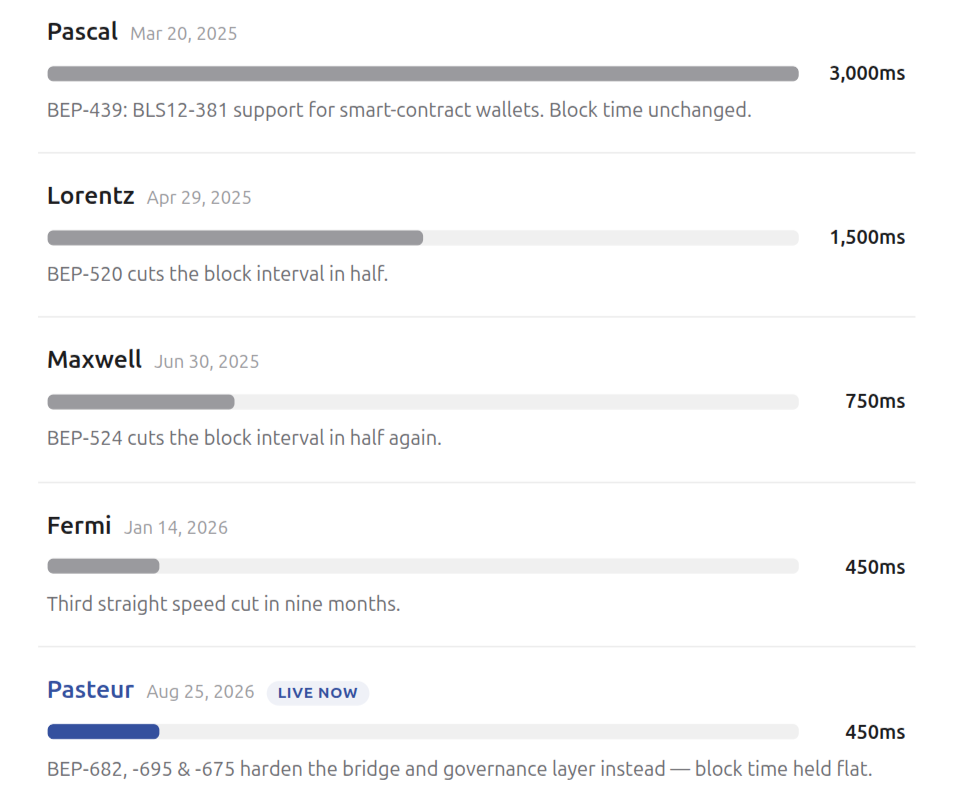
BNB Chain’s own 2025 recap credits four hardforks, Pascal, Lorentz, Maxwell and Fermi, with cutting block times, more than doubling bandwidth, and lowering gas prices over the year. Only three of those four actually touched block time: Pascal, which activated in March 2025, added smart-contract wallet support through BLS12-381 signatures and left the block interval at 3 seconds.
BNB Chain has cautioned that BEP-675’s throughput figures came from controlled testing. The comparison below is testnet data only.
| Metric (testnet) | Before BEP-675 | After BEP-675 |
|---|---|---|
| Throughput | 1,237 TPS | 2,324 TPS |
| Average block gas used | 46.35M | 84.15M |
| Block validation critical path | 125ms | 15ms |
Block time and the gas limit were unaffected by BEP-675 and held steady at 450ms and 100M gas throughout testing.
Node operators needed to run v1.7.7 ahead of the mainnet cutover; the upgrade first activated on BSC testnet on July 21, 2026, per the same announcement. No incident tied to the BEP-682 vulnerability class has surfaced since the 2022 Token Hub exploit, based on a review of exploit-tracking coverage of BSC’s bridge.
Disclaimer: Cryip's content is strictly for educational and informational purposes and does not constitute financial, legal, or investment advice. Cryptocurrency involves significant risk, and readers assume full responsibility for their own financial decisions. Asset references are never endorsements.
To make complex crypto topics accessible to readers at all experience levels, our team uses AI tools strictly to refine language, correct grammar, and simplify terminology. AI is never used to draft facts, source information, or form conclusions. Every article is fact-checked and approved by a human editor before publication. Read our full AI Use & Content Policy.