




- A federal jury convicted Brent C. Kovar on 15 counts of wire fraud, mail fraud, and money laundering on Aug. 24, 2026, after a nine-day trial.
- Kovar’s company, Profit Connect, took $24 million from at least 400 investors between late 2017 and July 2021 on a false promise of AI-powered cryptocurrency mining.
- Kovar was already permanently barred by the SEC from serving as a corporate officer after a nearly identical fraud in 2009.
A federal jury in Las Vegas convicted Brent C. Kovar on 15 counts of wire fraud, mail fraud, and money laundering on Aug. 24, 2026, closing a nine-day trial over a $24 million cryptocurrency Ponzi scheme run through his company, Profit Connect. Kovar faces a statutory maximum of 280 years in prison and is scheduled to be sentenced on Nov. 30, 2026, before U.S. District Judge Jennifer A. Dorsey.
LAS VEGAS – A federal jury convicted Las Vegas business owner Brent C. Kovar of operating a cryptocurrency Ponzi scheme that fraudulently obtained $24 million from at least 400 investors by promising high returns and falsely claiming his company was backed by substantial… pic.twitter.com/LOoLzRJg4C
— US Attorney Nevada (@USAO_NV) August 24, 2026
Prosecutors said Kovar told investors from late 2017 through July 2021 that Profit Connect used artificial intelligence running on a supercomputer to mine cryptocurrency, generating fixed annual returns of 15% to 30% with a full money-back guarantee. He also claimed the company’s crypto reserves were worth hundreds of millions of dollars and were backed by FDIC insurance, a claim FDIC insurance does not cover.
At least 400 investors put in $24 million combined. Instead of mining anything, Kovar used new investor money to pay earlier investors, bought a house, and covered employee gifts, according to the Justice Department. The SEC had already sued Kovar, his mother Joy I. Kovar, and Profit Connect in July 2021, freezing their assets after finding more than $12 million had come in from at least 277 investors by that point, with over 90% of incoming funds paid out to other investors rather than invested at all. It is the same fixed-return structure that undid Christopher Delgado’s $250 million scheme earlier this year.
A second act on an old playbook
Profit Connect was not Kovar’s first run at this. In 2009, the SEC charged him, then a senior vice president at Sky Way Global LLC, in a pump-and-dump scheme built on a different fabricated claim: that the company had broadcasting and anti-terrorism monitoring technology capable of tracking hijacked aircraft. It didn’t exist. That case ended with a federal court permanently barring Kovar, in 2010, from ever serving as an officer or director of any company registered with the SEC, and from penny stock offerings for life.
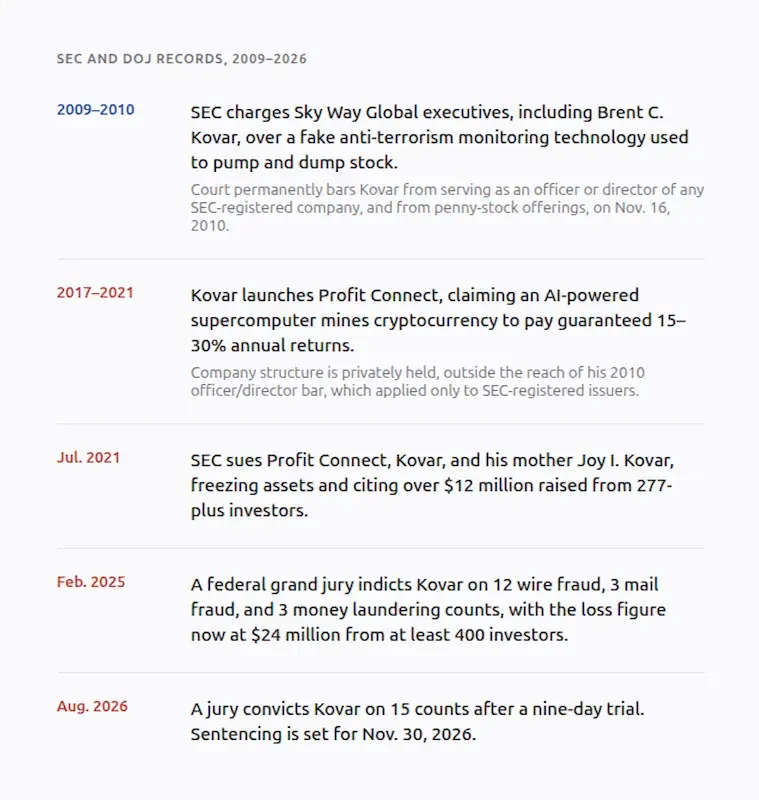
That bar had a gap. It covered SEC-registered issuers, and Profit Connect was privately held, so the restriction never applied to the company Kovar built next. Seven years after the Sky Way Global judgment, he was running the same basic pitch, a nonexistent proprietary technology promising outsized guaranteed returns, on a scale roughly twenty times larger than the first time.
Kovar’s sentencing on Nov. 30 will be the first time a court measures a punishment against both cases at once. It also lands in the middle of a broader reckoning for crypto-mining-flavored fraud, with prosecutors separately working to close out BitClub’s $722 million fraud case.
Disclaimer: Cryip's content is strictly for educational and informational purposes and does not constitute financial, legal, or investment advice. Cryptocurrency involves significant risk, and readers assume full responsibility for their own financial decisions. Asset references are never endorsements.
To make complex crypto topics accessible to readers at all experience levels, our team uses AI tools strictly to refine language, correct grammar, and simplify terminology. AI is never used to draft facts, source information, or form conclusions. Every article is fact-checked and approved by a human editor before publication. Read our full AI Use & Content Policy.