



- Bitcoin reclaimed the $66,000 level, gaining 3% in 24 hours and 5–6% over the past week as market sentiment improved.
- U.S. spot Bitcoin ETFs recorded five consecutive sessions of net inflows, attracting more than $600 million and signaling renewed institutional demand.
- Cooling U.S. inflation data eased concerns over prolonged high interest rates, supporting renewed appetite for risk assets, including cryptocurrencies.
- Regulatory optimism surrounding the proposed CLARITY Act, along with bargain buying after June’s selloff, added further support to Bitcoin’s recovery.
Bitcoin reclaimed the $66,000 level on Tuesday, extending its recovery as renewed institutional demand and improving macroeconomic conditions lifted investor sentiment across the cryptocurrency market.
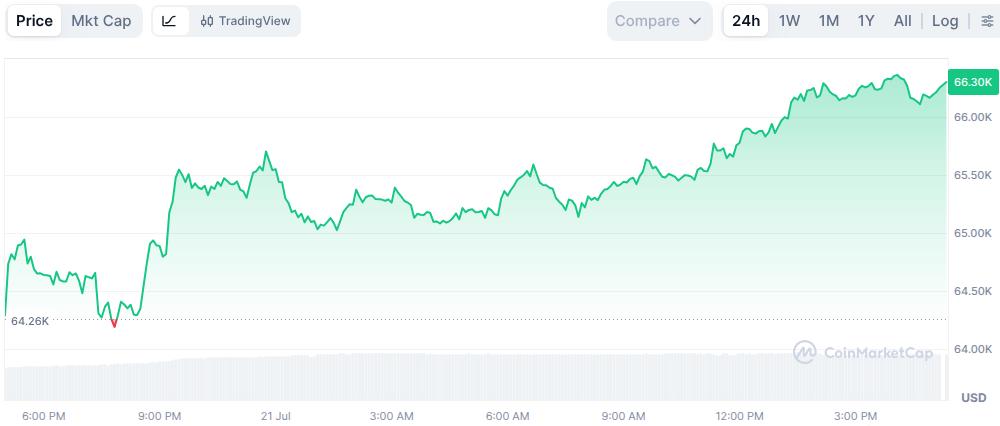
The world’s largest digital asset has gained around 3% over the past 24 hours and 5–6% over the past week, with market participants pointing to strong spot Bitcoin ETF inflows and easing inflation concerns as the primary catalysts behind the rally.
Institutional ETF Inflows Drive Bitcoin Higher
The biggest driver behind Bitcoin’s latest advance has been the return of institutional capital through U.S. spot Bitcoin exchange-traded funds (ETFs). After weeks of net outflows that weighed on prices, spot Bitcoin ETFs have recorded five consecutive trading sessions of positive inflows, bringing in more than $600 million. The sustained buying indicates that institutional investors are once again increasing their exposure to Bitcoin, providing fresh support for the market.
The latest rebound follows a sharp reversal in institutional sentiment. U.S. spot Bitcoin ETFs recorded their worst month since launch in June, with $4.06 billion in net outflows as investors reduced exposure during heightened macroeconomic uncertainty.
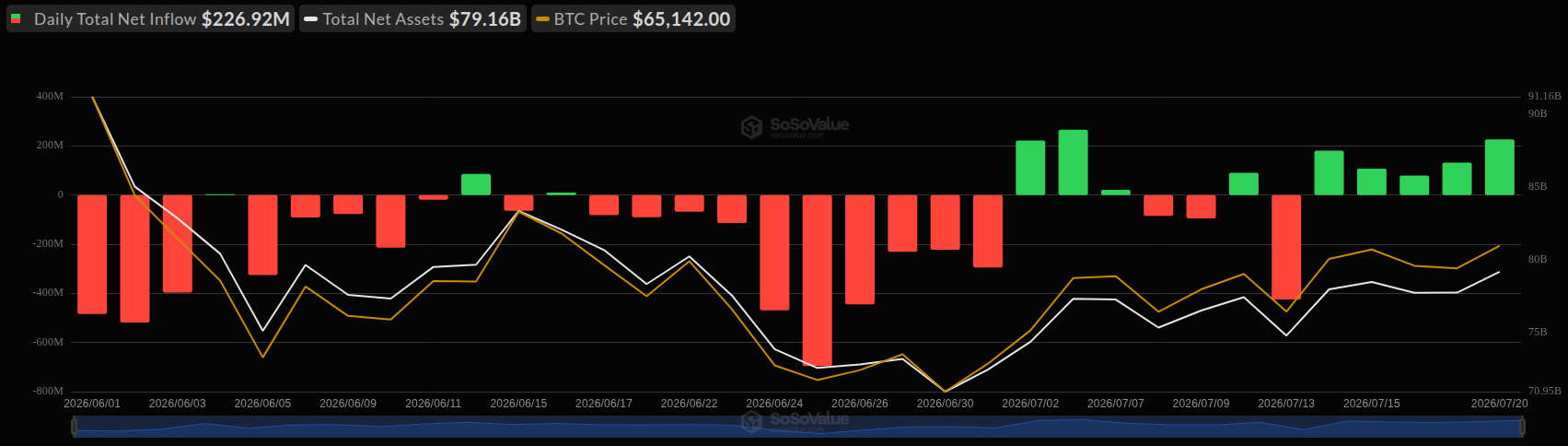
The turnaround began in early July, when U.S. spot Bitcoin ETFs recorded $222 million in net inflows, ending a 10-day streak of consecutive outflows. The positive momentum continued with subsequent daily inflows of $107.7 million, $79.1 million, $132.3 million, and $226.9 million, reinforcing confidence that institutional investors were returning to the market.
Cooling Inflation Supports Risk Assets
Another factor boosting sentiment is the latest U.S. inflation data, which came in softer than expected. The cooling inflation figures have eased concerns that the Federal Reserve may need to maintain higher interest rates for longer. As expectations for monetary policy became less restrictive, investors shifted back toward risk assets, including cryptocurrencies and technology stocks.
Institutional investors also appear to be taking advantage of Bitcoin’s lower prices following June’s market correction. After the cryptocurrency retreated sharply during the previous month, several large investors increased their holdings at discounted levels, contributing to the recent rebound above the $66,000 mark.
Regulatory Optimism Adds to Market Confidence: Optimism surrounding U.S. cryptocurrency regulation has also supported market confidence. Investors continue to monitor progress on the proposed CLARITY Act, which aims to establish a clearer regulatory framework for digital assets. Although the legislation has yet to become law, expectations that it could provide greater legal certainty have strengthened institutional sentiment toward the crypto market.
Key Market Drivers Behind Bitcoin’s Rally
- Bitcoin price: Above $66,000
- 24-hour gain: 3%
- 7-day gain: 5–6%
- Spot Bitcoin ETF inflow streak: Five consecutive trading sessions
- Total ETF inflows during the streak: More than $600 million
- Recent daily ETF inflows: Around $107.7M, $79.1M, $132.3M, and $226.9M
- Main catalysts: Institutional ETF buying, softer U.S. inflation, bargain accumulation after June’s selloff, and optimism surrounding the CLARITY Act.
Bitcoin’s Next Move Depends on Sustained Institutional Demand
Bitcoin’s recovery is encouraging, but the more important development is what happens after the initial rebound. A sustained rally will depend less on price momentum and more on whether institutional investors continue allocating capital despite macro uncertainties. If demand remains resilient through periods of consolidation, it would signal that investors are building long-term positions rather than chasing short-term gains. In that scenario, temporary pullbacks could increasingly reflect accumulation instead of a reversal in sentiment.
Looking ahead, the CLARITY Act could prove to be a more meaningful long-term catalyst than the current price recovery itself. While the legislation is unlikely to drive Bitcoin higher overnight, it has the potential to reduce one of the industry’s biggest barriers: regulatory uncertainty. Greater legal clarity could encourage broader institutional participation, accelerate investment in crypto infrastructure, and support wider digital asset adoption. Combined with sustained institutional inflows, this would strengthen the foundation for a more durable market cycle, shifting the focus from speculative momentum toward long-term capital formation.
Disclaimer: Cryip's content is strictly for educational and informational purposes and does not constitute financial, legal, or investment advice. Cryptocurrency involves significant risk, and readers assume full responsibility for their own financial decisions. Asset references are never endorsements.
To make complex crypto topics accessible to readers at all experience levels, our team uses AI tools strictly to refine language, correct grammar, and simplify terminology. AI is never used to draft facts, source information, or form conclusions. Every article is fact-checked and approved by a human editor before publication. Read our full AI Use & Content Policy.