


South Korea’s State Council approved amendments on Aug. 11 to the enforcement decree of the Special Financial Information Act, South Korea’s anti-money laundering (AML) law, that require domestic crypto exchanges to screen transfers of 10 million won ($6,800) or more sent to overseas exchanges or personal wallets.
How the Threshold Works
Under the amended decree, exchanges must run any transfer at or above that threshold through their own AML monitoring systems for suspicious transactions rather than clearing it automatically. Exchanges also have to differentiate how much they will allow to move to a given overseas platform based on that platform’s risk profile, so a transfer to one exchange may face a different cap than a transfer to another.
For transfers to platforms deemed higher risk, exchanges can require proof that the receiving account belongs to the sender, or ask the sender to state why the money is being moved. The transfer can be delayed or rejected, according to News1.
- March 25, 2022: South Korea’s Travel Rule takes effect for virtual-asset transfers of ₩1 million or more, requiring sender and receiver information to be shared between VASPs.
- March 30, 2026: The Financial Services Commission proposes extending the Travel Rule to transfers below ₩1 million. It separately proposes mandatory reporting of ₩10 million or more in overseas transfers regardless of whether the transaction is considered suspicious.
- August 11, 2026: The State Council approves the amended enforcement decree. The final framework retains ₩10 million as the threshold for enhanced AML monitoring of overseas transfers, while moving away from an automatic suspicious-transaction report for every transfer above that amount.
- Expected February 2027: The amended provisions are expected to take effect six months after formal promulgation, although the exact date will depend on the official publication date.
The result is a two-track system: the ₩1 million Travel Rule floor is being removed, extending identity-sharing requirements to transfers of any size, while ₩10 million remains the trigger for additional AML scrutiny on overseas transfers.
Google Play’s Crypto App Guidelines
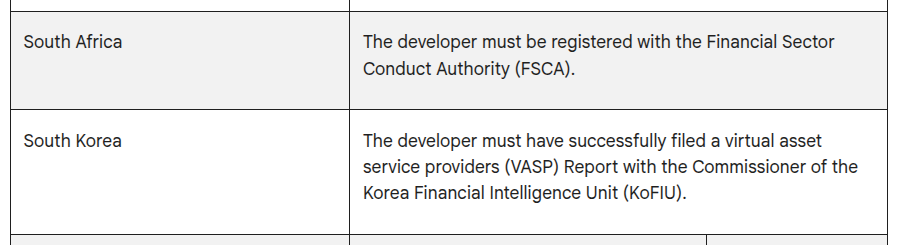
Google Play requires cryptocurrency exchanges targeting South Korea to comply with local laws and regulatory requirements. For South Korea,
“developers must have successfully filed a Virtual Asset Service Provider (VASP) report with the Korea Financial Intelligence Unit (KoFIU)”.
Apps that do not meet the required registration or licensing conditions may have to remove South Korea from their distribution targets. These rules help explain why regulatory action against unregistered overseas exchanges can affect their ability to distribute or update apps in the Korean market.
A Softer Version of an Earlier Proposal
| Issue | March Proposal | Aug. 11 Final Framework | Practical Effect |
|---|---|---|---|
| ₩10 million+ overseas transfer | Mandatory suspicious-transaction reporting | Enhanced AML monitoring | Not every qualifying transfer automatically becomes an STR |
| Risk assessment | Regulatory reporting trigger | Exchange-level monitoring | Exchanges assess transaction risk |
| High-risk destination | Stricter controls proposed/required | Verification and transfer-purpose checks possible | Transfers can face additional friction |
| Reporting burden | Industry estimated ~5.4M annual STRs | Automatic reporting requirement removed | Lower expected reporting volume |
The March proposal would have placed every overseas transfer of ₩10 million or more into the mandatory suspicious-transaction reporting process. The Aug. 11 framework replaces that automatic reporting trigger with enhanced AML monitoring by domestic exchanges, allowing them to assess the transaction’s risk and apply additional verification or transfer-purpose checks when necessary.
The finalized rule differs from what regulators proposed in March. Published by the Financial Services Commission and its Financial Intelligence Unit would have made suspicious-transaction reports mandatory for every transfer of 10 million won or more tied to an overseas exchange, regardless of whether the transfer looked suspicious.
The Digital Asset eXchange Alliance, the industry group representing Upbit, Bithumb, Coinone, Korbit and Gopax, told regulators that requirement would push the five exchanges’ annual suspicious-transaction reports from about 63,000 to roughly 5.4 million, an increase the group said would overwhelm the FIU’s own processing capacity.
As of June 1, the FSC said that provision remained under review rather than finalized. The version that passed the State Council on Aug. 11 instead leaves the risk assessment to exchanges’ own monitoring systems rather than mandating a report on every large transfer.
The amended decree takes effect six months after it is formally promulgated, which would put full implementation around February 2027 if publication follows soon after this week’s Cabinet approval.
Overseas Apps Already Harder to Reach
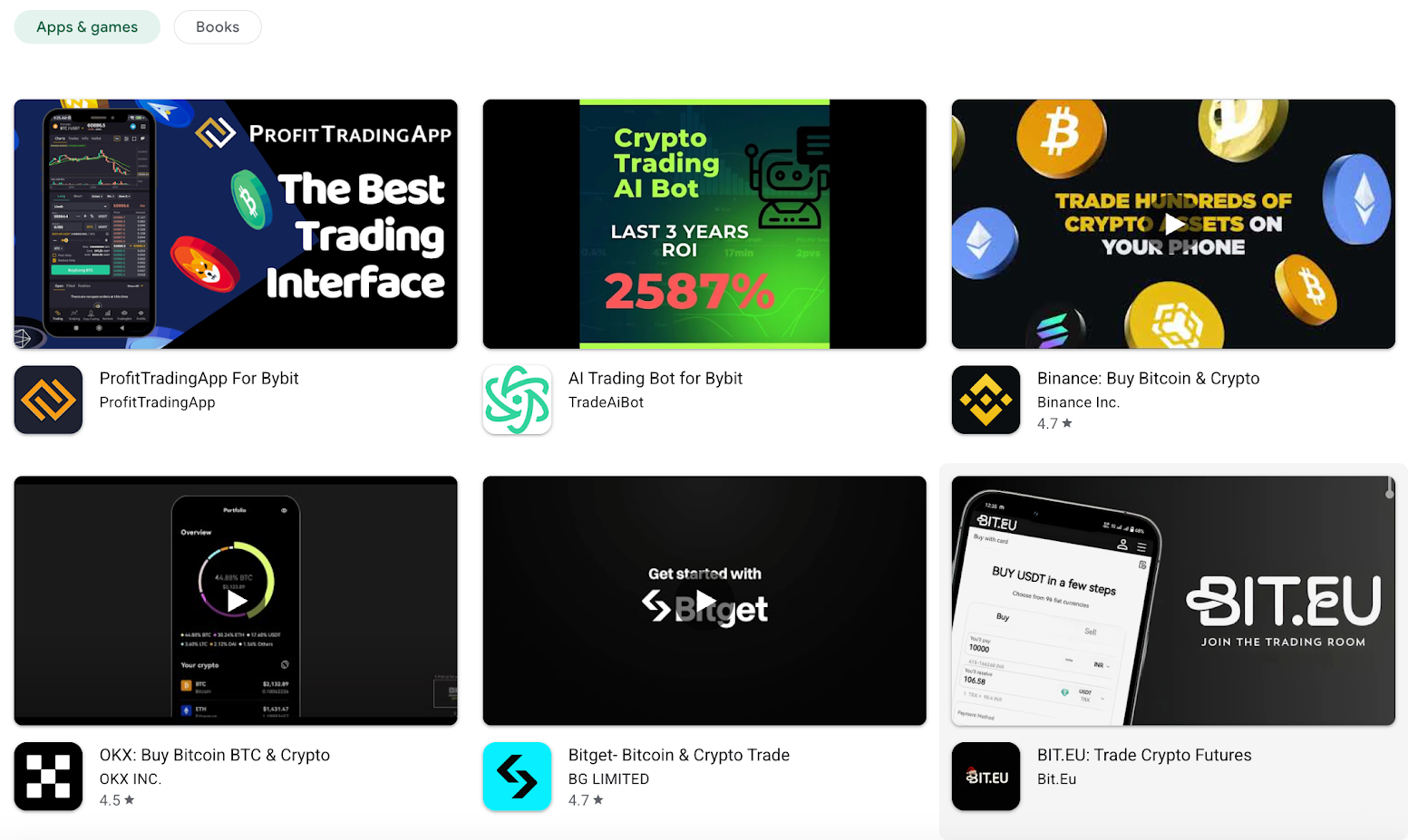
Google Play search results show overseas crypto trading apps available to South Korean users, including OKX and Bitget. Their availability sits alongside South Korea’s VASP compliance requirements, adding another layer of regulatory scrutiny as authorities tighten oversight of overseas crypto activity.
Access to some overseas platforms has already been getting harder for South Korean users outside of this rule change. Google removed Bybit’s app from its Play Store in Korea on July 10, and OKX’s app was pulled on July 24 before being reinstated four days later, on July 28.
Both removals followed the FIU’s designation of unregistered virtual-asset businesses as unreported entities, which triggered Google to restrict downloads and updates for affected apps. OKX, Bybit, Gemini, WhiteBIT and BitMEX were restricted even though none of the five appeared on the FIU’s own list of 14 formally designated platforms. As of July 28, Bybit’s app remained blocked from new downloads and updates in Korea, though users who had already installed it could keep using it.
The finalized framework leaves exchanges responsible for assessing the risk of qualifying overseas transfers rather than automatically reporting every transaction above the threshold.
South Korea plans to begin crypto taxation in January 2027, while lawmakers are considering new proposals to delay the rollout to 2029 or 2030. The government continues to support the scheduled start, leaving the proposed repeal and delay bills in legislative limbo as the tax debate moves forward.
Disclaimer: Cryip's content is strictly for educational and informational purposes and does not constitute financial, legal, or investment advice. Cryptocurrency involves significant risk, and readers assume full responsibility for their own financial decisions. Asset references are never endorsements.
To make complex crypto topics accessible to readers at all experience levels, our team uses AI tools strictly to refine language, correct grammar, and simplify terminology. AI is never used to draft facts, source information, or form conclusions. Every article is fact-checked and approved by a human editor before publication. Read our full AI Use & Content Policy.