



- Citi says it expects to go live with bitcoin custody for institutional clients later this year, built into a new platform called Custody+.
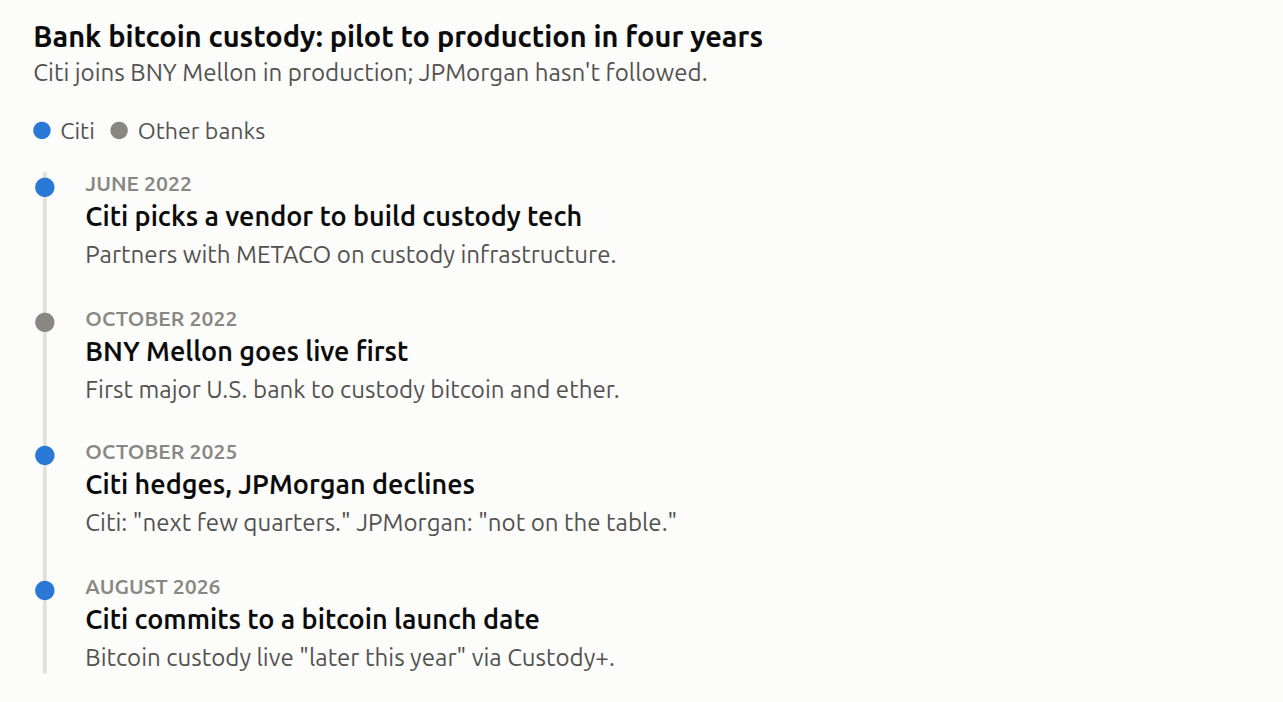
- The commitment replaces a hedged October 2025 comment from a Citi executive that a custody product was still “next few quarters” away.
- JPMorgan told reporters in October 2025 that custody was “not on the table,” a gap Citi’s new deadline now widens.
Citi said Tuesday it will launch its bitcoin custody service by the end of the year, the first time the bank has attached an actual deadline to a plan it had previously described only in hedged terms.
The commitment arrived packaged inside Custody+, a broader suite of near- and real-time custody tools Citi unveiled for asset managers and other institutional investors adjusting to faster settlement cycles. What that platform contains, and where bitcoin fits inside it, is detailed below.
Citi cut its 12-month Bitcoin target to $82,000 and Ether to $2,240, citing ETF outflows, slower U.S. regulation and broader crypto market pressure.
What Custody+ actually adds
Custody+ groups its features into three areas: instant settlement and on-demand foreign exchange; real-time cash and AI-driven tax processing; and infrastructure built for different operating models, which is where digital asset custody sits alongside a white-label platform option for other firms.
Citi cited internal performance numbers to back the launch: more than 80% of the bank’s total event volume is now processed in real time, voluntary corporate action processing time is down 92%, and 96% of U.S. voluntary events are completed in under two hours.
Chris Cox, Citi’s head of investor services, said the bank invests more than $2 billion annually in its platform strategy, with a focus on speed, scale and availability.
Amit Agarwal, Citi’s head of custody, called Custody+ “the product of a multi-year commitment to building infrastructure that matches the speed of our clients’ strategies.”
Bitcoin is named as the starting point for the digital asset piece specifically. Citi says other crypto assets are expected to follow once bitcoin custody is live.
From “next few quarters” to a deadline
In October 2025, Biswarup Chatterjee, Citi’s global head of partnerships and innovation, described the custody plan as still aspirational.
“We’re hoping that in the next few quarters, we can come to market with a credible custody solution,” Chatterjee said at the time. That was a hope, not a plan with a date attached.
JPMorgan, asked about the same subject, went the other way. Scott Lucas, the bank’s global head of markets digital assets, cited risk appetite and regulatory exposure as reasons to stay out of the business.
“Custody is not on the table at the moment,” Lucas said, even as JPMorgan explored crypto trading and stablecoin-linked products instead. Ten months later, Citi has replaced its hedge with a public commitment tied to a launch window.
Part of what changed in between is regulatory. The GENIUS Act, a federal stablecoin framework signed into law in August 2025, gave banks clearer legal footing to build out digital asset infrastructure without the ambiguity that had kept some institutions on the sidelines. Citi’s timeline moved forward inside that same window.
Built on a four-year-old bet
In June 2022, the bank picked Swiss fintech METACO to integrate its Harmonize platform into Citi’s infrastructure, the first concrete step toward digital asset custody. That was four months before BNY Mellon became the first major U.S. bank to actually launch bitcoin and ether custody, in October 2022.
Citi has framed the broader push in its own terms. In a 2026 strategy note, the bank argued that deposits and payments are the foundation of its balance sheet, and that “if value can move instantly elsewhere, it must move seamlessly with us.” That is Citi’s stated reason for building custody and settlement infrastructure that spans both traditional and tokenized assets, rather than treating bitcoin custody as a standalone crypto bet.
Whether this becomes the moment institutional bitcoin custody at a systemically important U.S. bank moves from pilot to routine depends on two things Citi hasn’t yet demonstrated: hitting the stated 2026 window, after a similar timeline already slipped once from 2025 expectations, and shipping a custody product credible enough for the institutional volumes Citi is pitching it to, not a limited pilot dressed up as a launch. If either slips, the “later this year” line becomes just another version of “next few quarters.”
Disclaimer: Cryip's content is strictly for educational and informational purposes and does not constitute financial, legal, or investment advice. Cryptocurrency involves significant risk, and readers assume full responsibility for their own financial decisions. Asset references are never endorsements.
To make complex crypto topics accessible to readers at all experience levels, our team uses AI tools strictly to refine language, correct grammar, and simplify terminology. AI is never used to draft facts, source information, or form conclusions. Every article is fact-checked and approved by a human editor before publication. Read our full AI Use & Content Policy.