




Compound’s decentralized autonomous organization approved a $52 million development program on Aug. 17, the largest budget in the nine-year-old lending protocol’s history, to build the infrastructure needed to serve banks, asset managers and other institutional lenders.
1/ Compound is entering its next era.
Today we’re announcing a new leadership team and a $52M DAO-approved development program,the largest in the protocol’s history, to bring institutional credit onchain.https://t.co/gMJMSVg2ZX
— Compound Foundation (@Compound_xyz) August 17, 2026
The DAO’s own non-native treasury holds $5.95 million, and the protocol earns $2.4 million a year in revenue. The commitment is nearly nine times the treasury and about 22 times annual revenue.
What the money is supposed to buy
Compound Foundation’s governance proposal, posted to the protocol’s forum in April, splits the money into two pieces: $28 million for engineering, integrations and risk systems, and $24 million for institutional partnerships and liquidity.
Funding releases in stages, starting with $14 million in the first year, tied to deliverables such as a new liquidation engine and audits of the protocol’s next major version. The proposal states the goal plainly:
“a trusted and easily integrated credit infrastructure layer for partners, institutions, and distribution platforms”
Running the effort is Aaron Schnarch, the Compound Foundation’s executive director. Schnarch already held that title before this week’s announcement: Compound’s own account showed him presenting as executive director at a Yale Innovation Summit panel on institutional blockchain adoption earlier this year.
The team behind Compound’s institutional push
- Aaron Schnarch – Executive Director, Compound Foundation. Former chief executive, Coinbase Custody.
- Christopher Donovan – Chief Operating Officer. Previously chief operating officer, Near Foundation.
- Steven Liu – Chief Product Officer. Compound says he previously helped grow Maple Finance’s balance sheet from about $500 million to $5 billion.
- Leo Eikelman – Chief Technology Officer.
- Additional hires from Anchorage Digital, HSBC and Broadridge Financial.
The push comes as Compound has fallen well behind its biggest rival. The protocol holds $1.24 billion in deposits, down from a peak of about $12 billion in 2021, a decline of roughly 90%. Aave, by comparison, holds $14.3 billion.
A thin margin underneath the treasury number
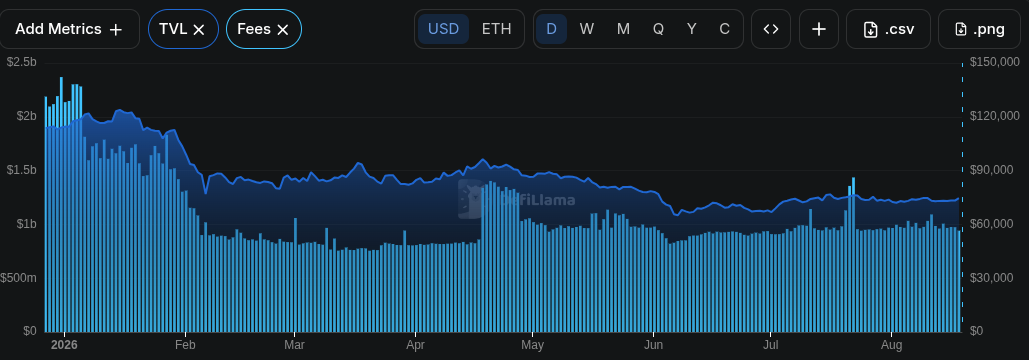
The $5.95 million treasury figure is not a one-time shortfall. Compound’s own dashboard shows the protocol collects $32.87 million a year in fees but keeps only $2.4 million of that as revenue, about 7%. The rest flows through to lenders and suppliers on the platform.
Compound’s $6.21 million in on-chain COMP liquidity is also thin next to the $33 million in COMP that changes hands daily, meaning most trading in the token happens away from Compound’s own markets.
A similar bet already failed
Goldfinch Finance, backed by Andreessen Horowitz and Coinbase Ventures, built a similar model starting in 2021, routing crypto deposits into loans for off-chain borrowers.
The protocol originated about $100 million before widespread defaults forced it to wind down this June. One depositor reported more than $50 million in outstanding loans across eight borrowers, two in default and six being restructured, with realized losses near 70% against a protocol estimate of 20%.
The person who built this protocol reached a different conclusion
Compound’s own founder argued the opposite thesis three years ago. Robert Leshner told the Permissionless conference in Austin in September 2023 that “the institutions aren’t coming,” saying banks and asset managers wanted exposure to traditional assets like stocks and bonds.
He left Compound Labs to found Superstate, a company built around bringing traditional assets onto blockchains rather than adapting DeFi lending for institutional use. Schnarch’s diagnosis today sounds similar. He said DeFi has achieved “limited institutional adoption” because current products fall short of “the traditional finance bar.” The two men reached the same starting observation and chose opposite paths.
- September 2023: Compound founder Robert Leshner says “the institutions aren’t coming” and later leaves to found Superstate, a company focused on tokenizing traditional assets.
- April 6, 2026: Compound Foundation posts the V4 Program Funding Proposal on its governance forum.
- April 18, 2026: An exploit drains roughly 16,776 ETH from rsETH positions linked to Compound and about 13,000 ETH from Aave-linked positions.
- April 28, 2026: Compound proposes contributing up to 3,000 ETH to the “DeFi United” recovery coalition formed after the exploit.
- Spring 2026: The V4 funding proposal is approved through Compound’s governance process.
- June 2026: Goldfinch Finance winds down after widespread borrower defaults.
- Aug. 17-18, 2026: Compound Foundation publicly announces the $52 million program and its expanded leadership team.
Neither Compound’s proposal nor its public statements explain how the $28 million operational portion gets funded against a treasury this size. The DAO approved the program through its standard governance process. The proposal’s milestone structure ties later payments to product deliverables rather than a lump sum.
Those milestones are the clearest test ahead: a liquidation engine, integration kits for Compound’s current version, and completed audits of the next one. Compound has said new institutional products will launch within weeks.
Disclaimer: Cryip's content is strictly for educational and informational purposes and does not constitute financial, legal, or investment advice. Cryptocurrency involves significant risk, and readers assume full responsibility for their own financial decisions. Asset references are never endorsements.
To make complex crypto topics accessible to readers at all experience levels, our team uses AI tools strictly to refine language, correct grammar, and simplify terminology. AI is never used to draft facts, source information, or form conclusions. Every article is fact-checked and approved by a human editor before publication. Read our full AI Use & Content Policy.