


MiniMax Group’s revenue grew 283.1% year on year to $116.6 million in the six months through June, the Shanghai-founded AI company said in its first earnings report since listing on the Hong Kong exchange in January.
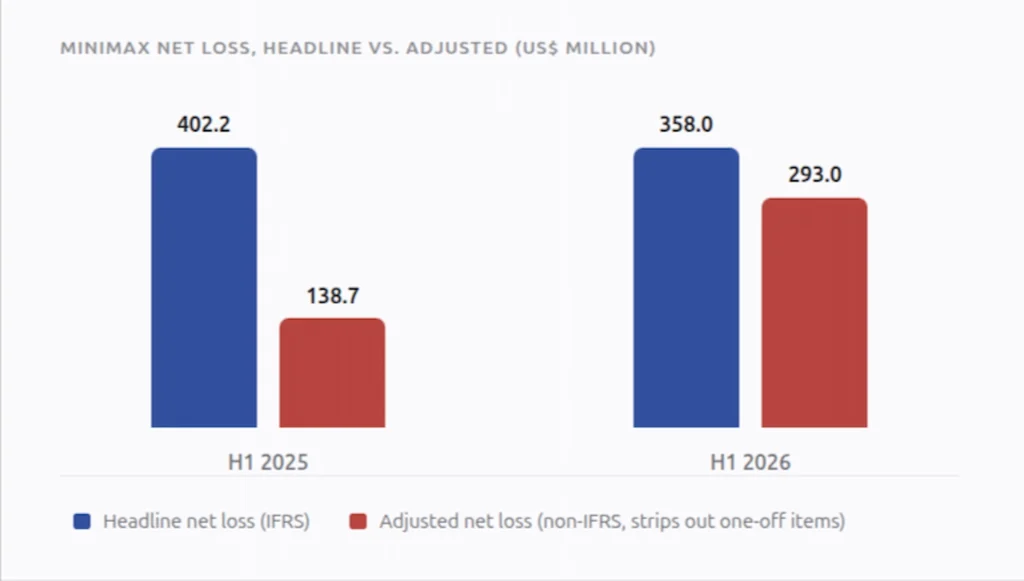
The company also reported a narrower net loss of $358 million, down 11% from $402.2 million a year earlier. MiniMax’s own results summary highlights that figure. What it does not highlight is a second, less favorable number sitting three pages later in the same filing.
That figure is MiniMax’s own adjusted net loss, a non-IFRS measure the company reports to strip out non-cash and one-time items. On that basis, the loss more than doubled, to $293 million from $138.7 million a year earlier.
The reason the two numbers move in opposite directions is specific and mechanical, not a matter of interpretation. A year earlier, MiniMax booked a $253.9 million paper loss from marking its preferred shares to fair value ahead of the IPO. Those shares converted into ordinary equity when the company listed in January, so the charge did not recur this year, which mechanically shrank the headline loss regardless of how the business actually performed. Strip that swing out, and the underlying loss widened as research and development spending jumped 138.8% to $296.9 million, a much faster pace than the 111.2% rise in adjusted losses it helped cause.
Where the growth came from
Most of the revenue growth came from MiniMax’s Open Platform, the API service enterprises and developers use to build on its models. Open Platform revenue grew 703.1% to $73.9 million and now accounts for 63.4% of total revenue, up from 30.3% a year ago, driven by rising API call volumes and adoption of the company’s usage-based Token Plan.
Revenue from MiniMax’s consumer-facing AI-native products, including its Hailuo AI video generator, grew a comparatively slower 100.9% to $42.6 million. The mix shift also came with a geographic trade-off: revenue from outside mainland China fell to 60.8% of the total from 71.8% a year earlier, even as the company describes itself as pursuing a global strategy across more than 230 countries and regions.
A well-funded but widening burn
MiniMax entered the period well capitalized. Cash and near-cash holdings stood at $1.32 billion as of June 30, up from $1.05 billion at the end of 2025, reflecting proceeds from the January listing, which raised roughly $538 million from investors including Alibaba and Tencent.
The company released its MiniMax M3 model during the period and followed with the open-weight MiniMax H3 shortly after, as it competes with rivals including Zhipu AI, Moonshot AI and DeepSeek for enterprise AI customers in China. Zhipu AI, which also listed in Hong Kong this year, is reported to have posted about $107 million in revenue for all of 2025, a fraction of what MiniMax booked in six months alone.
MiniMax has not said when it expects to turn a profit. With research and development spending still growing faster than gross profit, and the accounting boost behind this half’s narrower headline loss unlikely to repeat, the next set of results will show whether revenue growth alone can close the gap. MiniMax is not alone in facing that question: OpenAI’s losses have been growing three times faster than its revenue this year, even as a rival lab turned profitable on a similar growth curve.
Disclaimer: Cryip's content is strictly for educational and informational purposes and does not constitute financial, legal, or investment advice. Cryptocurrency involves significant risk, and readers assume full responsibility for their own financial decisions. Asset references are never endorsements.
To make complex crypto topics accessible to readers at all experience levels, our team uses AI tools strictly to refine language, correct grammar, and simplify terminology. AI is never used to draft facts, source information, or form conclusions. Every article is fact-checked and approved by a human editor before publication. Read our full AI Use & Content Policy.