

The Commodity Futures Trading Commission is telling Americans to slow down before using a crypto ATM. In an advisory titled “Pause Before You Pay”, the agency says anyone instructing a person to move money through one of these machines is very likely running a scam. The warning follows FBI Internet Crime Complaint Center data showing $388,981,267 lost to crypto-kiosk fraud in 2025, a 58% jump from the year before, spread across 13,460 complaints.
#Crypto ATMs might look familiar, but they operate very differently than typical ATMs. Cash deposited into a #CryptoATM is converted into various forms of cryptocurrency, and the transfer is often immediate and irreversible. They also allow criminals to conceal their… pic.twitter.com/S31nzSYC9q
— CFTC (@CFTC) August 26, 2026
Why it matters
Crypto ATMs work like ordinary cash machines but do the opposite of what a bank does. Cash fed into one is converted straight into cryptocurrency and sent to a wallet the sender does not control, and the transfer usually cannot be undone once it clears. The CFTC’s own advisory puts it plainly:
“No government agency, legitimate financial institution, or reputable company will instruct you to move money using crypto ATMs, gift cards, or couriers.”
Adults over 50 bore more than half of 2025’s complaints and over $302 million of the losses, and a separate FinCEN notice found people 60 and older were more than three times as likely as younger adults to report a kiosk loss.
The bigger pattern
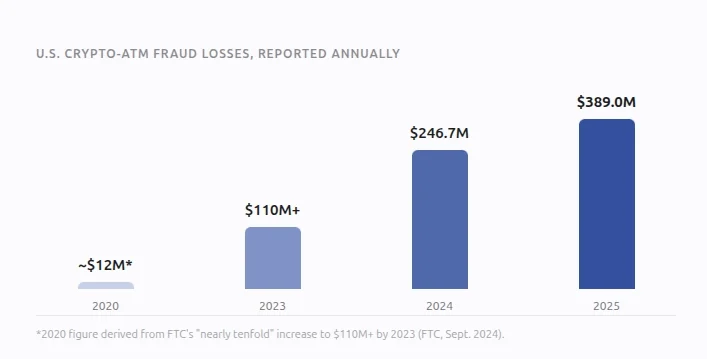
The FBI’s 2025 total is not an isolated spike. FTC data shows crypto-ATM losses climbed nearly tenfold from 2020 to over $110 million in 2023, then to $246.7 million in 2024, according to a FinCEN notice issued that August. What has not kept pace is the machines themselves: FinCEN’s own kiosk count rose from 4,128 in January 2019 to 37,342 by January 2025, about ninefold. Losses over almost the same stretch rose roughly 32-fold. The fraud is scaling faster than the hardware carrying it. Congress has already tried a narrower fix: the proposed Stop Crypto ATM Scams Act, unveiled in June, would cap new users at $2,000 a day, but the bill has not passed.
States are moving faster than Washington
That gap helps explain why state governments have stopped waiting on federal advisories. Hawaii’s new law bars cash deposits into crypto ATMs starting October 1, making it the first state to do so; the FBI logged $3.85 million in Hawaii kiosk losses in 2025, nearly four times 2024’s total.
“It usually starts with some unsolicited phone call, text message or email,” Hawaii Banking Commissioner Dwight Young said, describing how scammers open contact before directing victims to a kiosk.
Tennessee, Minnesota, Indiana and Georgia have each imposed their own crypto-ATM restrictions over the past two years. But banning the kiosk does not touch what feeds it: the exchanges supplying bitcoin to ATM operators sit outside state jurisdiction, so machines can simply relocate to a state that has not yet banned them.
Not every state has picked a ban. Arizona chose refunds and daily transaction caps instead. Its refund program has returned $171,332 to 35 victims in under a year, a fraction of the $177 million Arizonans lost to kiosk fraud in 2024 alone.
For now, the CFTC’s advice is the simplest tool available: treat any unsolicited call, text or email that ends with instructions to visit a crypto ATM as a red flag, hang up, and verify independently before sending anything.
Disclaimer: Cryip's content is strictly for educational and informational purposes and does not constitute financial, legal, or investment advice. Cryptocurrency involves significant risk, and readers assume full responsibility for their own financial decisions. Asset references are never endorsements.
To make complex crypto topics accessible to readers at all experience levels, our team uses AI tools strictly to refine language, correct grammar, and simplify terminology. AI is never used to draft facts, source information, or form conclusions. Every article is fact-checked and approved by a human editor before publication. Read our full AI Use & Content Policy.