


Key Facts
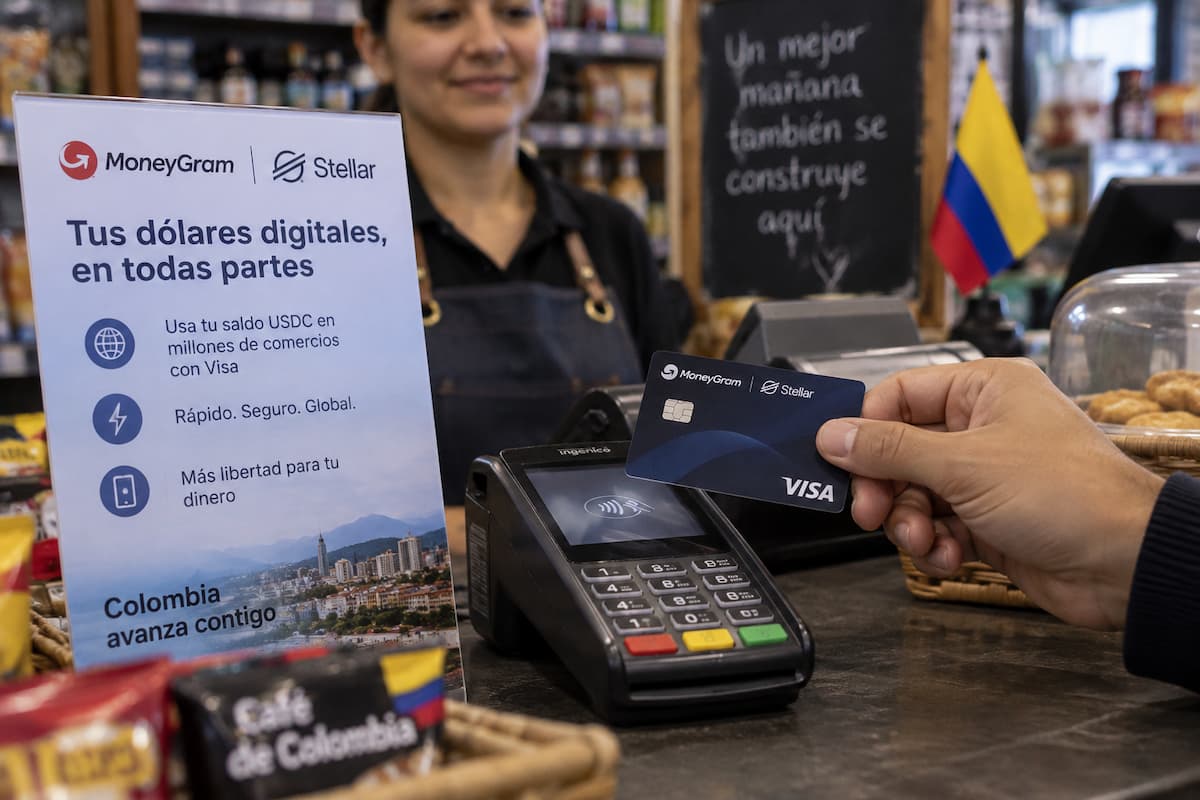
- MoneyGram has launched a Visa card that draws from a USDC stablecoin balance, starting in Colombia.
- The card runs on the Stellar network, extending a partnership MoneyGram has held with the Stellar Development Foundation for years.
- Cardholders can spend stablecoin balances anywhere Visa is accepted, without a separate conversion step at checkout.
MoneyGram has launched a Visa card that draws directly from a USDC stablecoin balance, starting with users in Colombia, extending a blockchain partnership the company first announced with the Stellar Development Foundation years earlier. The card’s function is simple to describe and harder to build than it sounds: a user holding stablecoins gets to spend them at any merchant that accepts Visa, without first manually converting that balance into local currency through a separate exchange step.
The Problem This Card Is Actually Solving
Stablecoins have solved cross-border transfer speed reasonably well; sending USDC across a network like Stellar settles in seconds at a fraction of the cost of a traditional wire. What stablecoins have not solved on their own is the last mile: a merchant at a corner store does not accept USDC, and most people are not going to open a crypto wallet app and route through a decentralized exchange before buying groceries. A card that sits on top of a stablecoin balance and converts it into a normal card payment at the point of sale is the specific piece of infrastructure needed to close that gap, and it is why a remittance company rather than a crypto-native firm is the one building it.
MoneyGram’s core business, moving money for people who send remittances internationally, gives it a reason to care about this problem that a typical crypto exchange does not have. Remittance recipients are often the population most exposed to local currency volatility and the highest transaction fees in the traditional system, which is exactly the group that benefits most from holding value in a dollar-pegged stablecoin and spending it directly, rather than converting in and out of local currency at each step.
Why Colombia First, and What Comes Next
Launching in a single market before any wider rollout is a deliberate and standard approach for a regulated financial product tied to card networks, since card issuance requires separate banking and compliance relationships in each jurisdiction. Colombia’s large remittance-receiving population and its relatively developed digital payments infrastructure make it a reasonable first market to prove the product works end to end, from stablecoin custody through to point-of-sale settlement, before MoneyGram takes on the added compliance complexity of expanding into other countries.
Disclaimer: Cryip's content is strictly for educational and informational purposes and does not constitute financial, legal, or investment advice. Cryptocurrency involves significant risk, and readers assume full responsibility for their own financial decisions. Asset references are never endorsements.
To make complex crypto topics accessible to readers at all experience levels, our team uses AI tools strictly to refine language, correct grammar, and simplify terminology. AI is never used to draft facts, source information, or form conclusions. Every article is fact-checked and approved by a human editor before publication. Read our full AI Use & Content Policy.