Cryip
  • Home
  • Crypto News Today
  • Research & Analysis
  • Learn Crypto
No Result
View All Result
Cryip
  • Home
  • Crypto News Today
  • Research & Analysis
  • Learn Crypto
No Result
View All Result
Cryip
No Result
View All Result
Home Crypto News Today Scams & Fraud

DOJ Restrains $52 Million in Crypto With Tether’s Help in Scam Center Case

Akil Prasath LV by Akil Prasath LV
September 12, 2026
in Scams & Fraud
0 0
Share on FacebookShare on Twitter
MakeCryipCryippreferred onGoogle

Key Facts

  • The DOJ’s Scam Center Strike Force restrained $52 million in laundered cryptocurrency in a single day.
  • The action targeted a Chinese-run illicit scammer marketplace and its associated crypto flows.
  • Restraining the funds relied on cooperation from a stablecoin issuer able to freeze tokens at the smart-contract level.

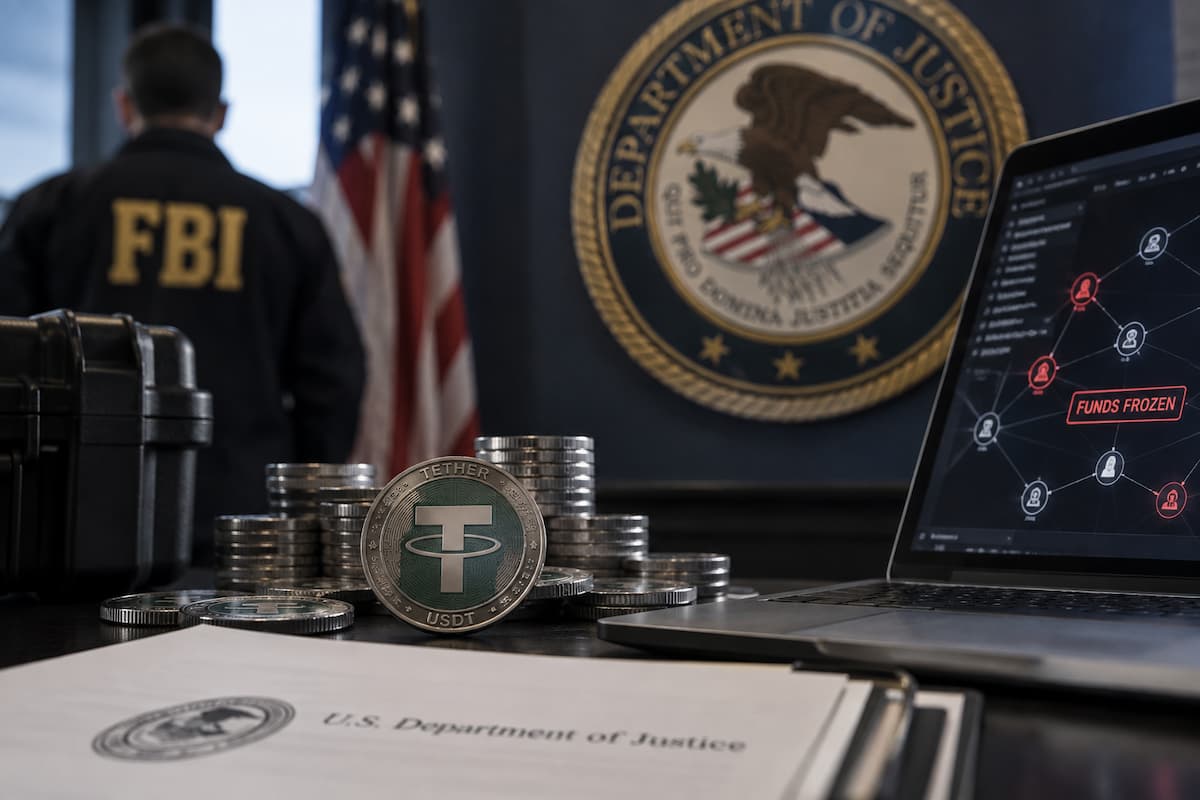
The Department of Justice’s Scam Center Strike Force restrained $52 million in laundered cryptocurrency in a single day, according to the U.S. Attorney’s Office for the District of Columbia’s own press release, as part of a broader action against a Chinese-run illicit scammer marketplace. The dollar figure is large enough to be the headline, but the more consequential detail sits in how the money was actually restrained, not just how much of it was.

Why a Stablecoin Freeze Is a Different Tool Than a Seizure

A traditional asset seizure requires law enforcement to physically locate and take control of funds, a process that gets dramatically harder once money has moved through several wallets and jurisdictions. A stablecoin issuer, by contrast, can freeze tokens at the smart-contract level on request from law enforcement acting under proper legal authority, effectively rendering specific token addresses unable to move regardless of who holds the private keys. That capability, built into how major stablecoins are architected, is what let this restraint happen in a single day rather than the weeks or months a traditional cross-border asset-tracing effort typically takes.

This detail also reframes what a stablecoin actually is from a law enforcement perspective. Bitcoin’s design makes freezing a specific address technically impossible; the protocol has no central party capable of doing it. A stablecoin like Tether’s USDT is issued by a company that retains exactly that capability by design, which is precisely why it appears so often in law enforcement press releases about restraining, not just tracking, illicit crypto flows. The same centralization that critics of stablecoins point to as a departure from crypto’s original design principles is the mechanism that made this specific $52 million restraint possible.

What “Restrained” Does and Does Not Mean

Restraining funds is not the same as forfeiting them to the government permanently; it is closer to a freeze pending further legal process, which still requires the DOJ to pursue civil or criminal forfeiture proceedings before the funds are formally transferred. The DOJ’s release frames this as one action within a broader ongoing strike-force effort against scam center networks, which are a distinct and rapidly growing category of organized fraud, often run out of Southeast Asia, that specifically launder proceeds from romance and investment scams through crypto rails. A single day’s $52 million restraint is a meaningful strike against that infrastructure, but it is one action against a network whose total scale, based on how the DOJ itself frames the broader strike-force mission, is understood to be far larger than any single case.

Disclaimer: Cryip's content is strictly for educational and informational purposes and does not constitute financial, legal, or investment advice. Cryptocurrency involves significant risk, and readers assume full responsibility for their own financial decisions. Asset references are never endorsements.

To make complex crypto topics accessible to readers at all experience levels, our team uses AI tools strictly to refine language, correct grammar, and simplify terminology. AI is never used to draft facts, source information, or form conclusions. Every article is fact-checked and approved by a human editor before publication. Read our full AI Use & Content Policy.

Tags: United States
Akil Prasath LV

Akil Prasath LV

Related Posts

Policy & Regulation

SEC and CFTC start acting like one crypto regulator instead of two

by Saravana Kumar Mahendran
September 12, 2026

The SEC and CFTC have moved forward on a joint harmonization initiative meant to align how each agency treats digital...

Read moreDetails

Nasdaq Invests $100 Million in Kraken Parent Payward, Locking In Its Tokenization Partner

September 10, 2026

Hunter Biden’s LAPTOP Token Is Still Crashing Hours After Its 99% Debut Plunge

September 10, 2026
California Set to Become First State to Ban Officials From Issuing Meme Coins

How Trump’s $TRUMP Coin Led California to Ban Officials From Meme Coins

August 28, 2026
Ripple Prime Launches Delta One, Opening Total Return Swaps on US Stocks

Ripple Prime Expands Into US Stock Trading With Delta One Launch

August 27, 2026 - Updated on August 28, 2026
CFTC Warns of Rising Crypto ATM Fraud as Losses Hit $388 Million in 2025

CFTC Warns of Rising Crypto ATM Fraud as Losses Hit $388 Million in 2025

August 27, 2026
Most Americans Call Crypto Risky for Retirement Savings Washington Disagrees.

Most Americans Call Crypto Risky for Retirement Savings Washington Disagrees.

August 27, 2026

Recommended

  • All
  • Crypto News Today

Revolut Suspected of Leaking Customer Data After Fake Government Request

September 12, 2026

A firmware bug in a popular hardware wallet became this year’s largest cold-storage exploit

September 12, 2026

SEC and CFTC start acting like one crypto regulator instead of two

September 12, 2026

Solana ships its biggest transaction upgrade in years, and token launches hit a new daily record

September 12, 2026

Bitcoin: Exchange balances keep shrinking as large holders keep buying

September 12, 2026

A ransom refused, and a vendor breach that wasn’t Trezor’s own

September 12, 2026

Regulation: India opens a tokenization channel as Europe tightens one

September 11, 2026

Ethereum & Altcoins: ETH outpaces bitcoin as Glamsterdam eyes October 6

September 11, 2026

Cryip focuses on crypto research and on-chain analysis, supported by coverage of markets, regulation, security events, and blockchain ecosystems.

Recent Posts

  • DOJ Restrains $52 Million in Crypto With Tether’s Help in Scam Center Case
  • Revolut Suspected of Leaking Customer Data After Fake Government Request
  • A firmware bug in a popular hardware wallet became this year’s largest cold-storage exploit

Categories

  • AI News
  • Data & Dashboards
  • DeFi Basics
  • Investing Basics
  • Market & Price
  • Market Updates
  • On-Chain Analysis
  • OpSec
  • Policy & Regulation
  • Post Mortems
  • Press Release
  • Reports
  • Research & Analysis
  • Scams & Fraud
  • Security & Hacks
  • Stablecoins
  • Tokenomics
  • VC & Funding
  • Wallets & Custody

Company

  • About Us
  • Contact Us
  • Editorial Standards & Integrity
  • Our Team
  • Privacy Policy
  • Review Methodology
  • Terms and Conditions
  • Trust, Disclosures & Independence

© 2026 Cryip - Research-Driven Crypto Analysis & News by Hashlays.

Welcome Back!

Login to your account below

Forgotten Password?

Retrieve your password

Please enter your username or email address to reset your password.

Log In

Add New Playlist

No Result
View All Result
  • Home
  • Crypto News Today
  • Research & Analysis
  • Learn Crypto

© 2026 Cryip - Research-Driven Crypto Analysis & News by Hashlays.

This website uses cookies. By continuing to use this website you are giving consent to cookies being used. Visit our Privacy and Cookie Policy.