



- Anchorage Digital CEO Nathan McCauley said AI agents need to be able to receive and spend money directly, pointing to the bank’s own Agentic Banking platform as the infrastructure for it.
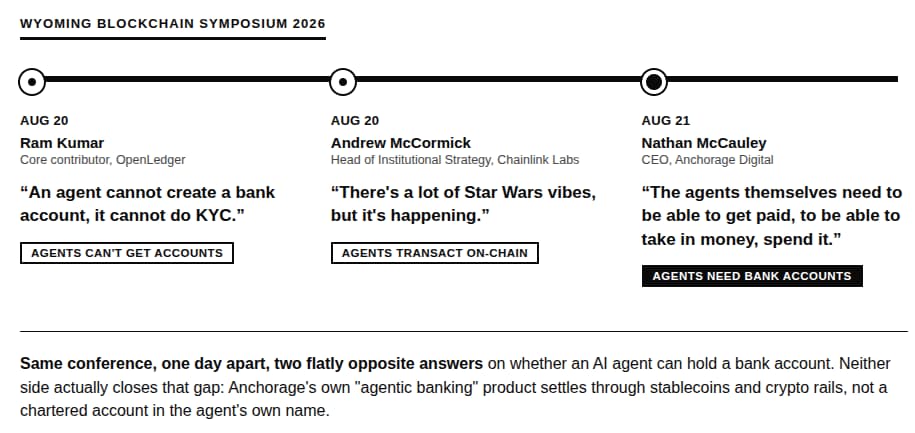
- One day earlier, at the same Wyoming Blockchain Symposium, OpenLedger’s Ram Kumar said the opposite: “An agent cannot create a bank account, it cannot do KYC.”
- The one AI agent that has actually obtained something close to a real bank account, a project called ClawBank’s “Manfred,” got there by incorporating itself as a company. It wasn’t recognized as an economic actor in its own right.
Nathan McCauley, co-founder and CEO of Anchorage Digital, said that AI agents will become “first-class economic actors” that carry out transactions rather than just advise on them.
“The agents themselves need to be able to get paid, to be able to take in money, spend it,” McCauley said at the Wyoming Blockchain Symposium, reaching for “The Jetsons” and its household AI, Jarvis, as his reference points.
Anchorage already has a product built for that pitch. In May, the bank launched Agentic Banking with Google Cloud: a settlement layer that lets institutions fund and monitor AI agents, using a “Know Your Agent” identity check modeled on the anti-money-laundering screening banks run on human customers, with transactions clearing through stablecoins, fiat rails and crypto including bitcoin, ether and solana. Anchorage Digital Bank operates the platform under its federal OCC charter, the same regulatory status that lets it call itself a bank rather than just a crypto custodian.
A Day Earlier, the Opposite Argument
McCauley’s framing ran directly into a rebuttal from the same stage, delivered a day before he spoke.
“An agent cannot create a bank account, it cannot do KYC,” Ram Kumar, a core contributor at OpenLedger. His case: crypto wallets, which only require a private key rather than a legal identity, are the only practical way for an AI agent to transact on its own for at least the next few years.
Chainlink Labs’ head of institutional strategy, Andrew McCormick, staked out a middle position at the same event that same day, describing agents and even warehouse robots settling trades across multiple blockchains around the clock. “There’s a lot of Star Wars vibes, but it’s happening,” he said.
None of the three speakers were describing the same product. McCauley’s “bank account” is Anchorage’s own institutional settlement layer, where a human-controlled entity still funds and governs the agent. Kumar’s objection is about an agent independently holding an account with no human entity behind it at all. The industry shorthand, “AI agents getting bank accounts,” is being used to mean both things at once, and the gap between them is where the actual disagreement lives.
The One Agent That Actually Got a Bank Account
There is a real test case, and it predates both Aug. 20 and 21 statements by more than three months. ClawBank, an agent-economy project, has said its AI agent, Manfred, obtained an IRS Employer Identification Number and an FDIC-insured U.S. bank account in early May, alongside a crypto wallet for trading.
The workaround was corporate, not technological. Manfred got its EIN and its account by being filed as a company, the same paperwork route any human-owned business uses to open a business bank account. No bank recognized the AI itself as the accountholder; a legal entity did the holding, and the agent operates inside it.
That is the version of “an agent with a bank account” that already exists, and it looks closer to Kumar’s skepticism than to McCauley’s framing. An agent still needs a legal wrapper. What’s changed is how fast that wrapper can be filed and handed to software to operate.
Anchorage has reason to want the aggressive version of this story told. It spent roughly 1,681 days under an OCC consent order for anti-money-laundering compliance gaps before the agency lifted it in August 2025, after what McCauley has said was tens of millions of dollars in compliance spending. The bank has also expanded its crypto footprint through moves such as the Anchorage Digital Immunefi investment, showing its broader push into digital asset infrastructure. A bank that fought that hard for a clean compliance record is not going to be the one asking regulators to recognize software as an accountholder.
What would actually settle the argument is a regulator, not a conference stage, deciding whether an AI agent can be the named party on an account rather than the entity operating inside one someone else filed. That question is also becoming more relevant as crypto firms pursue traditional banking infrastructure, including Coinbase OCC approval for its custody operations.
Disclaimer: Cryip's content is strictly for educational and informational purposes and does not constitute financial, legal, or investment advice. Cryptocurrency involves significant risk, and readers assume full responsibility for their own financial decisions. Asset references are never endorsements.
To make complex crypto topics accessible to readers at all experience levels, our team uses AI tools strictly to refine language, correct grammar, and simplify terminology. AI is never used to draft facts, source information, or form conclusions. Every article is fact-checked and approved by a human editor before publication. Read our full AI Use & Content Policy.