




- Bankers associations from 39 U.S. states announced BankChain Alliance on August 25, 2026, an industry-owned blockchain network open to banks of any size.
- Kathy Kraninger, president and CEO of the Florida Bankers Association, is serving as interim chair.
- The network is aimed at tokenized deposits, bank-issued stablecoins and automated settlement, targeting a 2027 launch with no technology vendor chosen yet.
Bankers associations from 39 U.S. states, including Texas, Florida and Iowa, said Tuesday they are building BankChain Alliance, an industry-owned blockchain network meant to let banks of every size issue tokenized deposits and bank-backed stablecoins under their own governance.
Kathy Kraninger, the Florida Bankers Association’s president and CEO, will serve as interim chair. The alliance has not picked a technology vendor and is targeting a 2027 launch.
“Through an unprecedented collaboration representing thousands of banks, BankChain Alliance is developing a secure, regulated, industry-built and industry-owned network,” Kraninger said.
Chris Furlow, president and CEO of the Texas Bankers Association, said the coalition gives smaller banks leverage they would not have alone.
Today, we are proud to announce our participation in the BankChain Alliance, joining state banking associations from across the country in a collaborative effort to explore an industry-owned, bank-governed, banking network designed to support innovation while preserving the… pic.twitter.com/ff9e4h9IVY
— Texas Bankers Association (@texasbankers) August 25, 2026
“Bringing so many state bankers associations together gives Texas community banks and Main Street banks across the country a practical path to participate in new financial technologies while keeping the needs of their customers and local communities in focus,” Furlow said.
The fourth bank blockchain effort in eight months
BankChain Alliance is not the first bank-led push into tokenized deposits this year. The Clearing House, owned by 16 money-center banks including JPMorgan Chase, Bank of America, Wells Fargo and BNY, launched its own on-chain settlement initiative in June. The same coalition has also pushed regulators to keep stablecoin KYC checks at the issuer level rather than across every wallet transfer. Cari Network, a separate bank-governed tokenized deposit system with more than 30 member banks holding over $10 trillion in combined assets, expanded through the American Bankers Association in July. In Texas, the Independent Bankers Association of Texas had already funded a pilot consortium called DTX in December.
Corey LeBlanc, co-founder and chief technology officer of Locality Bank, said state associations chose to build their own network rather than default to those existing options because governance mattered as much as access to the technology.
“We can go sign with Cari. But ownership and voice matters,” LeBlanc said.
That tension, more than competition with crypto stablecoins alone, is why a fourth industry effort launched this week instead of banks simply joining one already running. The pull toward banding together isn’t unique to the U.S. either: Japan’s top banks are pursuing a joint stablecoin launch of their own by fiscal 2026.
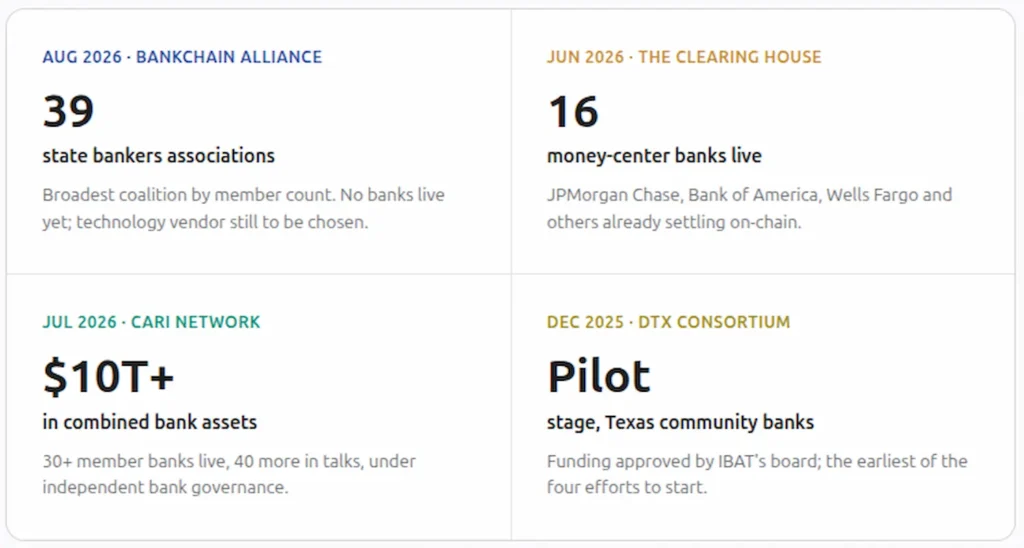
BankChain Alliance still has to select a technology vendor and prove its network works across all 39 participating states before any tokenized deposit or stablecoin reaches a bank customer. Its own materials already describe the planned network as interoperable with other systems, a detail that could blunt some of that overlap before it turns into open competition. Whether it ends up interoperating with the Clearing House’s and Cari’s networks, or competing with them for bank membership, is the question its 2027 target will have to answer.
Kraninger, who was Senate-confirmed to lead the CFPB in 2018, brings a regulatory pedigree that fits the alliance’s stated focus on staying inside existing banking rules. The effort also lands as Congress has stalled the CLARITY Act, the federal bill meant to set clearer digital-asset market-structure rules, after the Senate pushed its vote past the August recess to September. Without that federal clarity, a bank-owned network gives 39 state associations a way to move on tokenized deposits without waiting for Washington to finish the job.
Disclaimer: Cryip's content is strictly for educational and informational purposes and does not constitute financial, legal, or investment advice. Cryptocurrency involves significant risk, and readers assume full responsibility for their own financial decisions. Asset references are never endorsements.
To make complex crypto topics accessible to readers at all experience levels, our team uses AI tools strictly to refine language, correct grammar, and simplify terminology. AI is never used to draft facts, source information, or form conclusions. Every article is fact-checked and approved by a human editor before publication. Read our full AI Use & Content Policy.