


- Bison Bank and DK Bank began generating wallets and moving digital assets on a quantum-resistant NEAR testnet on August 24, 2026, watched by regulators from Abu Dhabi, Bhutan, and Malta.
- The pilot signs transactions with ML-DSA-65, the NIST-standardized post-quantum algorithm, split across a non-custodial 2-of-2 key setup so no single party controls a wallet alone.
- It is the first bank-facing test of the exact signing scheme NEAR’s engineering team said in May it would ship to testnet, and the first to test post-quantum cryptography at the wallet layer rather than the payment-messaging layer.
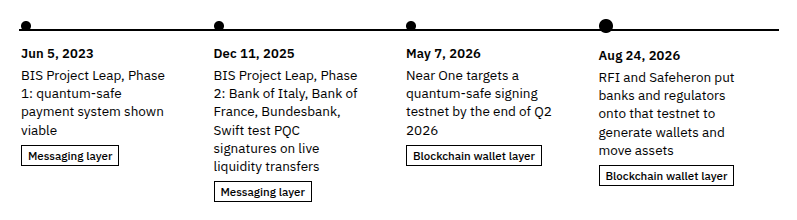
Two banks and three financial regulators started testing quantum-resistant crypto wallets on August 24, in a pilot organized by the Responsible Fintech Institute (RFI) and the custody vendor Safeheron.
Two Banks, One Key Split in Half
Bison Bank, a Portuguese private bank that runs a dedicated digital-assets subsidiary, and DK Bank are generating wallets and sending on-chain transfers on a quantum-resistant version of the NEAR testnet. Regulators from Abu Dhabi Global Market, Bhutan’s Gelephu Financial Services Office, and Malta’s Financial Services Authority are observing. The signing itself uses ML-DSA-65, the digital-signature standard NIST finalized under FIPS 204, making it central to the pilot’s use of NIST-approved quantum signatures, split across a non-custodial 2-of-2 multi-party computation setup, meaning a wallet only signs when both parties agree, and neither one holds the full key alone.
A Different Layer Than BIS Tested
That wallet-layer focus is what separates this from earlier bank-grade tests of post-quantum cryptography. The Bank for International Settlements ran the previous major test, Project Leap, with the Bank of Italy, the Bank of France, Deutsche Bundesbank, and Swift, publishing results in December 2025 that showed post-quantum signatures could secure live payment-messaging transfers. The development also reflects broader industry efforts around Ethereum quantum safety, as major blockchain networks prepare for potential quantum threats.
- The earlier test focused on the messaging layer within established payment rails.
- This is the first bank-facing financial test to shift post-quantum cryptography from payment messaging to a blockchain wallet layer, with the bank holding a portion of the signing key.
- Near One, NEAR’s engineering team, said in May that it aimed to run the same signing scheme on testnet by the end of Q2 2026.
- The pilot now places banks on that testnet about two months beyond that target.
“By bringing policymakers and financial institutions across jurisdictions together to test the same post-quantum architecture,” said Chia Hock Lai, RFI’s chairman, of the pilot’s purpose.
Who’s Behind the Pilot
RFI is a nonprofit that launched less than a year ago, in September 2025. Safeheron, which supplies the MPC protocol being tested, is a commercial custody vendor that has raised outside funding and previously partnered with MetaMask.
It stands to benefit if this protocol becomes an industry standard, worth noting since it co-designed the architecture it’s now helping test.
What’s Next
RFI says it plans to publish a whitepaper on the pilot’s findings and eventually open-source the underlying protocol. More banks and regulators are reportedly in discussions to join later phases, which will add governance work to the technical testing already underway.
Disclaimer: Cryip's content is strictly for educational and informational purposes and does not constitute financial, legal, or investment advice. Cryptocurrency involves significant risk, and readers assume full responsibility for their own financial decisions. Asset references are never endorsements.
To make complex crypto topics accessible to readers at all experience levels, our team uses AI tools strictly to refine language, correct grammar, and simplify terminology. AI is never used to draft facts, source information, or form conclusions. Every article is fact-checked and approved by a human editor before publication. Read our full AI Use & Content Policy.