




- Bitmine transferred 160,480 ETH worth approximately $248.7 million into staking wallets, according to blockchain.
- The transfers were executed through multiple transactions before being consolidated into a single destination wallet, indicating treasury management rather than exchange activity.
- The company has now staked around 4.88 million ETH, representing approximately 86% of its total Ethereum holdings.
- The latest staking operation follows major ETH purchases earlier this week, continuing Bitmine’s aggressive Ethereum accumulation strategy.
- Bitmine is set to join the Russell 1000 Index on June 26 after the market close, potentially increasing visibility among institutional investors and index-tracking funds.
- Ethereum traded lower despite the institutional activity, highlighting that broader market sentiment continues to outweigh individual corporate treasury moves.
Bitmine has transferred another 160,480 ETH, valued at approximately $248.7 million, into staking wallets, according to blockchain tracking data published on June 26 at 04:31 UTC. The latest on-chain activity further expands the company’s participation in Ethereum’s proof-of-stake network and strengthens its position among the largest known institutional holders of the cryptocurrency.
The transfers come only days after Bitmine disclosed additional Ethereum purchases that pushed its total treasury to approximately 5.67 million ETH. With the latest deposits, roughly 4.88 million ETH, or about 86% of the company’s holdings, are now committed to staking. The move reflects a broader institutional trend of deploying treasury assets to generate staking rewards rather than holding large balances in inactive wallets.
Multiple Wallet Transfers Suggest Internal Treasury Allocation
Blockchain data shows the staking operation was carried out through several separate transactions rather than a single transfer.
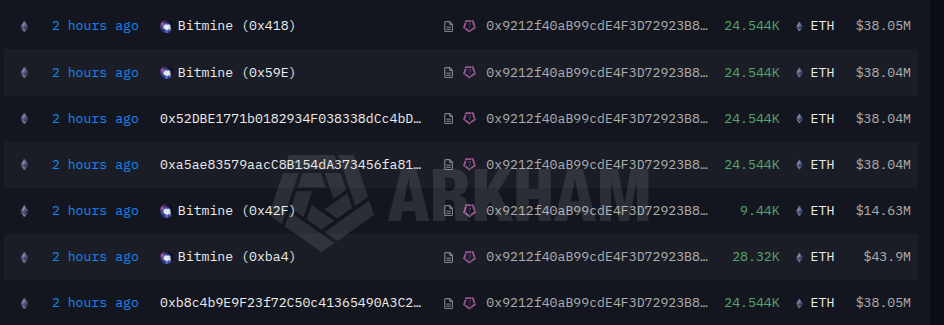
The recorded transfers included:
- Five transactions of 24,544 ETH each
- One transaction of 28,320 ETH
- One transaction of 9,440 ETH
- All transfers were directed to the same destination wallet
The transaction pattern indicates an internal treasury allocation process rather than deposits to a cryptocurrency exchange. Large organizations frequently distribute assets across operational wallets before consolidating them into validator or staking addresses for security and treasury management purposes.
Institutional Staking Strategy Continues to Expand
The latest deposits reinforce Bitmine’s strategy of treating Ethereum as an income-generating treasury asset instead of maintaining it solely as a reserve. By staking Ethereum, companies participate in securing the Ethereum blockchain while earning validator rewards. This approach has become increasingly attractive for corporate treasury managers seeking long-term exposure to digital assets without leaving substantial holdings idle.
However, staking also involves trade-offs. While it generates recurring rewards, staked assets become less liquid and remain exposed to Ethereum’s price fluctuations. Institutions must therefore balance expected staking yields against operational risks, liquidity requirements, and changing market conditions.
Bitmine’s decision to stake nearly nine-tenths of its Ethereum holdings signals confidence in Ethereum’s proof-of-stake ecosystem and a preference for long-term participation over short-term trading flexibility.
Latest Activity Builds on Recent Ethereum Purchases
The new staking transactions follow a series of major treasury additions announced earlier this week.
Recent Ethereum activity includes:
- June 22: Bitmine acquired 52,203 ETH, increasing its treasury holdings.
- June 23: The company added another 35,138 ETH, continuing its accumulation strategy.
- June 26: An additional 160,480 ETH was transferred into staking wallets, lifting total staked holdings to approximately 4.88 million ETH.
The sequence illustrates a coordinated treasury approach in which newly acquired Ethereum is gradually deployed into staking rather than remaining liquid.
Russell 1000 Inclusion Expands Institutional Visibility
Alongside its growing Ethereum treasury, Bitmine is set to join the Russell 1000 Index on June 26, with the latest FTSE Russell index reconstitution taking effect after the U.S. market closes. The 2026 reconstitution also marks the return of semi-annual Russell rebalancing, bringing additional attention to newly added companies.
The inclusion could increase trading activity because many passive funds and large institutional asset managers track Russell benchmarks and rebalance their portfolios to reflect index changes. While inclusion does not guarantee sustained buying pressure, it can improve liquidity and introduce Bitmine to a broader institutional investor base.
Bitmine had already attracted market attention because of its rapidly expanding Ethereum balance sheet. However, the company’s shares remain closely tied to Ethereum’s performance, meaning fluctuations in ETH prices are likely to continue influencing its valuation despite the increased visibility from joining the Russell 1000.
Market Reaction Remains Muted
Despite one of the largest recent institutional staking transactions, Ethereum’s market price showed little immediate response. As of 06:44 UTC, ETH traded at $1,569.30, down 4.95% over the previous 24 hours. The cryptocurrency’s market capitalization stood at approximately $189.38 billion, while 24-hour trading volume reached $17.24 billion.
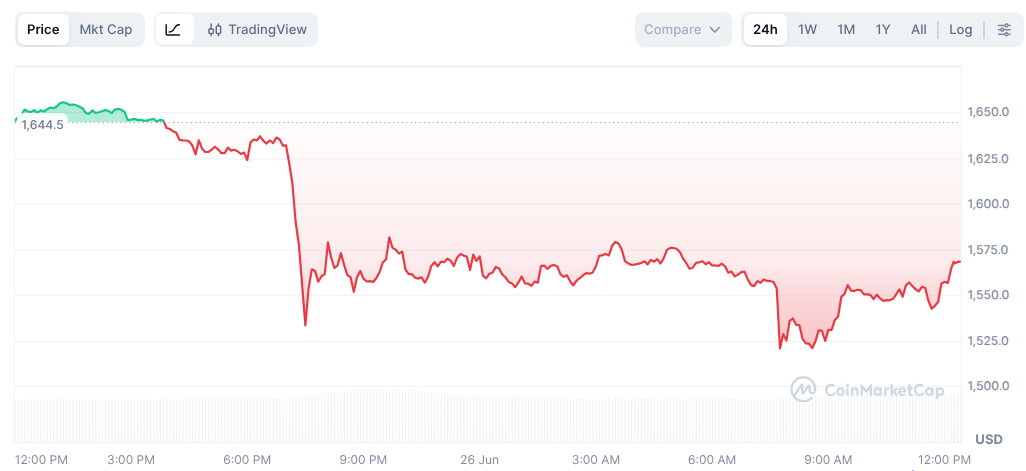
The decline reflects broader weakness across the digital asset market, suggesting macroeconomic conditions and overall investor sentiment continue to have a greater influence on short-term price movements than individual corporate treasury actions.
Nevertheless, Bitmine’s continued accumulation and staking activity highlights how institutional participants are increasingly viewing Ethereum as both a strategic reserve asset and a source of staking income, even during periods of market volatility.
Disclaimer: Cryip's content is strictly for educational and informational purposes and does not constitute financial, legal, or investment advice. Cryptocurrency involves significant risk, and readers assume full responsibility for their own financial decisions. Asset references are never endorsements.
To make complex crypto topics accessible to readers at all experience levels, our team uses AI tools strictly to refine language, correct grammar, and simplify terminology. AI is never used to draft facts, source information, or form conclusions. Every article is fact-checked and approved by a human editor before publication. Read our full AI Use & Content Policy.