




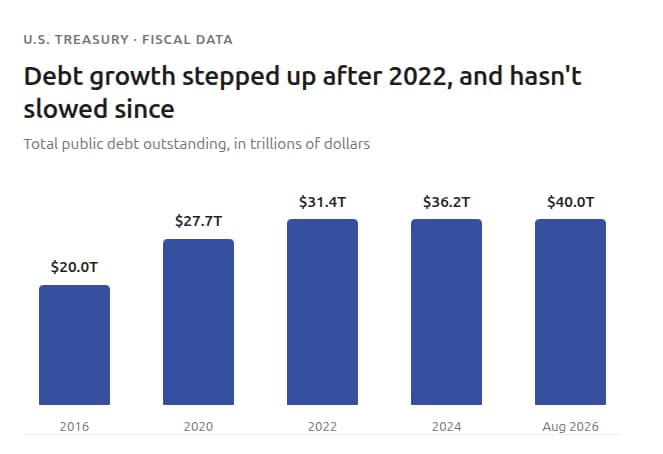
The United States’ total public debt crossed $40.035 trillion on August 24, Treasury Department data show. Robert Mitchnick, BlackRock’s head of digital assets, says that number, rather than Washington’s stalled crypto legislation, is what moves bitcoin from here. Mitchnick said this week that the fiscal situation is the most important fundamental driver bitcoin has ahead of it. He pointed to:
- A federal government now paying close to $970 billion a year in interest.
- A bill that eats up roughly 14% of total spending, on par with the defense budget.
- $32.27 trillion held by the public and $7.76 trillion the government owes itself.
- Debt that has roughly doubled since 2017.
The debt itself splits into $32.27 trillion held by the public and $7.76 trillion the government owes itself, and it has roughly doubled since 2017.
Why U.S. Debt Could Become Bitcoin’s Bigger Catalyst
That framing breaks from what has driven the bitcoin trade since spot ETFs launched in 2024. Mitchnick said the CLARITY Act, the crypto market structure bill stalled in Congress, matters less for bitcoin than for other tokens, since bitcoin already has SEC approved ETFs and a bipartisan consensus that it counts as a commodity, not a security. The latest BlackRock ETF filing also reflects the firm’s continued expansion of its bitcoin-focused offerings. In effect, BlackRock’s own crypto chief is telling investors to stop waiting on a bill and start watching the deficit instead.
That claim is easy to check against what happens next. If bitcoin catches a real bid the next time a debt or deficit headline spooks markets, and shrugs off whatever Congress does or does not pass on crypto rules, Mitchnick’s framing holds. If it keeps trading on ETF flows and regulatory news the way it has for most of the past two years, it does not.
Why Mitchnick’s Earlier Warning Still Matters
In February, he warned that leverage driven volatility was undermining bitcoin’s institutional narrative, the same narrative he is now leaning on to make the debt case.
An asset pitched as a clean hedge against government debasement is also, by his own account, prone to swings driven by borrowed money in the futures market. That tension does not show up in the highlight-reel version of BlackRock’s pitch.
BlackRock’s own fund has already priced in some of the optimism. IBIT held $60.65 billion in bitcoin as of August 25, and US spot bitcoin ETFs pulled in roughly $232 million in new money that same week. BlackRock’s broader bitcoin product lineup also includes the BlackRock BITA Bitcoin Income ETF, formally known as the iShares Bitcoin Premium Income ETF. Whether that keeps growing now depends less on Congress than on how nervous Washington’s balance sheet makes the rest of the market.
Disclaimer: Cryip's content is strictly for educational and informational purposes and does not constitute financial, legal, or investment advice. Cryptocurrency involves significant risk, and readers assume full responsibility for their own financial decisions. Asset references are never endorsements.
To make complex crypto topics accessible to readers at all experience levels, our team uses AI tools strictly to refine language, correct grammar, and simplify terminology. AI is never used to draft facts, source information, or form conclusions. Every article is fact-checked and approved by a human editor before publication. Read our full AI Use & Content Policy.