
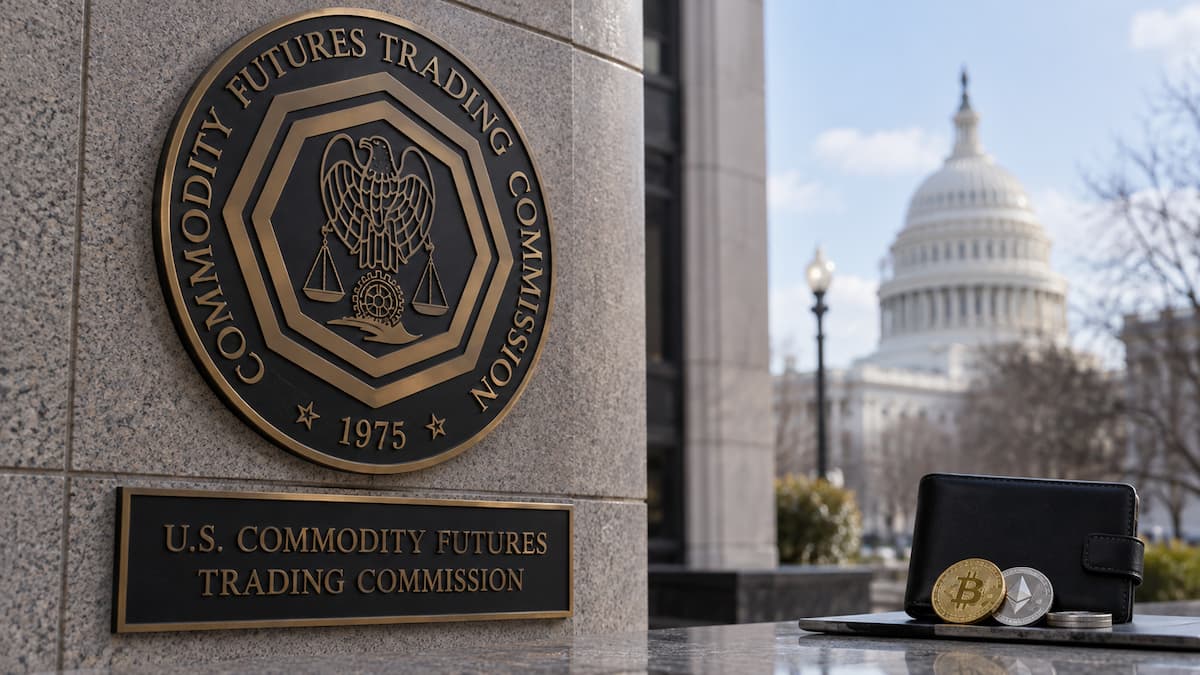


- The CFTC expanded no-action relief for passive software providers, including crypto wallet developers
- The relief covers firms that connect users to regulated derivatives without registering as brokers
- The move follows the CLARITY Act’s failure in the Senate
The CFTC expanded its no-action relief for passive software providers this week, giving crypto wallet developers and similar firms a clearer path to avoid broker registration requirements when their products connect users to regulated derivatives markets. No-action relief is a formal statement from the agency that it will not pursue enforcement action against firms operating within the specific conditions the relief describes, functioning as a practical substitute for a full rulemaking process that would otherwise take significantly longer.
The distinction the CFTC is drawing centers on the word passive. A wallet or software application that simply provides users with an interface to access derivatives markets, without actively managing trades, providing investment advice, or taking custody of user funds in the process, would qualify for the relief, while a firm that takes on any of those more active roles would still need to register as a broker under existing rules. That line has been a persistent source of uncertainty for crypto developers, many of whom have built products that sit somewhere between a pure interface and an active intermediary.
The CFTC’s leadership said the agency intends to keep advancing crypto-specific rules using its existing statutory authority regardless of the CLARITY Act’s stalled status in Congress, framing the no-action relief as evidence the agency does not need new legislation to make meaningful progress on regulatory clarity for the industry. That message has been echoed by SEC officials making similar arguments about their own recent actions, including this week’s tokenized stock exemption.
The relief is likely to be welcomed by smaller crypto software firms in particular, since the cost of broker registration, including compliance staffing and capital requirements, has historically been prohibitive for early-stage companies compared with larger, well-funded exchanges. Whether the relief proves durable will depend on how the CFTC’s leadership and priorities evolve over time, since no-action relief, unlike a formal rule, can be withdrawn more easily by a future commission.
Wallet developers have lobbied for this kind of clarity for several years, arguing that uncertainty over broker registration requirements has discouraged some US-based teams from building consumer derivatives access directly into their products, ceding that market to offshore platforms operating with less regulatory oversight. Formal no-action relief, even though it stops short of a binding rule, gives compliance teams at these firms a clearer basis for legal opinions supporting their existing product design, which in practice can be enough to unlock product launches that had been held back by legal uncertainty alone.
Disclaimer: Cryip's content is strictly for educational and informational purposes and does not constitute financial, legal, or investment advice. Cryptocurrency involves significant risk, and readers assume full responsibility for their own financial decisions. Asset references are never endorsements.
To make complex crypto topics accessible to readers at all experience levels, our team uses AI tools strictly to refine language, correct grammar, and simplify terminology. AI is never used to draft facts, source information, or form conclusions. Every article is fact-checked and approved by a human editor before publication. Read our full AI Use & Content Policy.