



- Nearly 90% of the global stablecoin market is backed by the U.S. dollar.
- Lagarde strongly warned against expanding euro-backed stablecoins due to “digital dollarisation” risks.
- The ECB prefers tokenized bank deposits over privately issued stablecoins.
- Lagarde called for separating blockchain technology from private money creation.
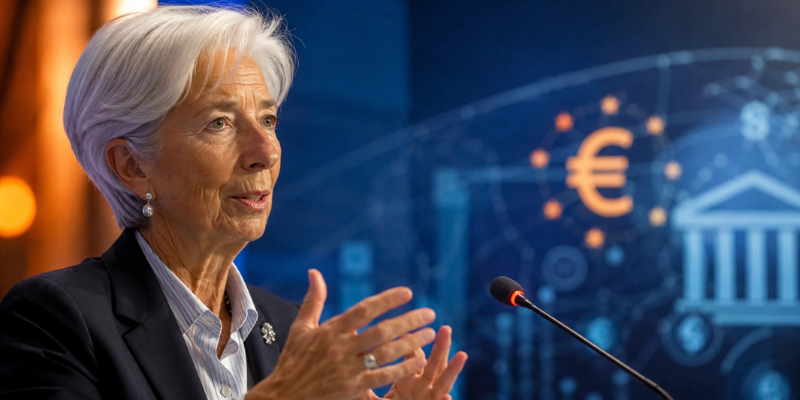
European Central Bank President Christine Lagarde on Thursday urged Europe to resist the expansion of euro-denominated stablecoins, warning that the bloc should instead focus on central bank-controlled digital infrastructure to protect monetary sovereignty.
In a keynote speech titled “Stablecoins and the future of money: separating functions from instruments”, delivered at the inaugural Banco de España LatAm Economic Forum, Lagarde highlighted the rapid rise of stablecoins – growing from less than $10 billion six years ago to more than $300 billion today. She noted that nearly 90% of the market remains backed by the U.S. dollar.
“Europe now faces increasing pressure to develop euro-backed stablecoins as dollar-backed stablecoins continue to expand globally,” Lagarde said. She warned that following this path could accelerate “digital dollarisation” and undermine financial stability.
Distinguishing Technology from Money Creation
Lagarde drew a sharp distinction between blockchain technology and privately issued stablecoins acting as money. While she acknowledged the benefits of tokenization and distributed ledger technology for payments, she cautioned against allowing private issuers to take on core monetary functions.
She cited the brief depegging of USD Coin (USDC) during the 2023 collapse of Silicon Valley Bank as an example of risks that could intensify in times of market stress. Lagarde also expressed concern that large-scale stablecoin adoption could trigger bank deposit outflows and impair the transmission of monetary policy.
Preference for Tokenized Bank Deposits: Instead of private stablecoins, the ECB President advocated developing tokenized bank deposits within the regulated banking system and strengthening European digital payment infrastructure under central bank oversight.
Geopolitical Implications
Lagarde’s remarks underscore a growing view in European policy circles that stablecoins have moved beyond consumer protection and financial stability concerns. They are increasingly seen as instruments linked to global demand for U.S. Treasuries and broader monetary influence.
Recently, Coinbase expanded its regulated crypto futures trading services across Europe as the region continues debating digital asset regulation and financial infrastructure oversight. The launch reflects increasing institutional demand for compliant crypto trading products under Europe’s evolving regulatory framework. The development also highlights Europe’s broader push to balance financial innovation with regulatory control in digital asset markets. The remarks come as both Europe and the United States continue debating stablecoin regulation.
FAQs
1. Why is Christine Lagarde against euro-backed stablecoins?
Lagarde believes that privately issued stablecoins, even if euro-denominated, could undermine monetary sovereignty, lead to deposit outflows from banks, and weaken the ECB’s control over monetary policy.
2. What is “digital dollarisation”?
Digital dollarisation refers to the increasing dominance of U.S. dollar-backed stablecoins in global digital payments and finance, which could reduce the influence of the euro and European monetary policy in the digital economy.
3. What alternative does the ECB propose instead of stablecoins?
The ECB prefers tokenized bank deposits, digital versions of traditional bank deposits issued within the regulated banking system, along with central bank-supervised digital payment infrastructure.
4. Will Europe still develop its own stablecoins?
While some European institutions and companies support euro stablecoins for competitiveness, the ECB under Lagarde remains cautious and is currently prioritizing regulated tokenized deposits and public digital infrastructure over private stablecoin expansion.
Source: Speech by Christine Lagarde
Disclaimer: Cryip's content is strictly for educational and informational purposes and does not constitute financial, legal, or investment advice. Cryptocurrency involves significant risk, and readers assume full responsibility for their own financial decisions. Asset references are never endorsements.
To make complex crypto topics accessible to readers at all experience levels, our team uses AI tools strictly to refine language, correct grammar, and simplify terminology. AI is never used to draft facts, source information, or form conclusions. Every article is fact-checked and approved by a human editor before publication. Read our full AI Use & Content Policy.