



- Circle Internet Group has agreed to buy Tazapay, a Singapore-based cross-border payments company processing more than $25 billion a year, for about $400 million in Circle stock.
- Tazapay has already been converting USDC into local currency inside Circle’s own payments network since June 2025, and its volume has grown past that network’s own throughput since then.
- The deal is expected to close in 2027, pending approval from Singapore’s Monetary Authority.
Circle Internet Group has signed a definitive agreement to buy Tazapay, a Singapore-based cross-border payments company, for about $400 million in Circle stock. The price will be set by Circle’s average share value over the 20 trading days before the deal closes, adjusted for Tazapay’s debt and cash on hand. Circle expects the acquisition to close in 2027, once Singapore’s Monetary Authority and other regulators approve it.
Tazapay moves more than $25 billion a year for businesses across over 100 markets, working with more than 60 banking and fintech partners. About 60% of that volume already runs through stablecoins. Circle chief executive Jeremy Allaire said combining USDC with Tazapay’s banking relationships and local payout rails would help make the stablecoin the default way businesses settle cross-border payments.
Why Circle Already Needed This Deal
That framing describes what the deal does. It says less about why Circle needed this particular company. Tazapay has not been a stranger to Circle. Since June 2025, it has operated as a settlement partner inside Circle’s own payments network, converting USDC that flows in from other institutions into Hong Kong dollars and US dollars for distribution to banks across Asia-Pacific. By August 2025, its own disclosed transaction volume was running at about $10 billion a year. Thirteen months later, that figure has grown past $25 billion, larger than the roughly $8.3 billion in annualized volume moving through Circle’s payments network on its own.
Buying the company that already handles more volume than your own network, at the point that company has become load-bearing for it, is not quite the same story as buying access to new markets. It looks more like closing off a dependency before it becomes someone else’s leverage, whether that means a rival bidder, a renegotiated contract, or simply a partner Circle no longer controls.
The Pattern Circle Just Joined
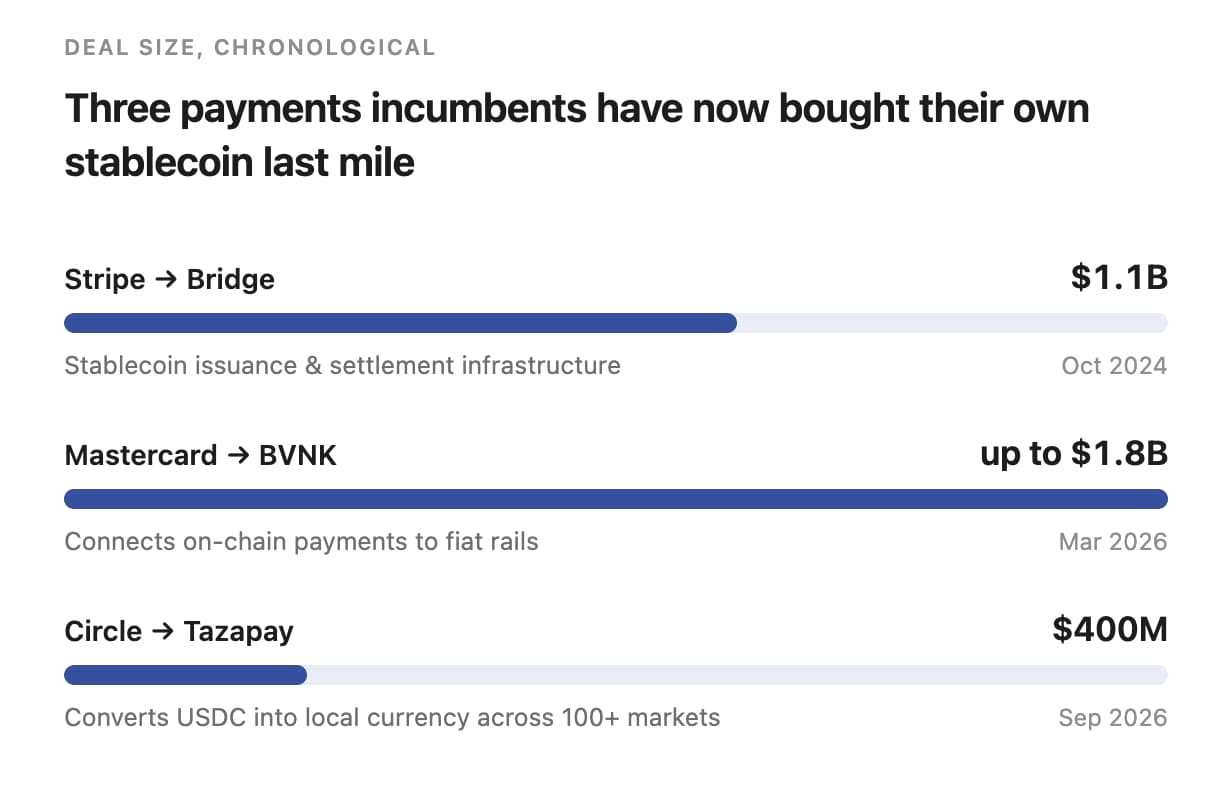
Circle is not the only payments company making this move. Two larger rivals have already paid more for the same kind of purchase, in the same shape: buying the operator that turns stablecoins into spendable local currency, rather than building that layer themselves.
What Still Has to Happen
Circle plans to keep Tazapay running as-is. The company has told Tazapay’s existing customers to expect no changes to service, pricing, APIs, or support once the deal closes. The deal structure is also reported to include about $25 million in retention incentives for Tazapay employees, a detail that points the same direction: Circle is paying to keep the team that built the relationships intact, not just to acquire a customer list.
Tazapay holds payments licenses in Singapore, Canada, Australia and the US, with applications pending in the European Union, Hong Kong and the United Arab Emirates, licenses Circle would otherwise have had to obtain market by market. Analysts at KeyBanc described the deal as a source of revenue diversification, framing Tazapay as the infrastructure that connects USDC to local currencies at scale.
Circle’s stock dipped roughly 2% on the announcement before steadying. Shares remain up about 25% for the year.
The Approval Circle Still Needs
The deal cannot close without the Monetary Authority of Singapore signing off, a process expected to stretch into 2027 given the transaction’s size and cross-border scope. Circle has not disclosed how much of Tazapay’s $25 billion in volume already flows through its own payments network specifically, the number that would show whether this deal is really about closing a dependency or simply adding a large, independently profitable business. That figure, if Circle ever discloses it, is the clearest test of which explanation is closer to the truth.
Disclaimer: Cryip's content is strictly for educational and informational purposes and does not constitute financial, legal, or investment advice. Cryptocurrency involves significant risk, and readers assume full responsibility for their own financial decisions. Asset references are never endorsements.
To make complex crypto topics accessible to readers at all experience levels, our team uses AI tools strictly to refine language, correct grammar, and simplify terminology. AI is never used to draft facts, source information, or form conclusions. Every article is fact-checked and approved by a human editor before publication. Read our full AI Use & Content Policy.