

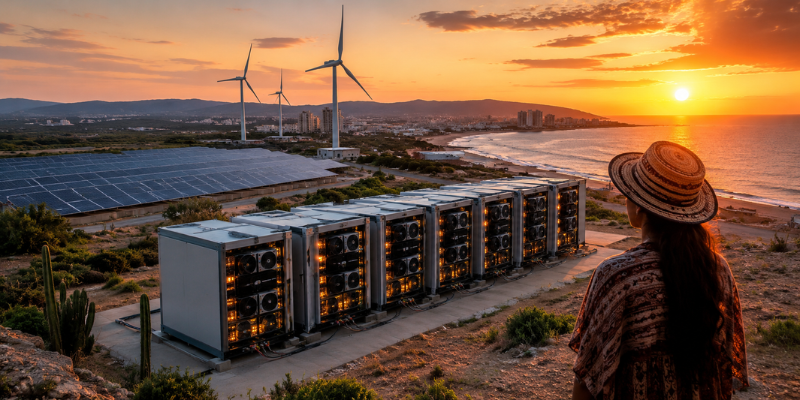


- Gustavo Petro said Colombia’s Caribbean coast could become a Bitcoin mining hub.
- Cities including Barranquilla, Santa Marta, and Riohacha were identified as potential mining locations.
- Petro said the initiative could use Colombia’s renewable energy surplus to attract foreign investment.
- The president proposed that the Wayúu Indigenous community could become co-owners of mining projects.
- Paraguay’s Bitcoin mining growth was referenced as an example of renewable-powered mining expansion.
Petro Proposes Caribbean Coast Bitcoin Mining Expansion
Colombian President Gustavo Petro said the country’s Caribbean coast has the potential to become a Bitcoin mining hub by leveraging surplus renewable energy resources.
Si las monedas virtuales se basan en energía fósil estalla el calentamiento mundial y el colapso climático
Hoy los países con abundantes energías limpias encerradas como Venezuela y Paraguay, logran atraer las inversiones en minería del bitcoin. La.minería del bitcoin es el… https://t.co/KroCrG9qkD
— Gustavo Petro (@petrogustavo) May 5, 2026
In a post published on X on Tuesday, Petro stated that the Caribbean cities of Barranquilla, Santa Marta, and Riohacha could host Bitcoin mining facilities. He said the initiative could attract foreign investment and support economic development in the region. Petro compared the proposal to developments seen in Venezuela and Paraguay, where renewable energy resources have supported Bitcoin mining operations in recent years.
“It’s an immense boost to the development of the Caribbean,” Petro said in the post.
The Colombian president also proposed that the Wayúu community, Colombia’s largest Indigenous group primarily located along the Caribbean coast, could become co-owners of the mining projects. Recently, Tether launched a modular Bitcoin mining infrastructure with Canaan Inc. and ACME Swisstech to improve mining efficiency and scalability.
Renewable Energy and Bitcoin Mining Potential
Bitcoin mining analysts, including Hashlabs managing partner Jaran Mellerud, have stated that the industry can create economic opportunities for emerging countries by converting unused electricity into cash flow. The proposal comes as some US commercial Bitcoin miners continue expanding into artificial intelligence and high-performance computing businesses, opening opportunities for countries with lower electricity costs to increase their share of the Bitcoin network hashrate.
Petro’s comments were made in response to a post from Luxor Technology’s Alessandro Cecere, who noted that Paraguay’s share of global Bitcoin hashrate has risen to 4.3% after utilizing hydroelectric energy from the Itaipu dam. Paraguay is currently the fourth-largest Bitcoin mining country by hashrate, behind the United States, Russia, and China.
A World Bank report published in April 2024 found that Colombia generates approximately 75% of its electricity from renewable energy sources, more than double the global average. Petro said renewable-powered Bitcoin mining could help address concerns about the environmental impact of fossil fuel-based mining operations and global warming.
Colombia Political Context and Crypto Industry Outlook
Petro has served as Colombia’s president since August 2022 and has maintained a relatively neutral stance toward Bitcoin and the broader cryptocurrency industry. His presidential term is scheduled to end in August. Prediction market data from Kalshi indicates that left-leaning Senator Iván Cepeda Castro and conservative lawyer Abelardo de la Espriella are currently among the leading candidates to succeed Petro. Neither candidate has made major public statements regarding Bitcoin or digital assets.
FAQs
1. What did Gustavo Petro say about Bitcoin mining in Colombia?
Gustavo Petro said Colombia’s Caribbean coast could become a Bitcoin mining hub by using surplus renewable energy to attract foreign investment and support economic growth.
2. Which cities were mentioned for Bitcoin mining projects?
Petro identified Barranquilla, Santa Marta, and Riohacha as potential locations for Bitcoin mining facilities along Colombia’s Caribbean coast.
3. Why does Petro believe Colombia is suitable for Bitcoin mining?
Petro said Colombia’s renewable energy resources could support environmentally focused Bitcoin mining operations while helping reduce concerns about fossil fuel-based mining.
4. What role could the Wayúu community play in the mining projects?
Petro proposed that the Wayúu Indigenous community could become co-owners of Bitcoin mining projects and benefit from the economic development created by the initiative.