



Ethena Foundation put a governance proposal live on August 27 that would eventually funnel most of its protocol revenue into buying back ENA on the open market. The catch: the mechanism only activates once Ethena’s synthetic dollar, USDe, reaches $7.5 billion in circulating supply. As of this week, USDe sits at roughly $4.04 billion, meaning supply needs to grow by about 85 percent before a single dollar of revenue gets diverted to buybacks.
We are excited to announce four updates regarding the Ethena ecosystem, further details on each point are provided in the blog linked below:
1. Buyout of early investors:
The Ethena Foundation executed a buyout of all locked tokens from certain major seed investors that sold any…— Ethena Foundation (@EthenaFndtn) August 27, 2026
How the $7.5 Billion Trigger Actually Works
The proposal, posted to Ethena’s governance forum, lays out a tiered structure: once the $7.5 billion floor is crossed, 5 percent of net revenue from Ethena’s core business lines goes toward repurchasing ENA, with that share stepping up at higher supply tiers. At the top disclosed tier, $25 billion in USDe supply, the share rises to 25 percent. Wherever a tier is active, 95 percent of the revenue captured at that tier is used specifically for open-market ENA buybacks, with the remainder funding growth initiatives across USDe savings products, white-label stablecoins, and a new product line the Foundation has described as launching imminently.
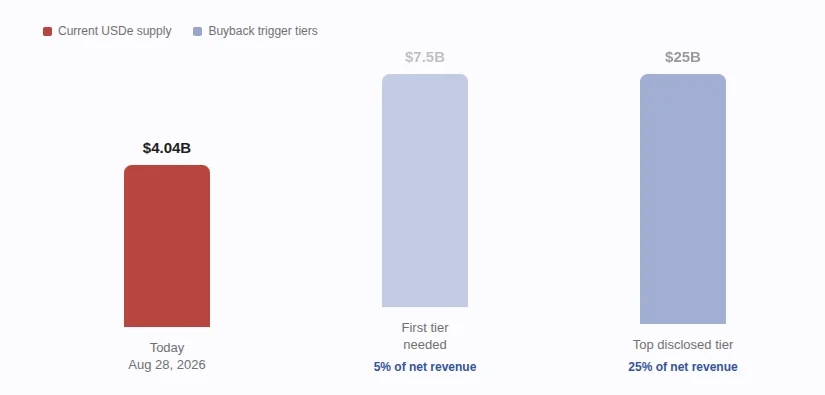
That $7.5 billion bar is notably higher than the one Ethena’s own Risk Committee set in November 2024, when it said USDe supply above $6 billion, combined with cumulative revenue past $250 million, would be enough to justify activating a fee switch. USDe actually cleared that lower bar last year, peaking near $15 billion in October 2025, before falling back to current levels. The new proposal effectively resets the goalposts higher than where the protocol has already been.
The Changes That Don’t Wait on USDe Growth
The parts of Thursday’s announcement that take effect immediately, and don’t depend on USDe growth, are the ones moving the market more directly. The Foundation bought out locked ENA tokens from early investors who had sold since the October 2025 peak, while investors who never sold were offered buybacks at par value that none accepted. Separately, the remaining investor token unlocks, previously released monthly, will now unlock in a single batch on October 5. Team tokens keep their original vesting schedule, and roughly 12 percent of ENA’s total supply remains locked across team, ecosystem, and Foundation holdings.
ENA’s Rally and the October IP Agreement Still to Come
ENA has rallied sharply since the announcement, trading near $0.147 with a 24-hour gain in the mid-single digits and a weekly gain approaching 45 percent, extending a rally that began before the announcement itself. Reports of the initial reaction to the news put the immediate pop in the teens percentage-wise. Separately, the Foundation and Ethena Labs have reportedly agreed in principle to shift protocol intellectual property and economic upside toward the Foundation and away from Labs’ equity holders, through an agreement expected to be published in October, though terms have not yet been made public.
The buyback mechanism is a real commitment, backed by a live governance vote and Risk Committee sign-off. But it functions as a claim on future growth, not a current cash flow. Until USDe supply climbs substantially from where it stands today, the tokenomics change with the most immediate effect on ENA’s float is the one nobody needs a threshold to activate: the buyout and the unlock consolidation.
Disclaimer: Cryip's content is strictly for educational and informational purposes and does not constitute financial, legal, or investment advice. Cryptocurrency involves significant risk, and readers assume full responsibility for their own financial decisions. Asset references are never endorsements.
To make complex crypto topics accessible to readers at all experience levels, our team uses AI tools strictly to refine language, correct grammar, and simplify terminology. AI is never used to draft facts, source information, or form conclusions. Every article is fact-checked and approved by a human editor before publication. Read our full AI Use & Content Policy.