




Hyperliquid’s outcome-market framework, HIP-4, let anyone stake HYPE and deploy their own prediction market on testnet this week, at a price of admission far lower than the one Hyperliquid itself proposed for the real thing.
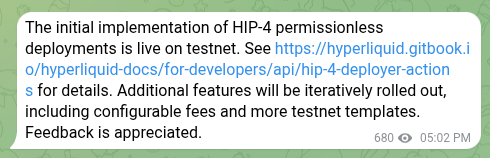
The testnet implementation, which went live according to Hyperliquid’s own developer documentation and a Telegram announcement from its API channel, sets the outcome-deployer staking requirement at 100 HYPE. That’s the number that actually shipped. Three weeks earlier, on July 20, Hyperliquid floated a preliminary framework for mainnet permissionless deployment that called for 500,000 HYPE, locked for six months, a figure worth roughly $30 million at the time. The testnet requirement is 1/5,000th of that.
100 HYPE vs. 500,000 HYPE
| Testnet (live now) | Mainnet (proposed July 20) | |
|---|---|---|
| Stake required | 100 HYPE | 500,000 HYPE |
| Lock/duration | 183-day minimum before deactivation | 6-month lock |
| Status | Shipped, per official docs | Preliminary, explicitly subject to change |
Inside HIP-4’s Templates: What Deploying Actually Requires
Deploying a market isn’t a free-for-all. Under HIP-4, validators vote on outcome templates first: fixed structures that define the display text, side names, and a set of typed keywords a deployer can fill in. A deployer doesn’t write a market from scratch; they instantiate one of three template types: a standalone outcome (a single YES/NO market), a question (a container for multiple related outcomes), or a question outcome (one named result nested under a specific question). Values plugged into a template are capped at 100 characters and can’t contain curly braces or pipe characters, since those are reserved for the system’s internal formatting.
What limits a deployer instead is a hard cap: 10 active outcomes at a time and 50 deployments per day, both figures specific to testnet. Hyperliquid has said only that additional features, configurable fees and more market templates, will roll out gradually, not that these particular caps will change. Settlement runs through two actions: settleOutcome for a single market, and a newer settleQuestion2 for resolving every named outcome under a question in one transaction, replacing an earlier settleQuestion action the documentation now lists as discontinued.
The Timeline Behind Hyperliquid’s HIP-4 Rollout
This week’s launch is the fourth stage in an eight-month build-out, not a standalone event:
- February 2026: Hyperliquid first showed HIP-4 on testnet in early February, according to reporting at the time, describing outcome contracts as fully collateralized and settled without leverage or liquidations.
- May 2, 2026: HIP-4 moved to mainnet in curated form, with deployments controlled by validators rather than the public. Hyperliquid has said that curated version drew roughly $100 million in trading volume in its first month.
- July 20, 2026: Hyperliquid proposed opening deployment to anyone, provided they meet a 500,000 HYPE bar, modeled on the same staking structure that already governs HIP-3, its permissionless perpetuals framework.
- July 31, 2026: The testnet implementation described above goes live, at 100 HYPE, not the 500,000 HYPE figure from three weeks earlier.
The 500,000 HYPE Figure Hasn’t Moved Yet
Configurable fees and additional market templates are also still pending, per this week’s announcement, with no mainnet date attached to any of it. Until Hyperliquid publishes an update on staking terms, developers building on testnet are working against numbers that could still shift five-thousand-fold before the same feature reaches mainnet, while the proposed model continues to follow the staking approach introduced through Hyperliquid HIP-3.
Disclaimer: Cryip's content is strictly for educational and informational purposes and does not constitute financial, legal, or investment advice. Cryptocurrency involves significant risk, and readers assume full responsibility for their own financial decisions. Asset references are never endorsements.
To make complex crypto topics accessible to readers at all experience levels, our team uses AI tools strictly to refine language, correct grammar, and simplify terminology. AI is never used to draft facts, source information, or form conclusions. Every article is fact-checked and approved by a human editor before publication. Read our full AI Use & Content Policy.