
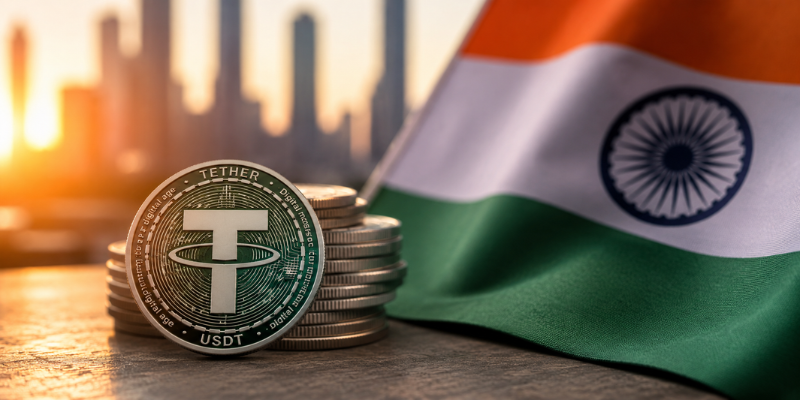


- USDT premium in India has increased to more than 8.5%, well above its usual 3%–4% range.
- Reduced stablecoin inflows have tightened local supply following recent Enforcement Directorate action.
- Regulatory uncertainty is contributing to higher pricing as market participants seek limited USDT liquidity.
India is witnessing a sharp increase in the local premium for Tether (USDT) after a sudden tightening in stablecoin supply reduced market liquidity. According to The Economic Times, USDT was quoted at INR 102.88 on Saturday, compared with the official USD/INR closing rate of 94.65 on Friday, pushing the premium above 8.5%.
The premium, which typically ranges between 3% and 4%, reflects a shortage of USDT available in India’s crypto market as inflows have slowed in recent days.
ED action tightens USDT availability
The supply disruption follows a recent Enforcement Directorate (ED) investigation into approximately INR 250 billion worth of money transfers conducted through virtual digital assets. The agency carried out searches under the Foreign Exchange Management Act (FEMA), examining entities allegedly involved in unauthorized cross-border transfers using crypto assets.
The enforcement action has reduced the movement of USDT into India, making it more difficult for traders and businesses to source the stablecoin. The tighter availability has resulted in buyers paying significantly higher prices than the prevailing dollar exchange rate.
The development comes shortly after several crypto service providers and exchanges introduced stricter compliance measures in India, including enhanced information requirements for crypto deposits and withdrawals, as regulatory scrutiny of cross-border digital asset transactions has increased.
Recently, Coinbase launched direct INR deposits and withdrawals for Indian users, improving access between local bank accounts and crypto trading as competition in India’s regulated crypto market continues to expand. Separately, India temporarily blocked Telegram nationwide ahead of the NEET-UG 2026 re-examination. While unrelated to crypto, the move affected traders and communities that rely on the platform for market updates and OTC transactions.
Regulatory uncertainty adds to market premium
Crypto Legal founder Purushottam Anand said the recent increase in USDT pricing may partly represent a risk premium driven by regulatory uncertainty.
“The recent rise may partly reflect a risk premium caused by regulatory uncertainty.”
Stablecoins such as USDT play a critical role in cryptocurrency trading, cross-border settlements, and liquidity management. When local supply contracts, premiums typically widen as traders compete for limited availability.
The latest surge contrasts with conditions seen late last year, when India’s USDT premium briefly disappeared as remittance-related flows weakened. The current reversal highlights how changes in regulatory conditions and cross-border liquidity can quickly influence domestic stablecoin pricing.
For now, the widening premium indicates tighter crypto liquidity in India’s market as participants assess the impact of recent enforcement actions and evolving compliance requirements.
Disclaimer: Cryip's content is strictly for educational and informational purposes and does not constitute financial, legal, or investment advice. Cryptocurrency involves significant risk, and readers assume full responsibility for their own financial decisions. Asset references are never endorsements.
To make complex crypto topics accessible to readers at all experience levels, our team uses AI tools strictly to refine language, correct grammar, and simplify terminology. AI is never used to draft facts, source information, or form conclusions. Every article is fact-checked and approved by a human editor before publication. Read our full AI Use & Content Policy.