




- Iran is reportedly considering an insurance-based model to manage transit through the Strait of Hormuz.
- Some reports claim payments for the proposed insurance could be made in Bitcoin through a platform called Hormuz Safe.
- The reported website offering “Iranian Digital Insurance” was unavailable at the time of writing.
- Fars News Agency said the plan could generate more than $10 billion in revenue.
- The Strait of Hormuz handles about one-fifth of global oil trade.
Iran Reports Outline Proposed Strait Insurance Framework
Iran is reportedly considering a plan to exercise control over the Strait of Hormuz through what has been described as an insurance-based model, according to reports from Iranian media outlets and other circulating claims linked to an unverified website.
On Saturday, Fars News Agency, an Iranian news outlet closely affiliated with the Islamic Revolutionary Guard Corps, reported that Iran’s Ministry of Economic Affairs plans to manage the Strait of Hormuz through insurance mechanisms. The report cited a state document that Fars said it had obtained.
According to Fars News, the proposed framework would allow authorities to issue various marine insurance policies and certificates of financial responsibility for vessels transiting the strait. Fars News stated that the platform seeks to distinguish between transit vessels from different countries. The report added that the initiative could potentially generate more than $10 billion in revenue for Iran.
Claims of Bitcoin Payments Circulate Online
Bitcoin cannot be stopped.
Iran is evading sanctions and accepting BTC as payment for safe passage in the Straight of Hormuz.
The world is changing fast.
National security hawks need to take this very seriously, update their mental model, and begin planning for a new paradigm. pic.twitter.com/Dp0IjwAst2
— Dennis Porter (@Dennis_Porter_) May 17, 2026
Dennis Porter, CEO and Co-Founder of Satoshi Action Fund, said Bitcoin “cannot be stopped” while commenting on reports that Iran may be accepting BTC-linked payments tied to transit through the Strait of Hormuz. His remarks came amid ongoing reports surrounding Iran’s reported insurance and tariff framework for ships operating in the strategic oil shipping route, although several claims related to Bitcoin payments and associated websites remain unverified.
Separate reports have claimed that Iran may seek payments for the proposed insurance in Bitcoin through a website identified as “Hormuz Safe.” A screenshot circulating online reportedly showed the site offering “Secure Digital Insurance for Maritime Cargo.” However, there is no confirmation that Iran will proceed with the insurance proposal, and the website claiming to provide “Iranian Digital Insurance” may not be authentic. The website was reportedly offline at the time of writing.
Reports also noted that scammers have previously targeted shipping companies operating in the Strait of Hormuz by demanding cryptocurrency payments in exchange for safe passage. Industry figures have previously described Bitcoin as suitable for sanctioned countries because of its decentralized structure and the absence of a central issuer capable of freezing funds.
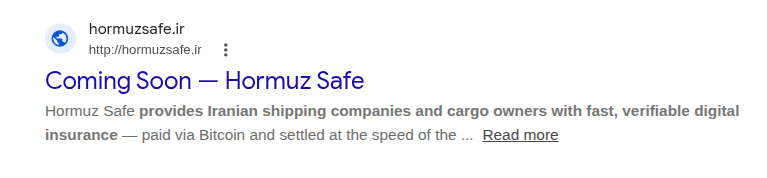
A screenshot circulating online shows a webpage titled “Coming Soon – Hormuz Safe,” which describes itself as a digital insurance platform for Iranian shipping companies and cargo owners. The page references Bitcoin-based payments and promotes fast, verifiable insurance services related to maritime cargo transit.
Shipping Disruptions Continue Amid US-Iran Conflict
Control over the Strait of Hormuz has become a major issue during the ongoing US-Iran conflict. The strategic shipping route handles approximately one-fifth of global oil trade. Many ships have reportedly been prevented from transiting the strait after the United States began launching airstrikes in Iran in late February.
Media reports also stated that Iran collected its first revenue from tolls imposed on ships transiting the Strait of Hormuz last month. Before the current conflict, no such measures had reportedly been implemented.
In early April, a spokesperson for Iran’s Oil, Gas and Petrochemical Products Exporters’ Union reportedly stated that certain vessels would be allowed to pass through the strait if they paid a tariff of $1 per barrel of oil in Bitcoin. The spokesperson said vessels would receive payment instructions by email and would be required to complete Bitcoin transactions within seconds to avoid traceability or confiscation linked to sanctions.
Iran’s reported consideration of an insurance-based framework for managing transit through the Strait of Hormuz has drawn attention due to claims involving Bitcoin-linked payments and maritime cargo coverage. While Iranian media outlets have outlined details of the proposed model, there is currently no official confirmation that the system will be fully implemented. Reports surrounding the “Hormuz Safe” platform and cryptocurrency-based payments also remain unverified, with the website unavailable at the time of writing.
FAQs
1. What is the reported Iran Strait of Hormuz insurance plan?
The reported plan involves managing transit through the Strait of Hormuz using an insurance-based framework that could issue marine insurance policies and financial responsibility certificates for vessels.
2. Is Iran officially accepting Bitcoin for Strait of Hormuz transit?
There is no official confirmation that Iran has implemented Bitcoin payments for Strait of Hormuz transit. Reports mentioning Bitcoin payments are based on circulating claims and unverified sources.
3. What is Hormuz Safe?
Hormuz Safe is the name of a website referenced in reports claiming to offer digital insurance services for maritime cargo with Bitcoin-based payments. The authenticity of the platform has not been confirmed.
4. Why is the Strait of Hormuz important?
The Strait of Hormuz is one of the world’s most important shipping routes, handling approximately one-fifth of global oil trade.
Disclaimer: Cryip's content is strictly for educational and informational purposes and does not constitute financial, legal, or investment advice. Cryptocurrency involves significant risk, and readers assume full responsibility for their own financial decisions. Asset references are never endorsements.
To make complex crypto topics accessible to readers at all experience levels, our team uses AI tools strictly to refine language, correct grammar, and simplify terminology. AI is never used to draft facts, source information, or form conclusions. Every article is fact-checked and approved by a human editor before publication. Read our full AI Use & Content Policy.