
- Most crypto assets are not securities
- 18 major crypto assets classified as digital commodities
- SEC + CFTC alignment brings clearer regulation
- New token classification system introduced
- Clarity on staking, mining, and airdrops
- Reduces uncertainty, boosts institutional adoption
SEC Issues Major Clarification on Crypto Asset Regulation
Washington D.C., March 17, 2026 – The U.S. Securities and Exchange Commission (SEC) has released a new interpretation outlining how federal securities laws apply to crypto assets, marking a significant step toward regulatory clarity in the digital asset sector. This marks one of the most significant regulatory shifts in crypto history, redefining how digital assets are classified in the United States.
Why This Matters Now
- Removes long-standing regulatory uncertainty in crypto markets
- Opens the door for institutional capital inflows
- Reduces legal risks for developers and exchanges
- Signals a shift from enforcement-driven regulation to clear rulemaking
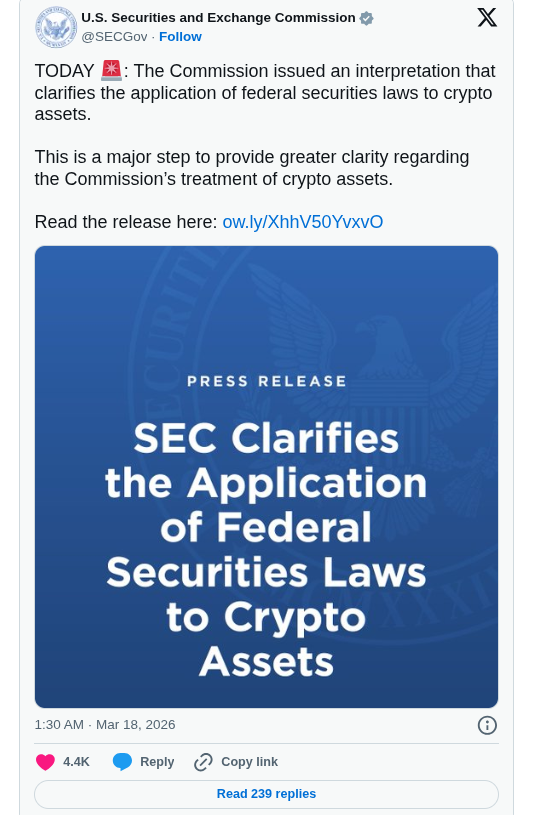
SECGov shared the update officially via X. The announcement aims to resolve longstanding uncertainty around how crypto assets are treated under U.S. law. It also aligns with ongoing legislative efforts in Congress to establish a comprehensive regulatory framework for digital markets.
Joint Effort With CFTC Signals Regulatory Alignment
The interpretation was issued in coordination with the Commodity Futures Trading Commission (CFTC), which confirmed it will apply the Commodity Exchange Act in a manner consistent with the SEC’s position.
According to SEC Chairman Paul S. Atkins, the move provides long-awaited clarity:
“After more than a decade of uncertainty, this interpretation will provide market participants with a clear understanding of how the Commission treats crypto assets under federal securities laws.”
CFTC Chairman Michael S. Selig added that the joint action reflects a shared commitment to building “clear and rational rules” for the crypto industry.
Key Areas Covered in the Interpretation
The SEC’s framework introduces several important elements designed to guide market participants:
Which Assets Are Classified
The SEC explicitly identified 18 crypto assets as digital commodities, including Bitcoin, Ethereum, Solana, XRP, Cardano, Avalanche, Polkadot, Chainlink, Litecoin, Stellar, Dogecoin, Hedera, Tezos, Aptos, Bitcoin Cash, Shiba Inu, Algorand, and LBRY Credits.
Several of these tokens were previously subject to SEC scrutiny or enforcement actions. Under the new interpretation, they are now treated as commodities rather than securities.
Investment Contract Clarification
- When a crypto asset may fall under an investment contract
- How and when it may cease to be classified as such
Specific Crypto Activities Addressed
- Airdrops
- Protocol mining
- Protocol staking
- Asset wrapping
A Shift in Regulatory Tone
According to the SEC, a digital commodity is a crypto asset that derives its value from the programmatic operation of a functional blockchain system and market-driven supply and demand, rather than from expectations of profit based on the managerial efforts of others.
In practical terms, this means the asset must serve a functional role within its network and should not provide passive income or profit rights tied to a central entity. A notable aspect of the announcement is the acknowledgment that most crypto assets are not inherently securities, signaling a shift toward more defined regulatory boundaries.
The SEC also emphasized that investment contracts tied to crypto assets can evolve or terminate over time, introducing flexibility into how these assets are assessed under securities laws.
Implications for the Crypto Industry
The new interpretation is expected to serve as a reference point for developers, investors, and institutions, helping them better understand the division of authority between the SEC and CFTC.
It also acts as a transitional framework while lawmakers work toward formal legislation governing crypto market structure. The full interpretation will be published on SEC.gov and in the Federal Register.
The SEC’s latest interpretation marks the most significant step toward crypto regulatory clarity in over a decade. While not a final legal framework, it establishes clear boundaries between securities and commodities, reduces uncertainty, and paves the way for broader institutional and retail participation. As Congress continues to develop formal legislation, this guidance serves as a critical bridge shaping the future of the U.S. crypto market.
Recent market trends highlight the growing institutional interest in crypto assets. Spot Bitcoin ETFs have attracted tens of billions of dollars in inflows since their launch, while newer products linked to assets such as Solana and XRP have also seen increasing demand. With clearer classification, additional crypto-based investment products could gain regulatory approval.