



The cryptocurrency market is experiencing a significant wave of token unlocks during the week of May 4-10, 2026, with 35 tokens scheduled to release $71.61 million worth of previously locked tokens into circulation. This comprehensive analysis examines the market dynamics, risk factors, and strategic implications for investors navigating this critical period.
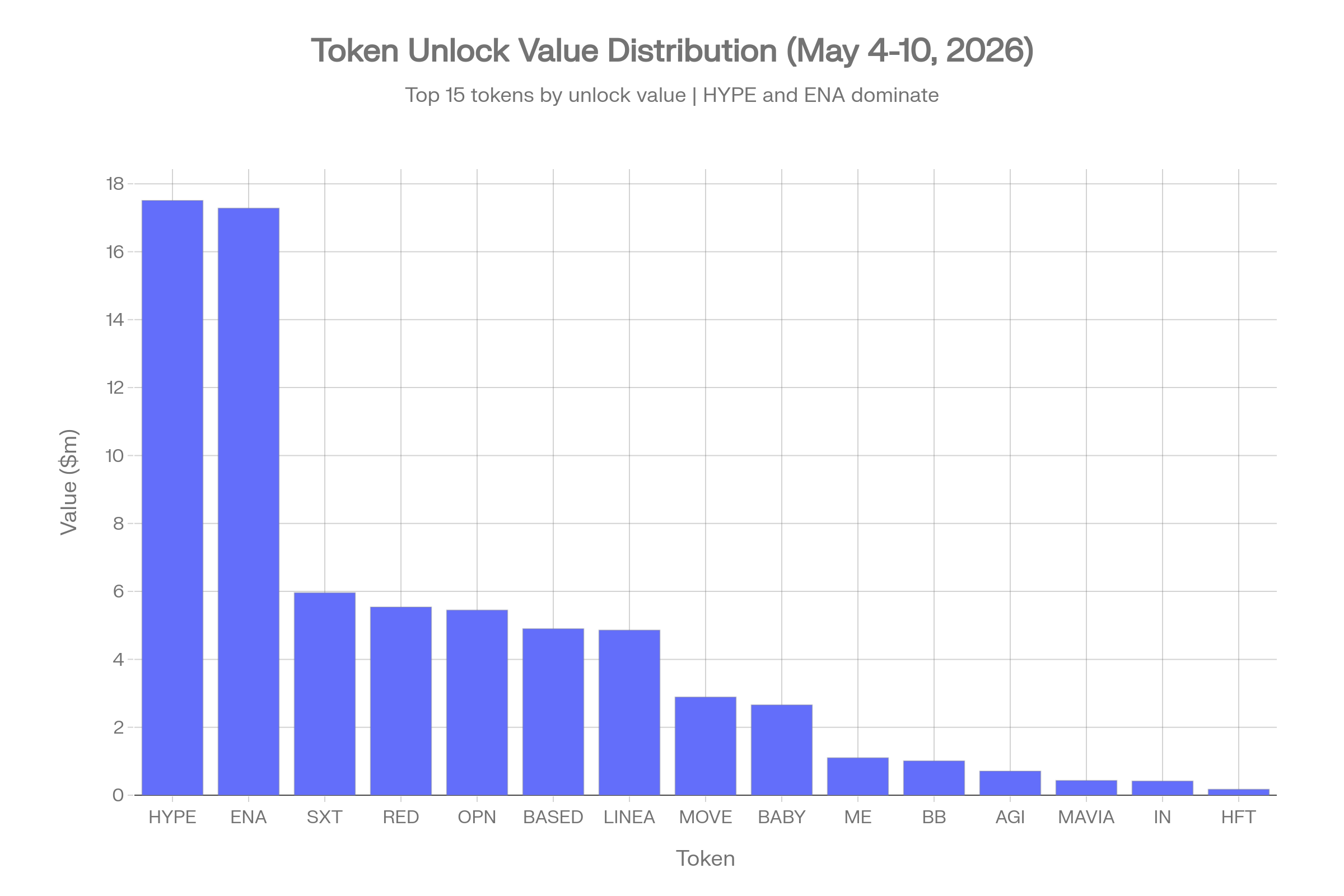
The week brings substantial supply-side pressure across multiple cryptocurrency projects, with two dominant unlocks accounting for nearly half the total value. HYPE leads with $17.51 million in unlocked tokens, followed closely by Ethena (ENA) at $17.28 million, representing a combined 48.6% of all unlock value for the period. The aggregate market capitalization of affected tokens stands at $11.48 billion, suggesting the unlocks represent approximately 0.62% of total market cap across these projects .
Major Token Unlock Events
High-Value Unlocks
The concentration of unlock value reveals a clear hierarchy of market impact. Beyond the leading HYPE and ENA unlocks, Space and Time (SXT) follows with $5.96 million, Red (RED) with $5.54 million, and Open Network (OPN) with $5.45 million. These top five tokens collectively account for 72.4% of total unlock value during this period .
Additional notable unlocks include BASED ($4.90M), LINEA ($4.86M), MOVE ($2.89M), and BABY ($2.66M), all representing significant liquidity events that could influence short-term price action. Historical patterns suggest that token unlocks frequently create downward price pressure as early investors and team members liquidate positions to realize profits.
Market Capitalization Analysis
Token unlocks span diverse market capitalization ranges, with the majority concentrated in smaller-cap projects. Only one token (HYPE with $9.89 billion market cap) falls into the mega-cap category above $1 billion, while 60% of unlocking tokens have market capitalizations below $100 million. As per tokenomist data, this skew toward lower-cap tokens amplifies volatility risk, since even moderate unlock values can represent a disproportionately large share of circulating supply and available liquidity. This distribution pattern suggests heightened volatility risk for smaller projects, where insights from ongoing tokenomics vesting updates become critical for anticipating liquidity shocks.
High-Impact Risk Assessment
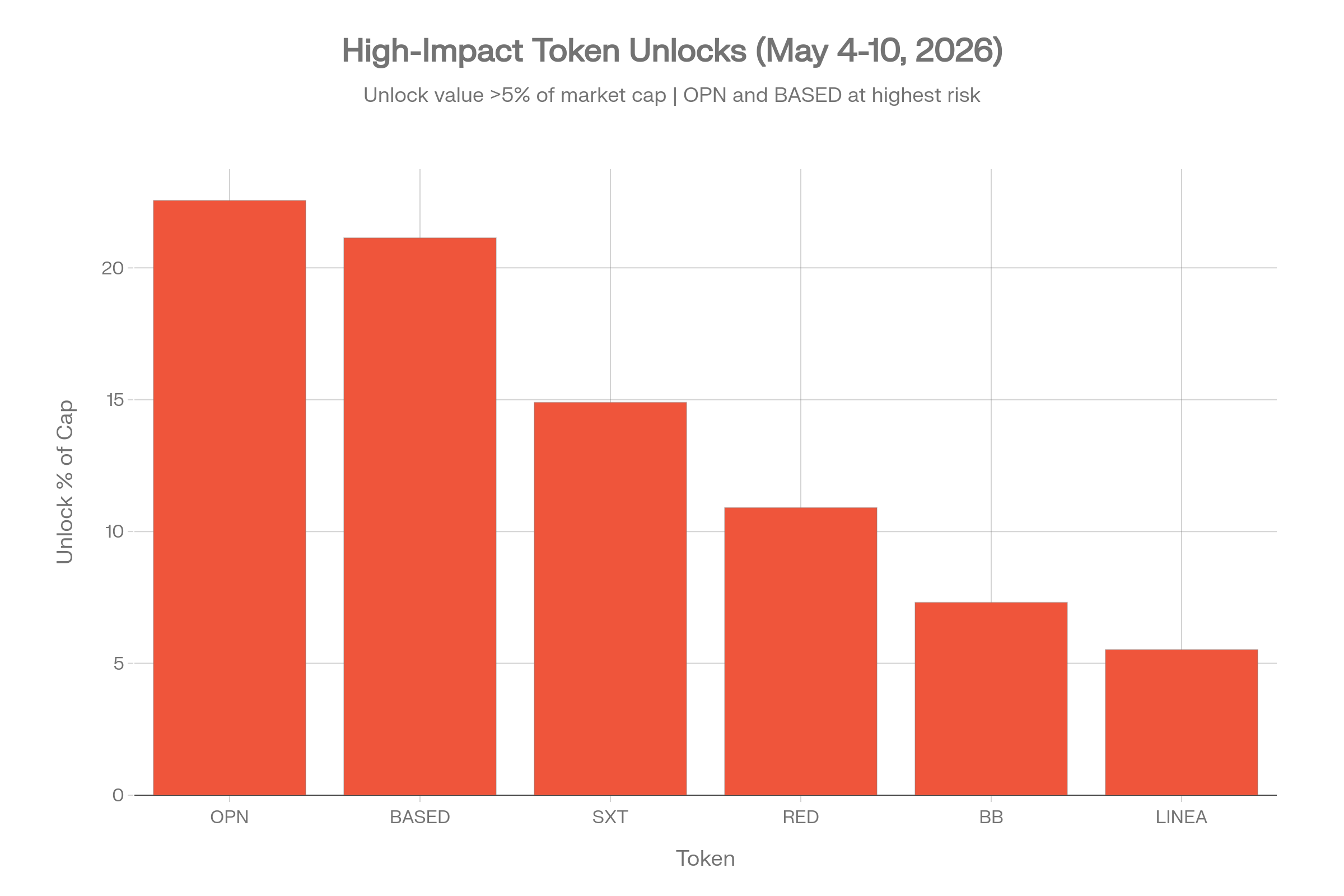
Six tokens face particularly acute pressure from unlocks exceeding 5% of their market capitalization, a threshold historically associated with significant price volatility . OPN leads this high-risk category with unlocks representing 22.6% of its $24.16 million market cap, followed by BASED at 21.1% of its $23.18 million cap.
Space and Time (SXT) unlocks 14.9% of its market cap, RED unlocks 10.9%, BB unlocks 7.3%, and LINEA unlocks 5.5% . These elevated unlock-to-cap ratios create substantial selling pressure that can overwhelm buy-side demand, particularly in lower-volume trading environments. Investors holding these tokens should anticipate increased volatility and potential drawdowns during the unlock period.
Vesting Schedule Maturity
The distribution of vesting progress reveals critical insights into project lifecycle stages . Approximately 54.4% of tokens have already released more than half their total supply, with 34.7% in advanced stages (50-100% released) . This maturity pattern indicates many projects are approaching full circulation, which typically reduces future unlock risk but may signal sustained selling pressure from long-term holders seeking exits.
Conversely, 32.4% of tokens remain in early vesting stages (0-25% released), representing projects with substantial future unlock schedules that could create recurring supply pressure in subsequent months . According to industry vesting standards, most projects employ cliff periods of 6-12 months followed by linear releases over 24-48 months, meaning early-stage tokens face years of continued unlocks.
Market Context
Institutional Dynamics: The May 2026 crypto market operates within a framework of increasing institutional participation and regulatory clarity. Bitcoin consolidation around $71,000 with potential moves toward $78,000 resistance suggests underlying market strength that could absorb unlock-related selling pressure. Ethereum’s positioning for a potential $4,000+ milestone indicates sustained interest in smart contract platforms, which may benefit tokens like ENA and SXT that operate within DeFi ecosystems.
Price Impact Mechanisms: Token unlock events typically trigger multi-phase price dynamics. Prices often decline in anticipation of unlocks as market participants front-run expected selling pressure, followed by actual declines when unlocked tokens hit exchanges. The magnitude of impact correlates directly with unlock size relative to market cap and trading volume, explaining why smaller-cap tokens face disproportionate risk.
Research indicates short-term negative price action is most common when early investors or insiders receive large allocations, as these stakeholders are often motivated to realize profits quickly. However, projects with strong fundamentals and sustained demand can absorb unlock pressure without significant long-term damage.
Strategic Implications for Investors
Risk Management Approaches: Investors should implement position sizing strategies that account for unlock-related volatility, particularly for the six high-impact tokens where unlocks exceed 5% of market cap . Conservative approaches include reducing exposure 1-2 weeks before scheduled unlocks or implementing stop-loss orders to protect against rapid drawdowns.
For long-term holders confident in project fundamentals, unlock events may present accumulation opportunities as prices dip below intrinsic value. This strategy requires careful analysis of project utility, development progress, and competitive positioning within the broader 2026 crypto landscape.
Portfolio Diversification: The concentration of unlock value in HYPE and ENA suggests these tokens warrant particular attention for portfolio rebalancing. Diversifying across tokens with varying unlock schedules, market caps, and use cases can mitigate single-event risk while maintaining exposure to sector growth.
Sector-Specific Considerations
DeFi and Infrastructure Tokens: Several unlocking tokens operate within decentralized finance and blockchain infrastructure sectors, which are experiencing renewed institutional interest in 2026. Ethena (ENA) represents synthetic dollar innovations, while Space and Time (SXT) focuses on decentralized data infrastructure. These sectors benefit from the broader tokenization narrative driving network demand, potentially offsetting unlock pressure through fundamental value accrual.
Gaming and Metaverse Projects: Tokens like MAVIA ($432K unlock), GFAL ($11K unlock), and GODS ($89K unlock) represent gaming and metaverse exposure. While their unlock values are relatively modest, the gaming sector’s volatility and evolving revenue models create additional risk layers beyond pure unlock mechanics .
Outlook
The May 4-10, 2026 unlock schedule represents a manageable liquidity event within the context of an $11.48 billion aggregate market cap, though individual tokens face varying degrees of pressure . The 0.62% unlock-to-market-cap ratio suggests the market can absorb this supply if broader conditions remain supportive .
Key monitoring priorities include HYPE and ENA price action given their dominant unlock values, OPN and BASED volatility due to extreme unlock-to-cap ratios, and overall market sentiment indicators that could amplify or dampen unlock impacts. The broader May 2026 outlook pointing toward potential altcoin season momentum may provide the demand necessary to counterbalance supply increases.
Investors should maintain disciplined risk management while recognizing that unlock events, though often negative catalysts short-term, represent normal project lifecycle progression that diminishes over time as vesting schedules complete. Projects demonstrating sustained utility and adoption typically recover from unlock-related drawdowns, making fundamental analysis paramount for position decisions during volatile periods.
Disclaimer: Cryip's content is strictly for educational and informational purposes and does not constitute financial, legal, or investment advice. Cryptocurrency involves significant risk, and readers assume full responsibility for their own financial decisions. Asset references are never endorsements.
To make complex crypto topics accessible to readers at all experience levels, our team uses AI tools strictly to refine language, correct grammar, and simplify terminology. AI is never used to draft facts, source information, or form conclusions. Every article is fact-checked and approved by a human editor before publication. Read our full AI Use & Content Policy.