




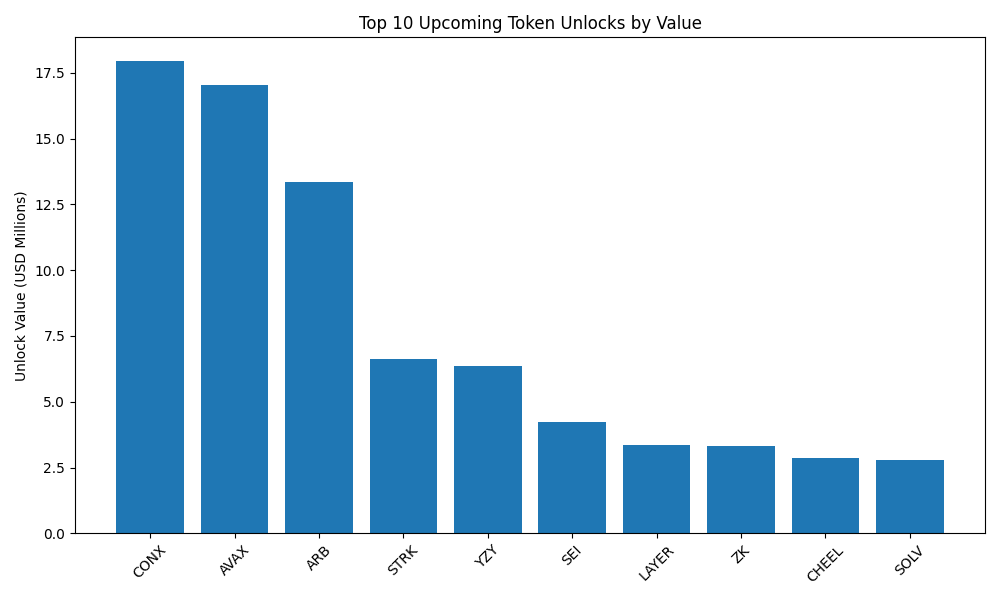
The week of May 11–17, 2026 features scheduled token unlocks for 41 tracked crypto assets, with a combined upcoming unlock value of approximately $91.73M based on prices as of May 11, 5:06 AM UTC. Unlock pressure is highly concentrated, with a handful of large events led by CONX, AVAX, ARB, STRK, and YZY driving the majority of the week’s dollar‑value supply expansion.
While this weekly total is small compared to multi‑billion dollar monthly unlock waves seen in early 2026, the relative size of unlocks versus market cap for several mid‑ and small‑cap tokens introduces material short‑term dilution risk at the individual asset level.
At the same time, large‑cap infrastructure tokens such as AVAX, ARB, SEI, and IOTA face unlocks that are significant in absolute terms but modest relative to their valuations, suggesting more manageable market impact in normal liquidity conditions.
Major token unlock events
Top‑tier unlocks ($10M+ range)
The top‑tier category this week is dominated by a small group of tokens whose individual unlocks fall in the high‑single‑digit to mid‑teens millions of dollars, collectively accounting for a large share of the $91.73M weekly total.
- CONX – $17.95M unlock: CONX has the single largest unlock of the week at about $17.95M, against a reported market cap of roughly $30.61M, implying an unlock-to-market-cap ratio close to 60%. With 88.60% of its maximum supply already released, this event is both a major one‑time liquidity injection and part of a late‑stage tokenomics profile with limited remaining locked supply.
- Avalanche (AVAX) – $17.02M unlock: AVAX is scheduled to unlock approximately $17.02M in tokens, but this sits against a reported market cap of about $4.41B, keeping the unlock size well under 1% of market cap. AVAX has 74.57% of its maximum supply released, signaling a mature emission curve where additional unlocks matter, but are unlikely to dominate price structure by themselves in the absence of other catalysts. Continued Avalanche blockchain development across DeFi, gaming, and enterprise infrastructure also helps support long-term ecosystem demand despite periodic supply expansion.
- Arbitrum (ARB) – $13.36M unlock: ARB’s upcoming unlock is around $13.36M, compared with a reported market cap near $885.56M, yielding an unlock of roughly 1.5% of market cap. With 54.14% of supply released, ARB is in a mid‑curve phase where recurring unlocks remain an important part of the investment and trading narrative.
- Starknet (STRK) – $6.62M unlock: STRK is set to unlock about $6.62M in tokens, against a reported market cap of roughly $307.51M, corresponding to an unlock near 2.1% of market value. Only 31.39% of its maximum supply is currently released, highlighting STRK as an early‑emission infrastructure asset where vesting schedules will shape supply dynamics for an extended period.
- YZY – $6.37M unlock: YZY’s unlock is approximately $6.37M versus a reported market cap of about $39.76M, implying a relative unlock size on the order of 16% of market cap. With 46.67% of maximum supply released, YZY remains mid‑curve, making the combination of substantial remaining supply and high relative unlock a notable short‑term risk factor.
Mid‑tier unlocks ($2M–$5M range)
The mid‑tier bucket includes tokens with unlocks in the $2M–$5M range that may be less headline‑grabbing in absolute terms but still meaningful, especially for small‑ and mid‑cap projects.
Key examples include:
- SEI – $4.22M unlock, with 58.29% of supply released and a reported market cap around $510.55M (under 1% of market cap).
- LAYER – $3.36M unlock, with 37.21% released and a market cap near $26.22M, implying a high unlock‑to‑cap ratio of roughly 13%.
- ZK – $3.32M unlock, with 29.40% released and a market cap around $186.26M, putting relative unlock size at about 1.8% of market cap.
- CHEEL – $2.88M unlock, with 78.77% released but no reported market cap, making relative imphe latest unlock also highlights a broader structural trend across the crypto industry: established ecosystems are gradually transitioningact harder to quantify.
- SOLV – $2.78M unlock, with 36.51% released and a market cap near $6.75M, implying an extremely high unlock‑to‑cap ratio north of 40%.
- IO – $2.12M unlock, with 42.05% released and a reported market cap around $52.90M, yielding an unlock of roughly 4% of market cap.
These mid‑tier events often produce the sharpest local volatility, particularly where unlocks exceed 10% of market cap and liquidity is relatively thin.
Distribution Analysis
Number of tokens and total unlock value
The week covers 41 tokens scheduled to unlock during the week, and these upcoming token unlocks May 2026 represent a combined upcoming unlock value of approximately $91.73M, excluding the non-numerical entry for PEPTAI. This implies an average unlock size of just over $2.2M, but the distribution is highly skewed toward the largest events, so the median unlock value is much lower than the mean.
A long tail of small unlocks often in the tens to hundreds of thousands of dollars adds incremental supply but is unlikely to be systemically important unless the underlying token is extremely illiquid. Instead, structural risk for the week is dominated by roughly 10–15 names with multi‑million dollar unlocks and, in several cases, high unlock‑to‑market‑cap ratios.
Market cap segmentation
- Large caps ($500M+ market cap): Includes names such as AVAX ($4.41B), ARB ($885.56M), SEI ($510.55M), and IOTA ($278.43M); for these, unlocks represent typically <2% of market cap.
- Mid caps ($10M–$500M): Captures tokens like STRK ($307.51M), ZK ($186.26M), XCN ($201.65M), CYBER ($47.41M), ROSE ($87.62M), PYR ($13.33M), and others; here, unlocks can range from a fraction of a percent to low‑double‑digit percentages of market cap.
- Small and micro caps (<$10M): Includes SOLV ($6.75M), BMT ($4.70M), HTM ($1.42M), GSWIFT ($314.71K), NYAN ($74.63K), VRTX ($61.83K), and several others.
In this group, even six‑figure unlocks can translate into double‑digit percentages of market cap, amplifying potential price impact.
This segmentation reinforces a familiar pattern: large‑caps face more modest relative dilution, while small‑caps bear disproportionate unlock risk despite modest absolute dollar amounts. The trend also mirrors broader tokenomics vesting updates across the industry, where mature ecosystems are increasingly operating with higher circulating supply levels while newer protocols continue navigating extended emission schedules and recurring dilution cycles.
Unlock Value Distribution
The distribution of unlock values suggests a two‑tier structure similar to monthly calendars:
- High‑value unlocks ($5M+): A small subset of tokens (CONX, AVAX, ARB, STRK, YZY, SEI, LAYER, ZK, CHEEL, SOLV) account for the majority of the $91.73M total.
- Standard unlocks ($100K–$5M): The bulk of tokens fall into this middle band, contributing moderate supply increments that can still be meaningful for individual price action but are unlikely to move the broader market on their own.
- Micro unlocks (<$100K): A number of tokens including DCB, TRIBL, VRTX, NYAN, FORT, YALA, MMX, and others have small unlocks measured in tens of thousands of dollars or less. These typically have minimal effect outside of very illiquid markets or thinly traded pairs.
From a liquidity standpoint, traders should focus primarily on the high‑value and high‑ratio unlocks; the rest form background supply noise unless coinciding with strong narratives or extremely constrained float.
High‑dilution Risk Tokens
Tokens with large unlocks relative to market cap and/or early‑stage released percentages present the highest near‑term dilution risk.
Notable high‑risk profiles include:
- CONX: $17.95M unlock vs $30.61M market cap (60%), with 88.60% of supply already released, marking a large one‑time liquidity event despite limited remaining future dilution.
- SOLV: $2.78M unlock vs $6.75M market cap (40%+), with only 36.51% of supply released, suggesting both a steep current unlock and substantial future issuance.
- YZY: $6.37M unlock vs $39.76M market cap (16%), with 46.67% released; this combination invites elevated volatility around the event.
- LAYER: $3.36M unlock vs $26.22M market cap (13%), with 37.21% released, implying ongoing dilution risk as further unlocks follow.
- FUN: $1.50M unlock vs $14.19M market cap (10.6%), with 24.64% of supply released, pointing to early‑curve tokenomics with meaningful remaining emissions.
- KAT: $1.81M unlock vs $23.99M market cap (7.5%), with 25.32% released, another early‑stage asset under steady supply expansion.
These tokens are most vulnerable to post‑unlock selling pressure if recipients are motivated to realize gains or rebalance positions, especially in environments of low demand or thin order books.
Sector‑level observations
- Infrastructure and base‑layer ecosystems (AVAX, ARB, SEI, STRK, ZK, IOTA, ROSE).
- DeFi, staking, and financial primitives (IO, PEAQ, SOLV, FUN).
- Gaming and metaverse‑adjacent assets (PYR, possibly NYAN and other small‑caps).
- Exchange or service tokens and miscellaneous utilities (CONX, CYBER, XCN, KAT, W, BMT, and others).
This breadth indicates that supply expansion is not isolated to one vertical; instead, unlocks touch multiple segments of the crypto stack during the week, from core infrastructure to niche experimental tokens.
Market Impact Assessment
Price pressure considerations
- Relative size: Unlocks exceeding 10% of market cap (for example, CONX, SOLV, YZY, LAYER, FUN) are most likely to generate meaningful pressure, especially if liquidity is limited.
- Emission stage: Early‑curve tokens with low “Released %” (for example, STRK, ZK, SOLV, FUN, KAT, PEAQ) remain structurally exposed to recurring dilution.
- Unlock structure: Although the unlock schedules do not clearly distinguish between daily linear releases and cliff-style distributions, large single-week unlocks often cluster around specific dates, increasing the risk of short-term intraday volatility.
For large‑caps like AVAX, ARB, SEI, and IOTA, unlocks of under ~2% of market cap are typically absorbed more efficiently, especially when governance catalysts such as Arbitrum DAO approves ETH release continue supporting ecosystem sentiment.
Liquidity absorption capacity
The $91.73M weekly unlock value is modest compared to monthly figures in the hundreds of millions or billions, suggesting that the broader market should have adequate capacity to absorb the aggregate supply under normal trading conditions. However, liquidity is not evenly distributed: some tokens enjoy deep order books and multi‑venue listings, while others trade on a limited set of exchanges with thin liquidity.
As a result, idiosyncratic volatility is most likely in:
- Small‑caps with high relative unlocks (SOLV, FUN, LAYER, KAT, PEAQ).
- Mid‑caps with early‑phase emissions and multi‑million dollar unlocks (STRK, ZK, YZY).
Strategic Insights for Investors
Risk‑management approaches
During weeks with concentrated unlocks, investors and traders may consider:
- Position sizing and leverage control: Avoid heavy leverage or oversized positions in tokens facing unlocks above ~5–10% of market cap, particularly in thinly traded names.
- Event‑driven timing: For volatile unlocks, historical patterns often show post‑unlock relief once the event passes and selling pressure is absorbed; traders may wait for this clearing period before adding exposure.
- Diversification: Spread exposure across tokens with different emission profiles, emphasizing large‑caps or late‑stage tokens with high “Released %” when seeking reduced dilution risk.
Opportunity identification
Unlock weeks can also create constructive entry points rather than just risk:
- Mature tokenomics: Tokens with >70% released and moderate unlock sizes (for example, GAL at 89.33%, SVL at 87.21%, DCB at 93.57%, TRIBL at 91.83%), often face limited future structural dilution once current events are priced in.
- High‑quality infrastructure names: For AVAX, ARB, SEI, STRK, ZK, and IOTA, modest relative unlocks may simply represent periodic supply emissions in fundamentally important networks; temporary dips around unlocks can offer long‑term accumulation opportunities.
- Idiosyncratic dislocations: In smaller tokens, disproportionate price reactions following unlocks can sometimes overshoot fundamentals, creating contrarian trade setups for disciplined participants.
Tokens to Monitor Closely
Based on absolute unlock size, relative unlock‑to‑market‑cap ratio, and supply‑curve stage, the following tokens warrant particular attention this week:
- CONX: Largest unlock (~$17.95M) with very high relative size (~60% of market cap) and 88.60% released.
- SOLV: ~40%+ of market cap unlocking (~$2.78M vs ~$6.75M cap) at only 36.51% released, blending early‑curve status with aggressive dilution.
- YZY: ~16% of market cap unlock (~$6.37M vs ~$39.76M cap) with 46.67% released, indicating meaningful near‑term overhang.
- LAYER and FUN: Unlocks of ~13% and ~10.6% of market cap respectively, at relatively low released percentages (37.21% and 24.64%), highlight ongoing supply‑curve pressure.
- STRK and ZK: Multi‑million dollar unlocks in early‑stage infrastructure tokens (31.39% and 29.40% released), where recurring emissions will remain central to valuation and positioning.
- AVAX, ARB, SEI, IOTA: Large‑cap names with meaningful absolute unlocks but modest relative dilution, important for broader market sentiment and narrative flow rather than acute supply shocks.
Conclusion
The week of May 11–17, 2026 presents a significant but localized token unlock window: $91.73M in scheduled releases across 41 projects, dominated by a small cluster of high‑value, high‑ratio events in CONX, AVAX, ARB, STRK, YZY, SEI, LAYER, ZK, CHEEL, and SOLV. For most of the market, these unlocks are manageable and unlikely to trigger systemic stress, but for individual tokens especially those with unlocks exceeding 10% of market cap short‑term price risk is elevated.
Investors navigating this period should balance defensive positioning in high‑dilution names with opportunistic strategies in fundamentally strong projects where unlocks are already well telegraphed and modest relative to valuation. As tokenomics across the industry continue to mature, with many assets now past their most aggressive emission phases, weeks like this one increasingly function as targeted, event‑driven trading environments rather than broad structural shocks to the entire crypto market.
Disclaimer: Cryip's content is strictly for educational and informational purposes and does not constitute financial, legal, or investment advice. Cryptocurrency involves significant risk, and readers assume full responsibility for their own financial decisions. Asset references are never endorsements.
To make complex crypto topics accessible to readers at all experience levels, our team uses AI tools strictly to refine language, correct grammar, and simplify terminology. AI is never used to draft facts, source information, or form conclusions. Every article is fact-checked and approved by a human editor before publication. Read our full AI Use & Content Policy.