

- Vitalik Buterin clarified the background of a large SHIB token donation made in 2021.
- Funds were distributed to CryptoRelief and the Future of Life Institute after meme tokens surged in value.
- The Future of Life Institute reportedly converted roughly $500M worth of SHIB.
- Buterin expressed concerns about large-scale political approaches to AI governance.
- He said his preferred strategy focuses on open-source technological solutions to global risks.
Background of the SHIB Donation
Vitalik Buterin has clarified the circumstances surrounding a major cryptocurrency donation made several years ago to the Future of Life Institute (FLI). The explanation comes amid ongoing discussions linking him to the organization’s policy initiatives.
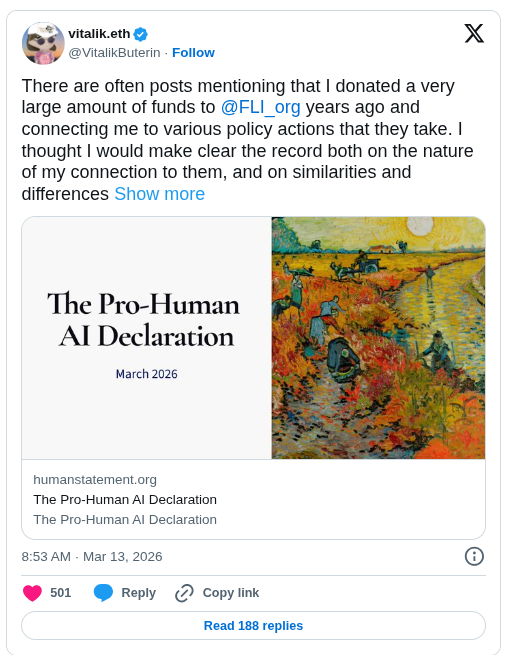
According to Buterin, the events began in 2021 when he unexpectedly received large quantities of meme tokens, including Shiba Inu and other similar assets. He said the tokens were sent to him by project creators who used the narrative that “Vitalik owns half the supply” as a marketing strategy to promote their tokens.
As the meme token market surged, the book value of the assets in his wallet temporarily exceeded $1 billion. Buterin stated that he believed the rapid appreciation represented a bubble and expected prices to decline sharply.
Converting and Donating the Tokens
Buterin attempted to move and liquidate part of the holdings from his cold wallet to convert them into Ethereum and donate to various charitable causes. He noted that some funds were directed to organizations such as GiveWell.
However, a substantial amount of SHIB remained. Buterin said he decided to distribute the remaining tokens between two organizations:
- CryptoRelief
- Future of Life Institute
He noted that CryptoRelief later directed a portion of the funds to the Balvi initiative and that another portion was used by the team led by Sandeep Nailwal to support medical infrastructure development in India.
Buterin initially expected the recipients would only be able to liquidate a small portion of the tokens, estimating between $10 million and $25 million, due to liquidity constraints in the SHIB market at the time. Instead, he said both organizations ultimately managed to convert around $500 million worth of tokens.
Differences in Approach to AI Risk
Buterin also addressed differences between his views and the current direction of the Future of Life Institute.
He said that when the donation was made, FLI presented a roadmap focused on addressing multiple existential risks, including biological threats, nuclear risks, and artificial intelligence. Over time, he noted, the organization shifted its strategy toward cultural and political advocacy related to AI governance.
FLI has argued that the pivot reflects rapid advancements in artificial intelligence and the possibility that artificial general intelligence (AGI) could emerge sooner than expected.
Buterin expressed concern that large-scale political campaigns supported by significant financial resources could produce unintended consequences or global backlash.
Technology-Focused Approach
Buterin stated that his preferred strategy centers on technological solutions that can help societies manage increasingly powerful technologies. He described this approach as focusing on building tools that enhance resilience against risks such as pandemics, cybersecurity threats, and advanced AI.
Examples he cited include:
- Air filtering and early detection technologies for pandemics
- Continuous air testing systems
- Improved hardware and software verification for cybersecurity
- Secure hardware development to protect digital systems
He added that part of a recent $40 million funding allocation has been directed toward research and development in secure hardware systems.
Continued Support for Some FLI Initiatives
Despite the differences, Buterin acknowledged several initiatives from the Future of Life Institute that he views positively. These include the organization’s “pro-human AI declaration,” which aims to build consensus across political and ideological groups on the development and governance of artificial intelligence.
He said he hopes the organization continues pursuing initiatives designed to reduce concentration of power in the AI sector while approaching the issue with caution. Ethereum co-founder Vitalik Buterin recently discussed the potential of AI-powered crypto wallets.