



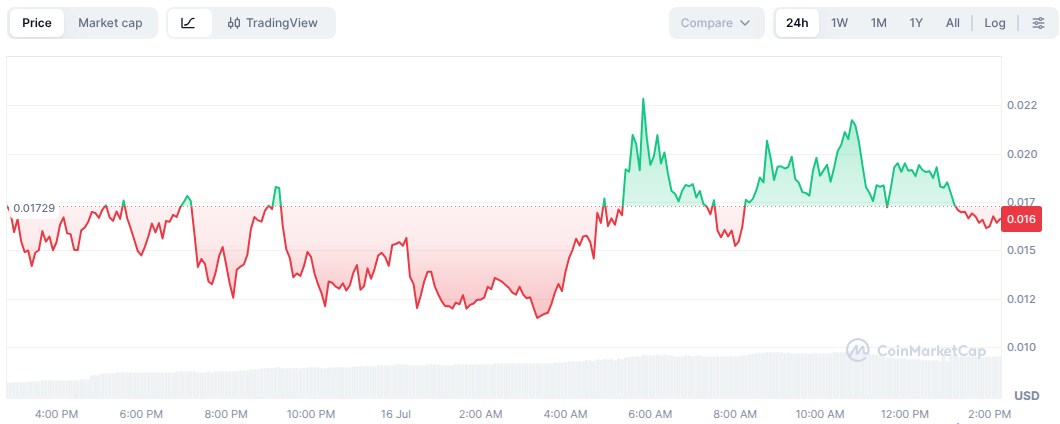
Robinhood Chain ecosystem token $INDEX surged more than 157% over the past 24 hours, lifting its market capitalization above $16 million as traders focused on a reward model that converts blockchain trading fees into tokenized equity distributions. The rally coincided with renewed developer interest in Robinhood Chain after CEO Vlad Tenev encouraged builders to develop applications around tokenized stocks and real-world assets (RWAs).
Unlike many ecosystem tokens that distribute newly issued crypto assets as incentives, $INDEX is designed to channel a portion of protocol-generated fees into purchasing tokenized stocks. Those assets are then distributed to eligible token holders, creating a reward structure tied to activity on the blockchain rather than token inflation.
Key Highlights
-
- $INDEX gained more than 157% in 24 hours.
- The token’s market capitalization climbed above $16 million.
- Robinhood Chain uses trading fees to purchase tokenized equities such as Nvidia (NVDA), Apple (AAPL), and Alphabet (GOOG) for distribution to holders.
- The move followed renewed attention on Robinhood Chain’s tokenized asset ecosystem after recent comments from Robinhood CEO Vlad Tenev.
Market Snapshot
Despite the sharp rally, $INDEX retraced part of its gains during later trading. As of 08:46 UTC, the token was changing hands at $0.01673, down 8.67% over the previous 24 hours. Even with the pullback, $INDEX retained a market capitalization of $16.75 million, while 24-hour trading volume surged 157.46% to $5.93 million, indicating that market activity remained elevated. The token has a total and maximum supply of 1 billion, all of which are reported to be in circulation, resulting in a fully diluted valuation (FDV) of approximately $16.73 million.
Fee-Based Rewards Differentiate the Token
The feature drawing market attention is not simply the token’s price movement but the mechanism supporting its rewards. Instead of relying on emissions, the protocol links distributions to Robinhood Chain fees generated through trading activity across the network.
As decentralized exchanges generate fees, those proceeds are pooled to acquire tokenized equities. The approach effectively connects blockchain usage with exposure to traditional financial assets, creating a model that differs from conventional staking rewards that are typically paid in native tokens.
This also means rewards are influenced by network usage. Higher trading volumes can expand the fee pool available for purchasing stock-backed tokens, while lower activity could reduce distributions.
Robinhood Chain Activity Provides Context
The token rally comes alongside rapid growth across Robinhood Chain following its July launch.
Recent ecosystem metrics highlighted by multiple market trackers include:
-
- More than $560 million in daily decentralized exchange volume.
- Around 7.6 million daily transactions.
- More than $3 billion in weekly DEX trading volume.
Those figures are significant because the reward model depends on fees generated by network activity rather than solely on speculative demand for the token itself.
Developer Push Adds Momentum
Market participants also linked the rally to recent comments from Robinhood CEO Vlad Tenev, who invited developers to build applications using tokenized stocks and RWAs on Robinhood Chain.
While we’re building robinhood chain to be the best chain for RWA … it works great for memes too
— Vlad Tenev (@vladtenev) July 8, 2026
The remarks reinforced Robinhood’s broader strategy of positioning the chain as infrastructure for tokenized financial assets while emphasizing Robinhood Chain security and remaining open to broader crypto applications. Increased developer participation could expand network activity over time, potentially increasing fee generation if adoption continues.
Why the Rally Stands Out
While ecosystem tokens often react to announcements or exchange listings, $INDEX has attracted attention because its value proposition is tied to a measurable economic mechanism rather than governance alone.
Key differences include:
-
- Rewards are funded through protocol-generated trading fees.
- Distributions consist of tokenized equity assets rather than newly minted ecosystem tokens.
- Token holders’ potential rewards depend on sustained blockchain usage instead of fixed emission schedules.
Whether that model proves durable will depend on Robinhood Chain maintaining high trading volumes and continued developer adoption, while Robinhood’s broader crypto expansion, including Robinhood perpetual futures, could keep attention on the ecosystem. A slowdown in network activity would directly affect fee generation, making blockchain usage an important factor in the long-term economics of the token.
Disclaimer: Cryip's content is strictly for educational and informational purposes and does not constitute financial, legal, or investment advice. Cryptocurrency involves significant risk, and readers assume full responsibility for their own financial decisions. Asset references are never endorsements.
To make complex crypto topics accessible to readers at all experience levels, our team uses AI tools strictly to refine language, correct grammar, and simplify terminology. AI is never used to draft facts, source information, or form conclusions. Every article is fact-checked and approved by a human editor before publication. Read our full AI Use & Content Policy.