



- Visa said Aug. 25 it joined the Monetary Authority of Singapore’s BLOOM initiative, naming cross-border payments firm Nium as its first partner to settle transactions in stablecoins seven days a week.
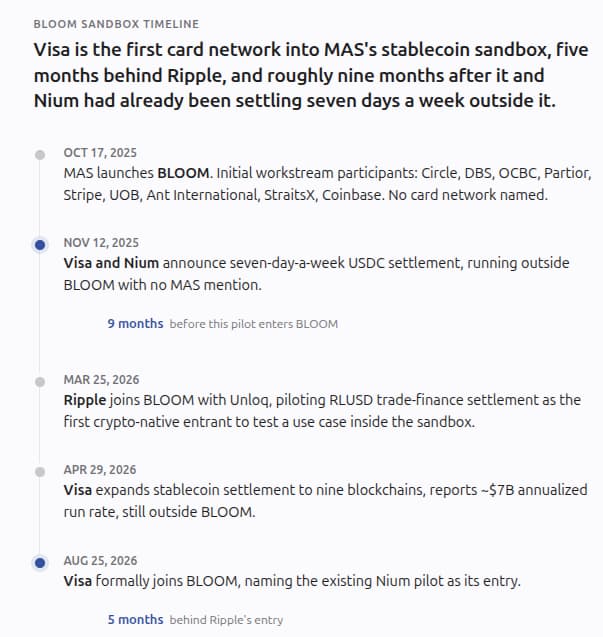
- Visa and Nium announced that same seven-day settlement capability, running on Circle’s USDC, on Nov. 12, 2025, roughly nine months before BLOOM entered the picture.
- Ripple was the first crypto-native firm to test a use case inside BLOOM, joining in March 2026, five months ahead of Visa.
Visa said Tuesday it has joined the Monetary Authority of Singapore’s BLOOM initiative, naming Nium as its first partner for a pilot that settles transactions in stablecoins seven days a week, including weekends and public holidays. The pilot uses U.S. dollar and euro-denominated stablecoins backed by major currencies, Visa said.
Today, Visa announced it’s joined MAS-led BLOOM, with Nium as the first partner. Through this pilot, we’re enabling 24/7 settlement and seamless interoperability for the region’s businesses and their customers.
As Nium Chief Compliance & Risk Officer Amaresh Mohan said: “BLOOM… pic.twitter.com/n1uK8W38XR
— Nium (@NiumGlobal) August 25, 2026
Visa and Nium announced the same seven-day settlement mechanic, running on Circle’s USDC, on Nov. 12, 2025, without mentioning MAS or any regulatory sandbox. What actually changed this week is that an already-running bilateral pilot moved inside Singapore’s regulated framework, nearly a year after that framework opened.
The scope did widen slightly: November’s pilot named only USDC, while Tuesday’s version adds euro-denominated stablecoins. The core mechanic Visa is presenting as new, always-on, seven-day settlement, is the one it already announced 286 days earlier.
“Businesses have long been constrained by settlement cycles that move on the cadence of clearing schemes and banks, not on the cadence of global commerce,” Nium chief payments officer Alex Johnson said when the pilot was first announced in November 2025.
BLOOM’s Timeline Puts Visa’s Nium Pilot in Context
BLOOM launched Oct. 17, 2025, building on Singapore’s earlier Project Orchid work, according to MAS chief fintech officer Kenneth Gay. Its first workstream lineup named Circle, DBS, OCBC, Partior, Stripe and UOB for settlement-asset distribution, Ant International and StraitsX for compliance controls, and Coinbase for agentic payments. No card network was among them.
Ripple filled that gap first. It joined BLOOM in March 2026 with trade-finance firm Unloq, piloting programmable settlement in its own RLUSD stablecoin on the XRP Ledger. Visa followed five months later, and only after running the Nium mechanic on its own rails, outside any sandbox, for the better part of a year.
Visa and Nium’s Broader Stablecoin Push
Visa’s BLOOM entry is a small piece of a larger stablecoin push. The company expanded its stablecoin settlement pilot to nine blockchains, including Ethereum, Solana and Stellar, on April 29, 2026, reporting an annualized settlement run rate of about $7 billion. Visa has also expanded its blockchain presence through the Canton Network Super Validator role. That volume was already flowing before Tuesday’s announcement and had nothing to do with MAS.
Mastercard is chasing similar ground from a different angle. It agreed in March 2026 to buy stablecoin infrastructure firm BVNK for $1.8 billion and closed that deal in August, giving it its own settlement rails rather than a regulator’s sandbox seat. Visa’s work on Open USD and its move into BLOOM, alongside Mastercard’s purchase of BVNK, point at the same pattern from opposite directions: both card networks built stablecoin settlement capability first and sought a regulator’s framework, or a company to buy, only afterward.
Whether other card networks follow that same order, pilot first, sandbox or acquisition second, will say more about how this technology actually gets adopted than any single name added to a BLOOM roster. Visa’s presence there formalizes a capability it already had. It does not yet show that Singapore’s sandbox is shaping what card networks build, rather than approving what they already did.
Disclaimer: Cryip's content is strictly for educational and informational purposes and does not constitute financial, legal, or investment advice. Cryptocurrency involves significant risk, and readers assume full responsibility for their own financial decisions. Asset references are never endorsements.
To make complex crypto topics accessible to readers at all experience levels, our team uses AI tools strictly to refine language, correct grammar, and simplify terminology. AI is never used to draft facts, source information, or form conclusions. Every article is fact-checked and approved by a human editor before publication. Read our full AI Use & Content Policy.