


- BitMine bought 28,086 ETH over the past week, lifting its total holdings to 5,929,198 ETH, or 4.9 percent of Ethereum’s entire supply, worth about $14.8 billion.
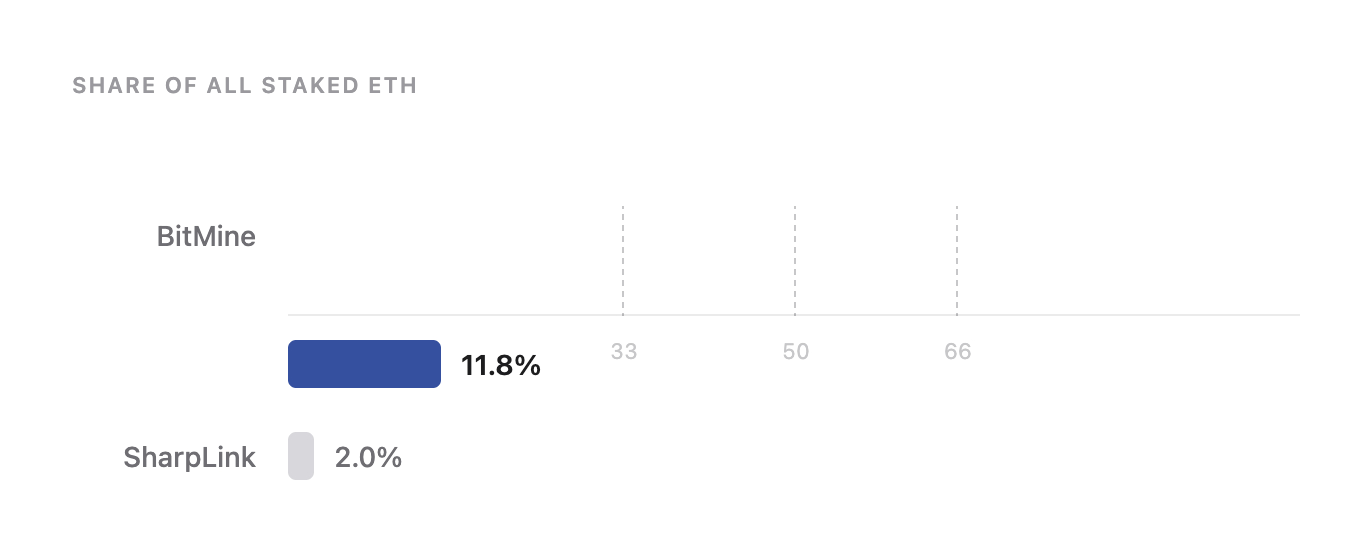
- The company’s own validator network stakes roughly 11.8 percent of all ETH currently staked on Ethereum, about six times the share held by SharpLink Gaming, the next-largest public ETH treasury.
- That puts BitMine near the scale of major exchanges like Coinbase, whose own validators staked about 12 percent of the network in early 2026, and both remain well short of the roughly 33 percent threshold where single-entity concentration threatens Ethereum’s finality.
BitMine Immersion Technologies bought 28,086 ETH over the past week, the Nasdaq-listed company said in a Sept. 8 release, lifting its total holdings to 5,929,198 ETH, or 4.9 percent of Ethereum’s entire supply.
A different number, one line down in the same release, is more unusual than the supply figure BitMine promotes. Its own validator network now stakes close to 12 percent of everything staked on Ethereum, a share that rivals major exchanges and dwarfs every other public ETH treasury company.
At $2,495 per ETH, BitMine’s stake is worth about $14.8 billion. Chairman Tom Lee said the company has now bought ETH for 65 straight weeks.
“Bitmine’s track record of consistent buying of crypto is unmatched by any public company,” Lee said.
Its Validator Share Is Larger Than Its Supply Share
Of BitMine’s ETH, 5,067,309 tokens, or 85 percent of its holdings, are staked directly through the company’s own validator network. Staking locks ETH into Ethereum’s system of network validators, who confirm transactions in exchange for rewards.
Roughly 42.9 million ETH is staked across the entire network as of this week, according to live data from the tracker validatorqueue.com. That puts BitMine’s own validators at about 11.8 percent of everything staked on Ethereum.
At least one estimate published this week put that figure at 13 percent, using an older, smaller total-staked count. Measured against current network data, BitMine’s actual share is a bit smaller, though still unusual for a single company.
Built as One Company’s Infrastructure, Not a Shared Pool
The distinction matters because BitMine’s validator network, called MAVAN, is not a decentralized pool like Lido or Rocket Pool, where thousands of independent operators split the work. BitMine built MAVAN as its own proprietary infrastructure when it launched the platform in March, with the stated goal of becoming, in the company’s words, “the largest Ethereum staking service provider globally.”
No other publicly traded ETH treasury company comes close to that scale. SharpLink Gaming, the next-largest, holds 868,699 ETH and has told the SEC that substantially all of it is staked too. Even so, its stake is about a seventh the size of BitMine’s.
Still Short of Where Concentration Turns Risky
BitMine is not alone in running a single company’s validators at this scale. Coinbase’s own validator infrastructure staked 4.5 million ETH in early 2026, about 12 percent of the network at the time, according to the exchange’s own performance report. Coinbase has said it will not let that figure exceed 30 percent.
Ethereum’s own protocol documentation lays out why that ceiling matters. A single entity controlling roughly a third of all staked ETH can prevent the network from finalizing blocks. Above half, it can dominate which chain gets built on. Above two-thirds, it can force through reversions. BitMine’s 11.8 percent, like Coinbase’s, is well short of any of those lines.
BitMine has said nothing about capping its own share the way Coinbase has. Its public target has only ever been about supply, not stake.
Disclaimer: Cryip's content is strictly for educational and informational purposes and does not constitute financial, legal, or investment advice. Cryptocurrency involves significant risk, and readers assume full responsibility for their own financial decisions. Asset references are never endorsements.
To make complex crypto topics accessible to readers at all experience levels, our team uses AI tools strictly to refine language, correct grammar, and simplify terminology. AI is never used to draft facts, source information, or form conclusions. Every article is fact-checked and approved by a human editor before publication. Read our full AI Use & Content Policy.