


- Harmony has proposed retiring its seven-year-old layer-1 blockchain entirely and migrating the ONE token to Ethereum as an ERC-20, through an automatic snapshot and airdrop.
- Validators can begin shutting down nodes on September 10, 2026, and users must exit smart contracts and liquidity pools by then, since none of that can migrate.
- The move follows an August 12 exploit that let an attacker mint roughly 4 billion unauthorized ONE tokens, about 26% of the network’s supply.
Harmony has proposed shutting down its layer-1 blockchain and moving its native ONE token to Ethereum, telling validators they can begin powering down their nodes starting September 10.
The proposal, posted to Harmony’s official X account on September 6, is officially non-binding. But the network has already set a working deadline: any ONE sitting in smart contracts, liquidity pools, or multisig wallets needs to come out before that date, because none of it is able to make the jump to Ethereum.
Everything else moves on its own. Harmony plans to take a final snapshot of ONE balances across user wallets, staking delegations, validator rewards, and centralized exchanges, then issue matching ERC-20 tokens to the same addresses on Ethereum. Holders do not need to file a claim. Total supply and Harmony’s existing emission schedule are meant to stay the same.
Validators who shut down on schedule, keep their stakes, and sign on as what Harmony is calling “governors” can draw from a $1.372 million pool, paid out over four quarters.
A chain’s security budget becomes an AI video budget
Harmony’s stated reason is blunt. “The threats posed by state actors and AI agents are too great,” the team wrote in the proposal.
That framing follows a rough month. On August 12, an attacker exploited a flaw in Harmony’s cross-shard verification and minted roughly 4 billion unauthorized ONE tokens, about 26% of the network’s 14.87 billion supply. Harmony said the attacker had already moved 97% of that haul to exchanges before the team could freeze it, and the network later rolled back more than 141,000 blocks on one shard to undo the damage, a decision that also erased over 109,000 legitimate transactions along with it. A handful of reports put the gross issuance far higher, near 3 trillion ONE; that figure traces to duplicate cross-shard receipts in the same incident rather than a second exploit, and Harmony’s own reckoning of the net damage, about 4 billion tokens, is the one that actually lines up with the network’s supply.
Under the plan, the ONE emissions that once paid validators to secure the network would instead fund something unrelated: a subscription platform Harmony calls the “Remix Economy for AI Video,” where creators publish open prompts and assets that fans and AI agents can remix into new clips. Subscriptions run $10 a month, promoters keep a 30% commission on subscribers they refer, and Harmony is projecting “tens of millions of dollars” in advertising revenue if the platform reaches a million users. Individual operators, the company says, could earn up to $1 million in the first year.
Harmony frames all of this as a response to a categorically new threat, attackers using AI agents to find exploits that used to take state actors years to build. But its own numbers tell a plainer story too. The network’s market cap sits near $10.6 million. ONE trades at roughly $0.0007, more than 99% below its October 2021 high of $0.38. DeFi activity on the chain has fallen to about $45,000 in locked value, per DefiLlama, down 68% in the past day alone as users appear to be pulling funds ahead of the deadline. Independently securing a network that small was already a losing trade before any AI agent showed up.
Harmony joins BounceBit in choosing retirement
Harmony is not the first layer-1 to make this exact call this year. On August 21, BounceBit announced it would retire its own blockchain and reissue its BB token on BNB Chain after an attacker moved 286.5 million BB, worth about $3 million, in an exploit that began the day before. Harmony took about 25 days to go from exploit to retirement announcement. BounceBit did it inside a week.
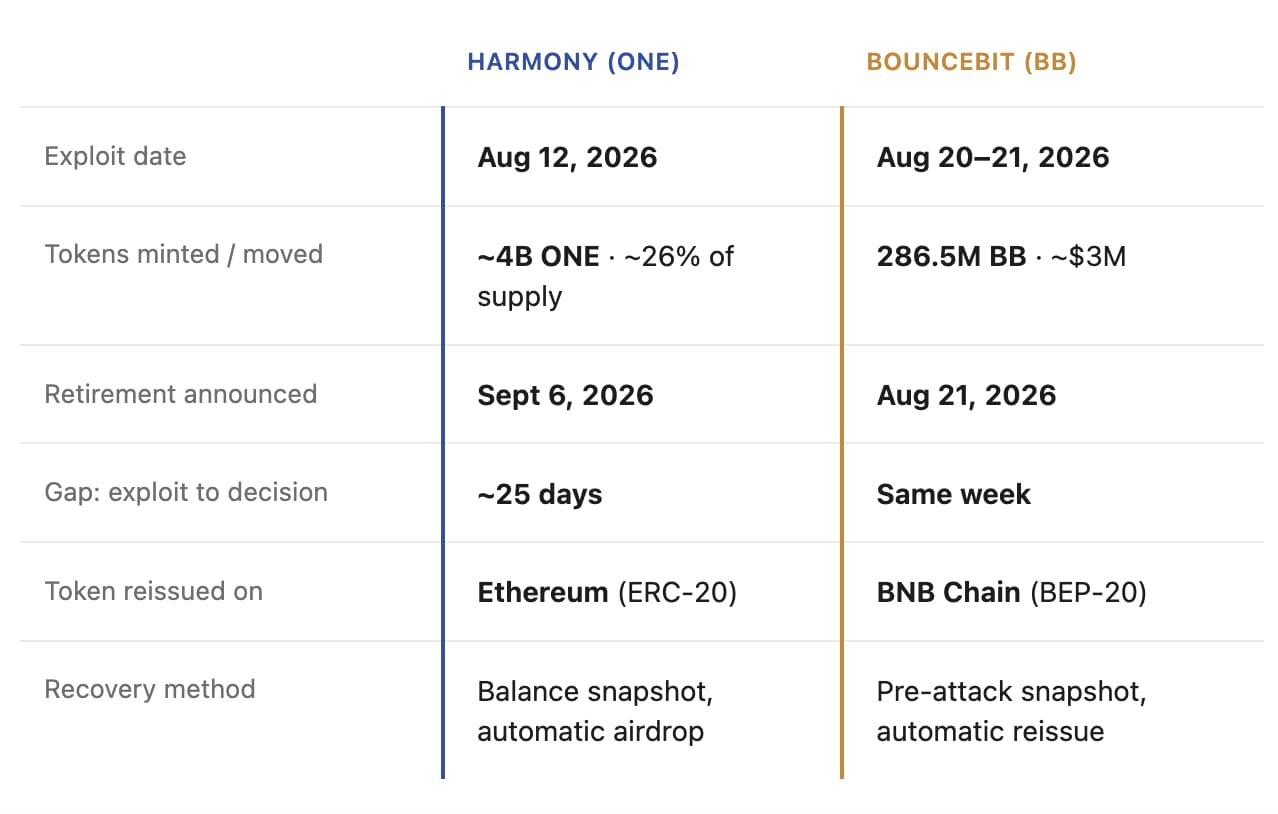
The mechanics are nearly identical: a final-block or pre-attack snapshot, an automatic reissue on a bigger chain, no claim required. That is a different move than the one Celo made in 2025, when it became an Ethereum layer-2 rather than shutting down. Celo kept its chain, its applications, and its validators, who stayed on as sequencers. Harmony and BounceBit are not upgrading. They are closing.
Whether Harmony’s governance vote, which needs 51% of staked ONE to take part and two-thirds approval, actually happens is still open. No dedicated thread on Harmony’s own community forum has appeared for this proposal as of publication, only the September 6 posts on its X account. What is not in question is the deadline validators are already working against: September 10, when the chain that once marketed itself as an “Ethereum killer” starts allowing itself to be switched off.
Disclaimer: Cryip's content is strictly for educational and informational purposes and does not constitute financial, legal, or investment advice. Cryptocurrency involves significant risk, and readers assume full responsibility for their own financial decisions. Asset references are never endorsements.
To make complex crypto topics accessible to readers at all experience levels, our team uses AI tools strictly to refine language, correct grammar, and simplify terminology. AI is never used to draft facts, source information, or form conclusions. Every article is fact-checked and approved by a human editor before publication. Read our full AI Use & Content Policy.