



- Polymarket has been blocked in India following enforcement measures targeting online prediction market platforms.
- Kalshi could face similar action, according to people familiar with the matter, though it remains accessible in India at publication time.
- Authorities classify prediction markets as online money games under the Promotion and Regulation of Online Gaming Act 2025.
- Indian regulators continue scrutiny of crypto-linked financial activity, including stablecoin use and capital movement concerns.
- Argentina also blocked Polymarket in March following a court ruling related to gambling regulations.
MeitY Acts Against Polymarket
Polymarket has been blocked in India after authorities increased enforcement against platforms they classify as illegal online money gaming services. According to reports advisory issued by the Ministry of Electronics and Information Technology (MeitY), internet service providers and VPN operators were instructed to prevent local users from accessing “illegal and blocked prediction market and online betting platforms.” Polymarket was included among the platforms listed in the advisory.
Users attempting to access Polymarket from India are now presented with a connection error page indicating that the website cannot be reached. Refreshing the page does not restore access.
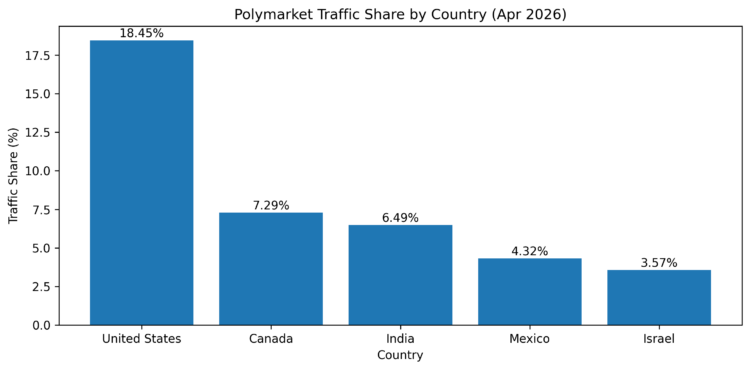
India has also emerged as a notable source of traffic for Polymarket. According to Similarweb data for April 2026, India accounted for approximately 6.49% of visits to the platform, ranking among its top user markets behind the United States and Canada. The data also showed a 37.15% increase in traffic share from India during the period, highlighting continued user interest in prediction market platforms despite increasing regulatory scrutiny. The growth underscores India’s significance as a digital market for global prediction platforms, even as authorities move to restrict access under the country’s online gaming framework.
People familiar with the matter told local media that MeitY has already issued a blocking order against Polymarket and may take similar action against Kalshi, a U.S.-regulated prediction market platform overseen by the Commodity Futures Trading Commission (CFTC). Kalshi remained accessible in India as of publication.
Prediction Markets Classified Under Online Gaming Rules
Indian authorities have increasingly categorized prediction markets as “online money games” under the Promotion and Regulation of Online Gaming Act 2025. Under the legislation, platforms that allow users to deposit real money on uncertain outcomes may be treated as prohibited betting activity, regardless of whether operators describe the services as forecasting or research tools.
Government officials have stated that platforms linked to binary event speculation may expose users to financial distress and gambling-related harm, particularly among younger digital-native users. Regulatory documents associated with the PROG framework also identify offshore prediction market platforms as high-risk services due to their use of cryptocurrency payments and stablecoin-based settlement systems.
Regulators Continue Oversight of Crypto-Linked Financial Activity
Indian regulators have continued examining cryptocurrency-related financial activity through capital control and anti-money laundering frameworks. Discussions involving the Ministry of Finance and the Reserve Bank of India have focused on concerns that decentralized platforms could enable movement of capital outside the domestic banking system through stablecoins such as USDC. Parliamentary discussions concerning the virtual digital assets sector have also addressed concerns regarding potential tax evasion and unmonitored capital outflows through crypto-related channels.
Earlier this week, India’s Parliamentary Standing Committee on Finance met representatives from crypto exchanges including Binance, WazirX, and ZebPay in New Delhi to discuss taxation and regulatory matters affecting the virtual digital asset industry. Committee members raised concerns about large capital movements through cryptocurrency channels.
India has not introduced a direct constitutional ban on cryptocurrencies. However, authorities have imposed a 30% tax on crypto gains and a 1% tax deducted at source on transactions while placing the sector under Financial Intelligence Unit monitoring and compliance requirements. Several cryptocurrency startups have relocated operations to jurisdictions including Dubai and Singapore, citing regulatory uncertainty and taxation policies in India. On March 23, a bipartisan bill led by Senators Adam Schiff and John Curtis was introduced to ban sports betting on CFTC-regulated prediction market platforms, including Kalshi and Polymarket, while also covering casino-style gaming products.
Regulatory pressure on prediction markets has also increased internationally. In March, Argentina ordered internet service providers to block Polymarket after a Buenos Aires court concluded that the platform operated outside the country’s gambling framework. Authorities in Argentina cited concerns related to cryptocurrency-based payments, identity verification standards, and the handling of markets connected to sensitive economic data.
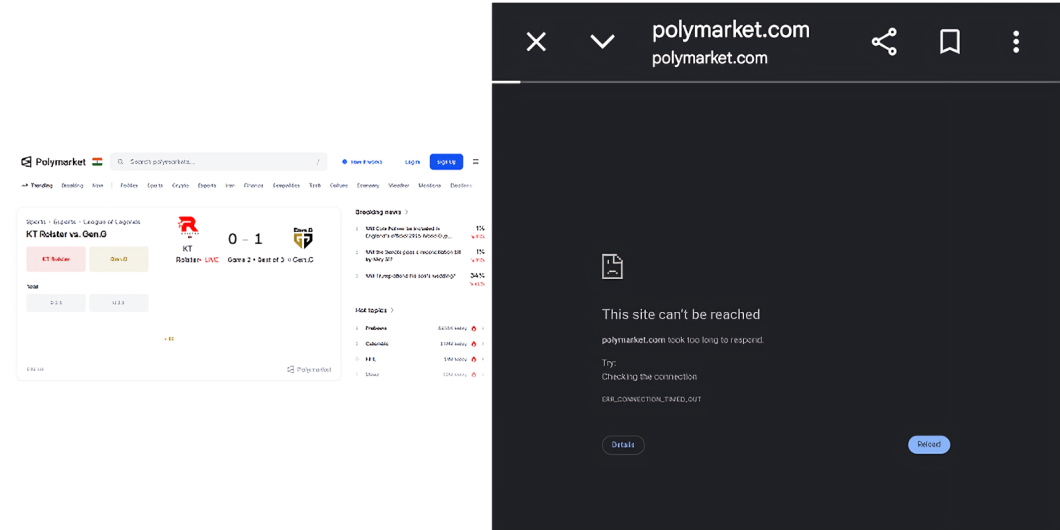
Our team also tested access to Polymarket through multiple ISPs across India and found mixed results, with the platform remaining accessible on certain broadband and mobile networks while showing timeout or connection errors on others. The inconsistent availability suggests that the restrictions may currently be enforced selectively at the ISP level, leading to varying user experiences depending on the telecom provider, network routing, and region.
Polymarket Targets Japan Expansion
Recently, Polymarket is seeking government authorization to operate prediction markets in Japan by 2030. The company reportedly views Japan as a significant growth opportunity despite the country’s current restrictions on such services. Polymarket recently appointed a representative in Japan as the company explores expansion opportunities in the country and seeks government authorization to operate prediction markets by 2030. Japan is currently listed as a restricted jurisdiction on Polymarket’s website. Japanese law imposes penalties for habitual gambling and operating gambling businesses, while certain exceptions exist under the legal framework.
Disclaimer: Cryip's content is strictly for educational and informational purposes and does not constitute financial, legal, or investment advice. Cryptocurrency involves significant risk, and readers assume full responsibility for their own financial decisions. Asset references are never endorsements.
To make complex crypto topics accessible to readers at all experience levels, our team uses AI tools strictly to refine language, correct grammar, and simplify terminology. AI is never used to draft facts, source information, or form conclusions. Every article is fact-checked and approved by a human editor before publication. Read our full AI Use & Content Policy.