
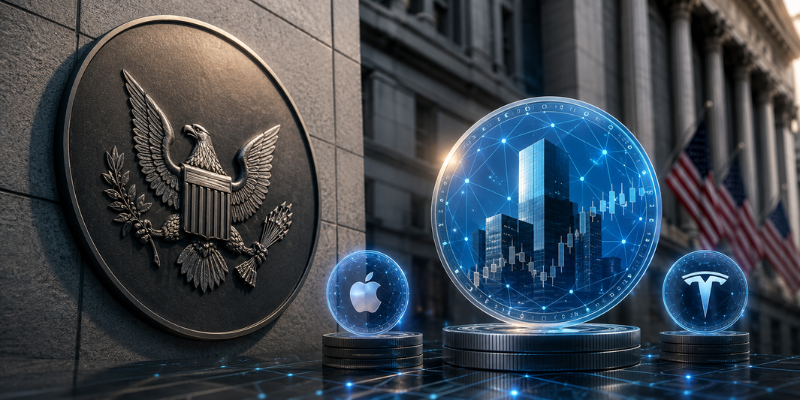


The U.S. Securities and Exchange Commission (SEC) has postponed a widely anticipated framework that would have granted broad exemptions to crypto firms for trading tokenized versions of American stocks, according to people familiar with the matter.
The agency’s staff had prepared a draft of the so-called “innovation exemption” for tokenized stocks and was initially set to release it as early as this week. However, the timeline has been pushed back as regulators review feedback from traditional stock exchange officials and other market participants who raised concerns in recent discussions.
Tokenized stocks refer to blockchain-based digital assets designed to track the price and performance of traditional equities, such as shares of Apple or Tesla. Proponents argue that these instruments could bring greater efficiency, 24/7 trading, and broader global access to U.S. markets through decentralized finance (DeFi) platforms.
Shift in Regulatory Approach
The proposed exemption represented a significant departure from previous SEC stances under earlier administrations, aligning with the current crypto-friendly environment. Earlier reports indicated the plan could allow third-party issuers to create tokens without direct backing or consent from the underlying public companies, potentially enabling trading on crypto exchanges with lighter regulatory requirements.
This move was seen as part of a broader push by the Trump administration to integrate crypto more deeply into traditional finance. Just days ago, sources suggested the SEC was preparing to accelerate such innovations.
Reasons for the Delay
The delay appears driven by pushback from Wall Street incumbents worried about potential risks. Traditional market players have expressed concerns over liquidity fragmentation, investor protection, market stability, and the possibility that synthetic tokenized versions could undermine established stock exchanges.
Critics, including major firms and industry groups, have argued that such structural changes warrant a formal rulemaking process rather than exemptions. Issues such as shareholder rights (including voting and dividends), settlement finality, and potential for misuse have also been highlighted in ongoing discussions.
SEC Commissioner Hester Peirce, often known as “Crypto Mom,” recently indicated that any exemption would likely be “much narrower than a blanket exemption,” tempering expectations within the industry.
Market Context
The tokenized real-world assets (RWA) sector has experienced explosive growth, reaching record levels of approximately $33–34 billion in recent months.Despite the regulatory pause, market enthusiasm remains high, with platforms and firms like Jump Trading and Securitize already exploring tokenized stock initiatives.Crypto stocks reacted positively to the initial news of the planned exemption but showed mixed movements following the delay report.No new timeline for the proposal has been announced. The SEC continues to review input as it balances innovation with investor safeguards in an evolving digital asset landscape.
Disclaimer: Cryip's content is strictly for educational and informational purposes and does not constitute financial, legal, or investment advice. Cryptocurrency involves significant risk, and readers assume full responsibility for their own financial decisions. Asset references are never endorsements.
To make complex crypto topics accessible to readers at all experience levels, our team uses AI tools strictly to refine language, correct grammar, and simplify terminology. AI is never used to draft facts, source information, or form conclusions. Every article is fact-checked and approved by a human editor before publication. Read our full AI Use & Content Policy.