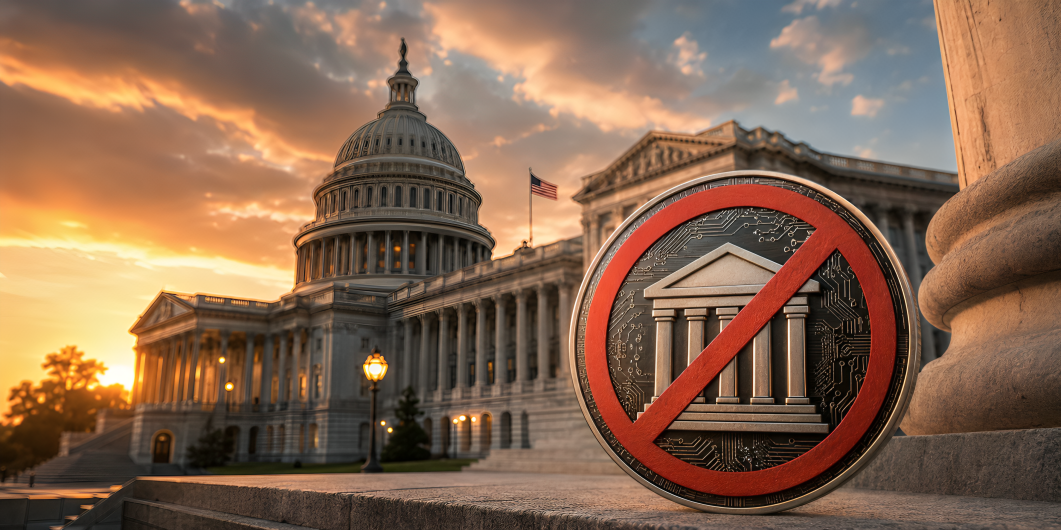


- Republican lawmakers are calling for a permanent ban on a US CBDC.
- The amended House bill removes the previous 2030 sunset provision.
- The legislation is expected to face a House vote this week.
- Tom Emmer continues to support the Anti-CBDC Surveillance State Act.
- Critics argue CBDCs could create risks related to privacy and government control.
House Republicans Seek Permanent CBDC Ban
A pair of Republican lawmakers is calling for a permanent ban on a United States central bank digital currency (CBDC) to be included in the 21st Century ROAD to Housing Act ahead of a planned House vote this week. The bill released by the US Senate Committee on Banking, Housing and Urban Affairs in March primarily focused on revisions to federal housing programs. The Senate version also included a provision banning the Federal Reserve System or any Federal Reserve bank from issuing a CBDC or similar instrument until Dec. 31, 2030.
The US House later introduced an amended version of the legislation. Congressman Mike Flood said the updated bill removes what he described as a “backdoor green light for a CBDC” by making the restriction permanent rather than temporary. If the amended legislation passes the House vote this week, it will return to the Senate for further consideration and possible amendments. The bill must pass both chambers of Congress before it can be sent to President Donald Trump to be signed into law.
Lawmakers Raise Concerns Over CBDC Development
Critics of CBDCs have raised concerns regarding privacy, surveillance, and government control. The Human Rights Foundation stated that while CBDCs could improve financial inclusion for people with limited access to financial services, they could also create risks related to privacy and potential government misuse.
The US House of Representatives could deliver a unifying win this week with bipartisan housing affordability legislation. Instead, they currently plan to deliver a go-live date for Central Bank Digital Currency (CBDC), using housing as the Trojan Horse.
Sadly, it’s being… pic.twitter.com/YTaAlr2XP3
— Warren Davidson 🇺🇸 (@WarrenDavidson) May 18, 2026
“Sadly, it’s being pitched as a ban, but the 2030 sunset works a pre-launch development period,” Warren Davidson stated.
US Representative Warren Davidson supported efforts to make the CBDC restriction permanent. Davidson said the existing 2030 sunset clause could allow a “pre-launch development period” for a future digital dollar. According to data tracked by the Atlantic Council, only Nigeria, Jamaica, and the Bahamas have fully launched CBDCs, while dozens of countries remain in pilot programs or research phases.
Separate Anti-CBDC Bills Remain Active
The Chinese Communist Party uses a central bank digital currency (CBDC) to surveil and control its people.
If the U.S. adopted its own CBDC, privacy and economic freedom as we know it would cease to exist.
My Anti-CBDC Surveillance State Act BANS our government from ever…
— Tom Emmer (@GOPMajorityWhip) May 18, 2026
If the U.S. adopted its own CBDC, privacy and economic freedom as we know it would cease to exist. My Anti-CBDC Surveillance State Act BANS our government from ever creating this Orwellian tool. The House passed it. Now, the Senate must act.
House Majority Whip Tom Emmer is also advocating for the Anti-CBDC Surveillance State Act, legislation aimed at preventing the Federal Reserve from creating or issuing a CBDC. The bill passed the House on July 17 but has not yet received full Senate approval. Emmer stated that a US CBDC could threaten privacy and economic freedom and cited concerns over government surveillance.
Separately, Senator Mike Lee previously introduced the “No CBDC Act,” a standalone bill designed to prohibit the Federal Reserve or the Treasury Department from issuing a CBDC. The proposal did not advance in Congress.
Recently, the Senate Banking Committee advanced the CLARITY Act with a 15-9 vote despite opposition from Elizabeth Warren, who introduced 44 amendments and warned the bill could weaken investor protections. The move signals growing momentum in Washington toward clearer crypto regulations and digital asset oversight.
FAQs
1. What is the proposed US CBDC ban?
The proposed legislation would permanently prohibit the Federal Reserve and regional Federal Reserve banks from issuing a US central bank digital currency (CBDC).
2. Why are Republican lawmakers opposing a CBDC?
Some Republican lawmakers argue that a CBDC could create privacy concerns and increase government surveillance over financial transactions.
3. What is the Anti-CBDC Surveillance State Act?
The Anti-CBDC Surveillance State Act is a bill supported by House Majority Whip Tom Emmer that aims to block the Federal Reserve from creating or issuing a CBDC.
4. Which countries have already launched CBDCs?
According to data referenced in the article, Nigeria, Jamaica, and the Bahamas have fully launched central bank digital currencies.
Disclaimer: Cryip's content is strictly for educational and informational purposes and does not constitute financial, legal, or investment advice. Cryptocurrency involves significant risk, and readers assume full responsibility for their own financial decisions. Asset references are never endorsements.
To make complex crypto topics accessible to readers at all experience levels, our team uses AI tools strictly to refine language, correct grammar, and simplify terminology. AI is never used to draft facts, source information, or form conclusions. Every article is fact-checked and approved by a human editor before publication. Read our full AI Use & Content Policy.