



- Bitcoin plunged from above $75,000 to nearly $61,000, contributing to a crypto market wipeout of more than $500 billion since the start of 2026.
- Spot Bitcoin ETF outflows exceeded $2.8 billion, adding significant selling pressure and accelerating the market correction.
- More than $800 million in leveraged long positions were liquidated after Bitcoin broke key support levels at $70,000 and $67,000.
- Bitcoin has since recovered to around $64,234, but remains below key resistance levels as investors monitor ETF flows and macroeconomic conditions.
- Analysts remain cautious, warning that continued outflows and risk-off sentiment could push BTC toward $58,000 despite signs of short-term stabilization.
The cryptocurrency market has experienced one of the sharpest corrections of the current bull cycle, with more than $500 billion erased from total market capitalization since the start of 2026. Bitcoin led the decline, falling from above $75,000 to around $61,000 and losing over $400 billion in market value. Total crypto market capitalization dropped from more than $2.7 trillion to approximately $2.3 trillion as a combination of institutional outflows, macroeconomic pressures, technical breakdowns, and liquidation events accelerated selling activity.
Bitcoin’s Rapid Decline Unfolded Over Two Days
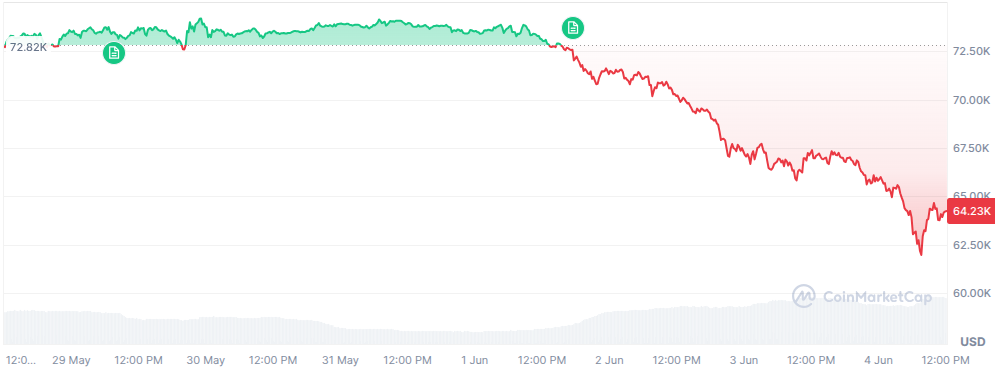
Bitcoin’s selloff accelerated between June 2 and June 3 as bearish momentum intensified across the cryptocurrency market. BTC was trading near $68,900 at 1:10 PM UTC on June 2, already down more than 4% over the previous 24 hours as investors reacted to growing macroeconomic uncertainty and persistent institutional selling pressure.
Later that day, Bitcoin fell below the key $70,000 level at 8:19 UTC, extending losses to more than 3.5%. The break of this psychologically important support level triggered additional selling activity, with traders rushing to reduce risk exposure amid weakening market sentiment. The decline also coincided with continued outflows from U.S. spot Bitcoin ETFs, which added further pressure to the market.
Selling pressure continued into June 3, with BTC dropping to approximately $67,060 at 06:45 UTC, representing a 4.41% daily decline. The move came as broader crypto market capitalization continued to shrink, reflecting risk-off behavior among both retail and institutional investors. Major altcoins also recorded significant losses during the same period, amplifying concerns that the correction could deepen.
The downward move intensified further when Bitcoin slipped below $67,000 at 12:43 PM UTC on June 3, highlighting the severity of the market-wide correction. The breakdown triggered a wave of stop-loss orders and forced liquidations across leveraged trading platforms, accelerating volatility and creating a self-reinforcing cycle of selling pressure.
According to derivatives market data, hundreds of millions of dollars in leveraged positions were liquidated as Bitcoin breached multiple support levels within a short period. The rapid decline underscored the market’s sensitivity to institutional flows, macroeconomic developments, and leveraged trading activity, all of which contributed to one of the sharpest pullbacks of the current bull market cycle.
ETF Outflows Intensify Market Weakness
A major driver behind the decline has been persistent outflows from U.S. spot Bitcoin ETFs. Over recent weeks, these products have recorded more than $2.8 billion in net redemptions, marking one of the longest periods of sustained withdrawals since their launch. According to Farside Investors, U.S. spot Bitcoin ETFs recorded net outflows of $396.6 million on June 3 alone. As ETF issuers sell underlying Bitcoin to meet redemption requests, the additional supply has intensified downward pressure on spot prices and contributed to the broader market correction.
Macroeconomic Concerns Shift Investors Toward Safety
Broader financial market conditions have also contributed to the selloff. Ongoing inflation concerns and expectations of further monetary tightening by central banks have increased bond yields and reduced investor appetite for risk assets. Cryptocurrencies, which are often viewed as high-risk investments, have been particularly vulnerable during this shift toward safer assets.
Technical Breakdown Sparks Liquidation Wave
Bitcoin’s decline below key support levels at $70,000 and $67,000 triggered a wave of stop-loss orders and forced liquidations across leveraged trading platforms. Approximately $800 million in long positions were liquidated within a 24-hour period, amplifying selling pressure and increasing volatility throughout the crypto derivatives market.
Institutional Selling and On-Chain Capitulation Add Pressure
Selling activity from large holders and institutional participants further weighed on the market. On-chain metrics indicate a notable increase in realized losses as Bitcoin traded within the $54,000 to $61,000 range, a historically important cost-basis zone. At the same time, Bitcoin dominance declined to multi-month lows, suggesting some capital rotation into alternative cryptocurrencies despite the broader market downturn.
Market Outlook Remains Uncertain
Technical indicators suggest Bitcoin is approaching oversold conditions, with the Relative Strength Index (RSI) hovering near 33. Analysts are closely monitoring the $60,000 to $63,000 range as a key support area. A short-term relief rally could emerge if ETF outflows moderate and macroeconomic conditions improve. However, continued institutional selling and risk-off sentiment could open the door for a further decline toward the $58,000 level.
Market Outlook Remains Uncertain
Technical indicators suggest Bitcoin is approaching oversold conditions, with the Relative Strength Index (RSI) hovering near 33. Analysts are closely monitoring the $60,000 to $63,000 range as a key support area. A short-term relief rally could emerge if ETF outflows moderate and macroeconomic conditions improve. However, continued institutional selling and risk-off sentiment could open the door for a further decline toward the $58,000 level.
Bitcoin found some short-term support around $61,000. That’s slightly above the February low of just under $60,000. It makes sense that there would be some initial support there. So far it’s bounced over $2,000 off that low. Let’s see how long it lasts.
— Peter Schiff (@PeterSchiff) June 4, 2026
“So far it’s bounced over $2,000 off that low. Let’s see how long it lasts, “Peter Schiff, Chairman of SchiffGold and Founder of SchiffSovereign.
Schiff’s comments reflect broader market uncertainty, as traders debate whether the recent rebound represents the beginning of a sustained recovery or merely a temporary relief rally within a larger correction. Market participants remain focused on ETF flows, macroeconomic developments, and key technical levels for confirmation of the next directional move.
Bitcoin Holds $64,234 as Market Stabilizes After $500 Billion Crypto Selloff
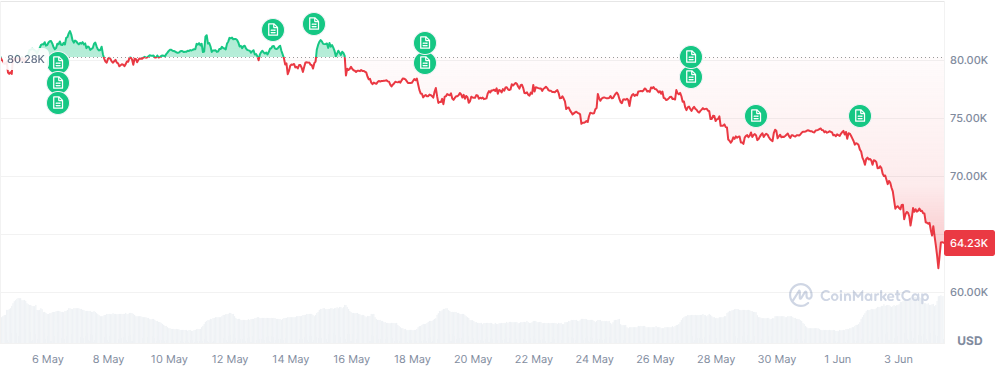
Bitcoin is currently trading at $64,234 as of 6:27 AM UTC, the broader cryptocurrency market has also stabilized slightly following a $500 billion decline in total market capitalization during the recent selloff.
The downturn was driven by sustained spot Bitcoin ETF outflows, macroeconomic uncertainty, and tightening financial conditions. Selling pressure intensified as Bitcoin broke key support levels, triggering leveraged liquidations and forced unwinding of positions across derivatives markets.
Despite the rebound, market sentiment remains cautious, with ETF flows and macro signals continuing to dictate short-term direction. Overall, traders are watching whether Bitcoin can sustain momentum above the mid-$60K range or face renewed downside pressure.
Conclusion
The recent $500 billion market wipeout underscores the cryptocurrency sector’s growing connection to traditional financial markets and its increasing sensitivity to macroeconomic developments. While the correction has been severe, such drawdowns have historically been a recurring feature of crypto market cycles, often creating opportunities for long-term investors during periods of heightened capitulation and uncertainty.
Disclaimer: Cryip's content is strictly for educational and informational purposes and does not constitute financial, legal, or investment advice. Cryptocurrency involves significant risk, and readers assume full responsibility for their own financial decisions. Asset references are never endorsements.
To make complex crypto topics accessible to readers at all experience levels, our team uses AI tools strictly to refine language, correct grammar, and simplify terminology. AI is never used to draft facts, source information, or form conclusions. Every article is fact-checked and approved by a human editor before publication. Read our full AI Use & Content Policy.