
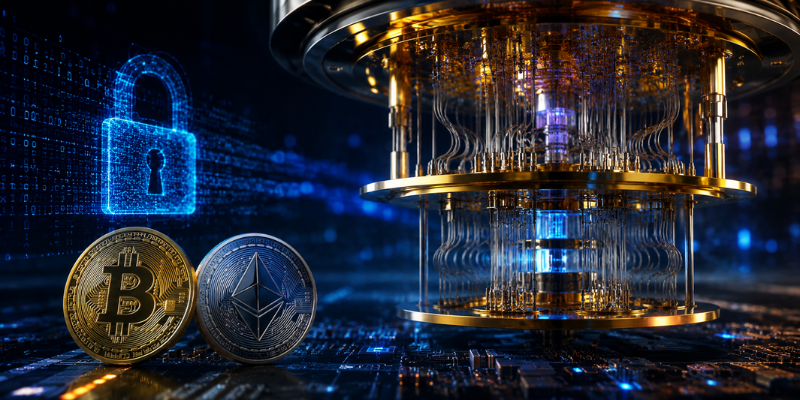


A quiet but significant acceleration in quantum cryptanalysis has sent ripples through the cryptocurrency industry. It has reignited debates about the long-term security of elliptic curve cryptography (ECC), the backbone of Bitcoin, Ethereum, and much of the digital economy.
In late March 2026, Google Quantum AI dropped a bombshell whitepaper. It estimated that breaking the 256-bit ECDLP (the hard problem behind ECDSA signatures used in secp256k1) could be achieved with dramatically lower resources than previously thought: roughly 1,200–1,450 logical qubits and 70–90 million Toffoli gates. On a superconducting quantum architecture, this could theoretically run in minutes using under 500,000 physical qubits.
Crucially, Google did not publish the actual quantum circuits. Instead, they released a zero-knowledge proof verifying their resource claims. This move was framed as responsible disclosure amid engagement with the U.S. government. The paper highlighted risks not just to Bitcoin but to broader ecosystems, including smart contracts, Proof-of-Stake chains, and real-world asset tokenization.
What followed was an unexpected plot twist.
The Streisand Effect Meets Agentic Science
Within weeks, the ZK verifier (intended to keep the details secret) became a powerful public benchmark. Independent researchers, including non-experts and AI agents, began optimizing elliptic curve point addition circuits against it.
French quantum researcher André Schrottenloher publicly rediscovered and published key optimizations. Meanwhile, a collaborative effort exploded. Undergraduates and even an 18-year-old researcher, using custom AI agent swarms and modest compute spend, pushed performance dramatically closer to Google’s unpublished result.
— Sreeram Kannan (@sreeramkannan) June 2, 2026
Eigen Labs’ Sreeram Kannan detailed how two students achieved roughly 80% of Google’s breakthrough through open agentic collaboration. One undergraduate improved prior public circuits by around 2x before the community effort took over.
Justin Drake (Ethereum Foundation researcher and co-author on the Google paper) summarized the frenzy on X. He noted rediscoveries, AI-driven micro-optimizations, and even a public challenge at ecdsa.fail that saw 8–11% gains over Google’s numbers in days. He raised his personal estimate for “Q-Day” (when a cryptographically relevant quantum computer breaks real cryptography) to 10% by 2030 and 50% by 2032. This timeline is far more aggressive than official NIST timelines.
Balanced Perspectives Emerge
My turn to call out quantum FUD.
The new “we improved on Google’s Bitcoin-breaking quantum circuit” story is, in my view, a nothingburger.
Roughly: Google obscured details of a particular circuit. Researchers reverse-engineered it and found a more efficient way to…
— Eli Ben-Sasson | Starknet.io (@EliBenSasson) June 2, 2026
Not everyone is hitting the panic button. StarkWare CEO Eli Ben-Sasson called the latest optimizations a “nothingburger.” He argued that while circuit improvements are real, the real challenge remains building fault-tolerant machines with 1,000+ reliable logical qubits at scale. Hardware, not just algorithms, is still the bottleneck.
Ledger CTO Charles Guillemet struck a measured tone. He acknowledged that the ZK approach backfired by creating an open reward function for AI, but no one has a working CRQC yet. He emphasized the need for planned migration rather than panic.
Implications for Crypto
The developments underscore a dual reality:
- On-spend attacks on mempool transactions could become feasible sooner on fast-clock quantum architectures (superconducting/photonic).
- Dormant assets (especially Bitcoin’s old P2PK outputs holding millions of BTC) represent a massive fixed target for future quantum attackers.
- Chains with heavy smart contract usage (Ethereum, Solana, etc.) face additional risks beyond simple signature forgery.
Ethereum appears further along in preparation, targeting 2029 for post-quantum readiness using hash-based schemes and tools like leanVM. Bitcoin’s path remains more fragmented.
The broader lesson? Quantum timelines are compressing faster than many expected. This is not necessarily because of one breakthrough, but through the compounding power of open collaboration, AI agents, and persistent optimization.
The industry does not need to panic today. But it must stop treating post-quantum cryptography as a distant theoretical concern. Migration planning, wallet upgrades, consensus changes, and policy discussions around dormant assets should accelerate now.
Disclaimer: Cryip's content is strictly for educational and informational purposes and does not constitute financial, legal, or investment advice. Cryptocurrency involves significant risk, and readers assume full responsibility for their own financial decisions. Asset references are never endorsements.
To make complex crypto topics accessible to readers at all experience levels, our team uses AI tools strictly to refine language, correct grammar, and simplify terminology. AI is never used to draft facts, source information, or form conclusions. Every article is fact-checked and approved by a human editor before publication. Read our full AI Use & Content Policy.