


- Nasdaq plans to launch a new 9 p.m. to 4 a.m. ET overnight session on December 6, 2026, stitching together a 23-hour trading day, five days a week.
- The SEC granted accelerated approval for the rule change on April 10, 2026, but Nasdaq’s own FAQ still calls the December date conditional on data-system readiness and further SEC sign-off on operational details.
- Nasdaq isn’t first to this model: 24X National Exchange has run a 23/5 schedule since October 2025, and NYSE Arca holds separate approval for a 22-hour day.
Nasdaq’s first-quarter 2026 earnings release states it plainly: “Nasdaq plans to go live with 23/5 trading on December 6, 2026, broadening global investor access to U.S. equities.” Read the exchange’s own trading-hours FAQ, though, and the date comes with conditions attached. The transition is “currently expected to occur” on that Sunday, the FAQ says, “pending SIP readiness as well as any applicable SEC rule changes.” SIP is the industry-run system that consolidates and reports trades across exchanges; if it isn’t ready, the launch slips regardless of what Nasdaq intends.
The Regulatory Fight Is Over. That’s Not the Same as Ready.
That gap between “plans to go live” and “pending readiness” is the actual story here, because the part of this that sounded uncertain a year ago isn’t uncertain anymore. The SEC granted accelerated approval for Nasdaq’s rule change on April 10, 2026, clearing the regulatory hurdle that had been the subject of a formal comment period since the proposal was filed the previous December. Nasdaq’s own filing lays out why it wants this: investors in Asia and other time zones who can’t trade during regular U.S. hours, and a stated need to “compete for order flow” with crypto platforms that already trade 24/7, and to position itself favorably to participate in markets that trade digital assets. That’s Nasdaq’s reasoning in its own words, not an outside read on its motives. What’s left unresolved isn’t whether Nasdaq is allowed to do this. It’s whether the infrastructure holds up once it does. Traders aren’t treating that as settled, either. As of August 18, 2026, Polymarket’s own market on whether Nasdaq launches round-the-clock trading by year-end was pricing the odds at 52%, roughly a coin flip, months after the SEC had already signed off.
52% chance Nasdaq launches round-the-clock trading by end of year. https://t.co/G6b4emcWpb
— Polymarket (@Polymarket) August 17, 2026
The One Time Overnight Trading Actually Broke
There’s already one real test case for that question, and it didn’t go well. In August 2024, Blue Ocean ATS, the main U.S. venue for overnight equities trading at the time, broke under a surge in overnight volume driven by a weak jobs report and an unwinding yen carry trade. Blue Ocean’s chief executive, Brian Hyndman, later said the platform’s pre-upgrade system could handle 50 million messages per overnight session; the demand that night blew past it. Trades were cancelled, the venue halted, and Robinhood had to suspend its own overnight order routing until the next session. Blue Ocean has since upgraded to a stated capacity of 35 billion messages per session, a jump of roughly 700 times. Nasdaq is a far larger, more heavily engineered system than Blue Ocean was in 2024, so the comparison isn’t a direct prediction of failure. But it’s the only precedent anyone has for what happens when a real macro shock lands during the hours markets have never traded before, and it argues against treating overnight capacity as a solved problem.
Wall Street Can’t Agree on What Thinner Hours Will Do
Wall Street’s own trading desks aren’t united on what thinner overnight hours will actually do to markets, either. Wells Fargo’s trading desk called the plan “the worst thing in the world,” arguing that spreading the same pool of orders across more hours doesn’t create new liquidity, it just dilutes what already exists, widening spreads and worsening execution for anyone trading outside the crowded open and close. Research firm BMLL Technologies reached a more measured conclusion from its own data: overnight spreads on Blue Ocean for at least one large tech stock were broadly comparable to, and at times slightly tighter than, spreads during regular hours. That study covered a volatile stretch of trading, though, which makes it a weaker guide to what an ordinary quiet overnight session looks like. Neither side has enough evidence yet to settle the question.
The $17 Trillion Number Is Older Than the Argument Built on It
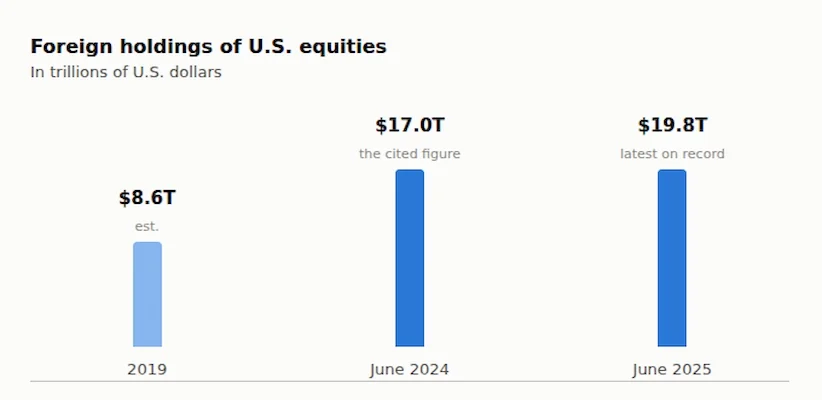
One number doing a lot of work in the “why now” argument for overnight trading deserves a closer look, too. A widely cited figure, that foreign holdings of U.S. equities hit $17 trillion in June 2024, up 97% since 2019, comes from S&P Dow Jones Indices’ own March 2025 market commentary. It’s a real, sourced statistic. It is also, by the time this launch happens, a two-and-a-half-year-old snapshot, and it’s been recirculating in recent coverage and social media commentary as though it describes the present moment rather than mid-2024. The underlying trend, foreign appetite for U.S. stocks growing, is real and separately supported by U.S. Treasury data showing foreign holdings of U.S. equities at $19.8 trillion as of June 2025. But the specific $17 trillion figure is older than the argument built on top of it lets on.
What Actually Decides Whether December 6 Holds
What actually determines whether December 6 holds is narrower than the headlines suggest: whether the SIP is ready, whether Nasdaq’s remaining operational details clear the SEC without delay, and whether anything resembling the August 2024 shock hits global markets between now and then. The one running example of a live 23/5 U.S. exchange, 24X, has been operating since October 2025, but its trading volume remains small next to Nasdaq, Cboe, and IEX, too small yet to say what a mature 23/5 market actually looks like under stress. Nasdaq is set to be the first true test of that at scale.
Disclaimer: Cryip's content is strictly for educational and informational purposes and does not constitute financial, legal, or investment advice. Cryptocurrency involves significant risk, and readers assume full responsibility for their own financial decisions. Asset references are never endorsements.
To make complex crypto topics accessible to readers at all experience levels, our team uses AI tools strictly to refine language, correct grammar, and simplify terminology. AI is never used to draft facts, source information, or form conclusions. Every article is fact-checked and approved by a human editor before publication. Read our full AI Use & Content Policy.