
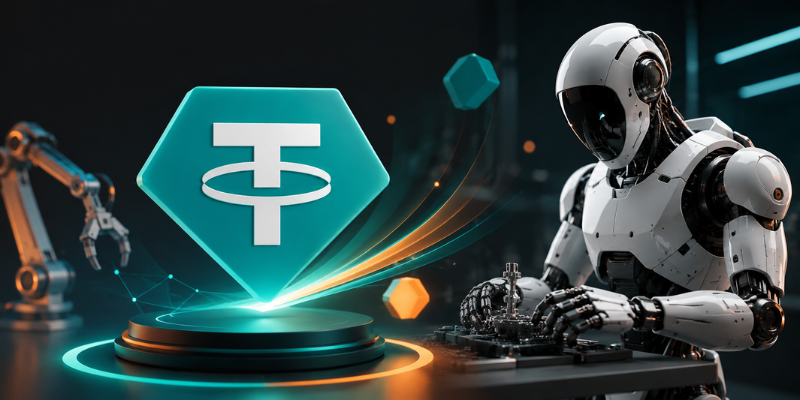


- NEURA Robotics is raising up to $1.4 billion in a Series C round led by Tether.
- The funding ranks among the largest private investments in humanoid robotics.
- Capital will support manufacturing expansion, software development, and commercial deployment.
- Tether continues to diversify investments beyond cryptocurrency infrastructure.
- Investor interest in robotics is rising, though large-scale commercialization remains a challenge.
Funding Round Overview
German robotics company NEURA Robotics is raising up to $1.4 billion in a Series C funding round led by Tether, marking one of the largest private financing rounds announced in the humanoid robotics sector.
The round includes participation from strategic and financial investors and comes as funding activity in robotics accelerates alongside broader investment in artificial intelligence, while Tether continues to expand its presence through Tether Stablecoin Launch initiatives in global markets. The capital is expected to support manufacturing expansion, product development, and deployment of NEURA’s robotic systems.
Tether is leading a landmark Series C financing round of up to $1.4 billion for NEURA Robotics, @NEURARobotics , representing one of the largest private investment rounds in humanoid robotics history.
As robotics moves into true autonomy, payment and compute systems must evolve.… pic.twitter.com/NF3hO5hnke
— Tether (@tether) June 10, 2026
Tether announced that it is leading a Series C funding round of up to $1.4 billion for NEURA Robotics, one of the largest private investments in the humanoid robotics industry to date.
Funding Focuses on Scaling Commercial Operations
Founded in 2019 and based in Metzingen, Germany, NEURA Robotics develops humanoid robots, industrial robotic arms, autonomous mobile robots, and service robots. The company has positioned itself as a developer of “cognitive” robots designed to operate alongside humans in industrial and commercial environments.
The latest financing is expected to be used for:
- Expanding robot production capacity
- Scaling commercial deployments
- Developing AI and robotics software
- Growing the company’s developer ecosystem
- Supporting international expansion
The company has been expanding its product portfolio beyond industrial automation, targeting sectors facing labor shortages and increasing demand for automation.
Tether Broadens Technology Investments
The investment represents another step in Tether’s strategy of expanding beyond digital assets. While Tether is primarily known as the issuer of the USDT stablecoin, the company has increasingly invested in sectors including artificial intelligence, energy infrastructure, telecommunications, and biotechnology. Robotics is now becoming part of that broader investment strategy.
As part of the partnership, NEURA plans to integrate certain Tether-developed technologies into its platform, including digital wallet infrastructure and edge AI software designed to run models locally on devices rather than relying entirely on cloud computing. The companies have not disclosed a timeline for commercial deployment of those technologies.
Robotics Sector Attracts Larger Funding Rounds
The deal highlights growing investor interest in robotics companies developing physical AI systems and represents one of the most significant web3 Fundraising updates involving a major cryptocurrency company diversifying into emerging technologies. Over the past two years, advances in AI models have renewed interest in autonomous machines capable of performing real-world tasks. Investors have increasingly backed startups building humanoid robots, warehouse automation systems, and industrial robotics platforms.
Several robotics companies globally have announced large funding rounds as investors seek exposure to technologies that could benefit from AI-driven automation. Supporters of the sector argue that labor shortages, aging populations, and productivity challenges are creating long-term demand for robotic systems. However, commercial adoption remains at an early stage compared with software-based AI products.
Commercialization Remains the Key Challenge
Despite increased investment activity, robotics companies continue to face significant execution challenges. Manufacturing robots at scale requires substantial capital expenditure, while deployment often involves lengthy testing, integration, and regulatory processes. Industry analysts note that many humanoid robotics projects remain in pilot phases, with large-scale adoption still years away.
For NEURA Robotics, the latest financing provides additional resources to scale operations, but the company’s long-term success will depend on its ability to convert technological development into sustained commercial demand.
Disclaimer: Cryip's content is strictly for educational and informational purposes and does not constitute financial, legal, or investment advice. Cryptocurrency involves significant risk, and readers assume full responsibility for their own financial decisions. Asset references are never endorsements.
To make complex crypto topics accessible to readers at all experience levels, our team uses AI tools strictly to refine language, correct grammar, and simplify terminology. AI is never used to draft facts, source information, or form conclusions. Every article is fact-checked and approved by a human editor before publication. Read our full AI Use & Content Policy.